

Parents usually do not need a perfect baby milestones chart 0-12 months to use well. They need a calm, practical guide to developmental milestones for infants 0 12 months that shows what skills to watch, what normal variation looks like, and when to follow up with a doctor.
Infant developmental milestones 0–12 months at a glance
Developmental milestones are skills many babies show around certain ages from birth to 12 months. They usually span gross motor, fine motor, communication, social-emotional, cognitive, and sensory development, and they help parents observe progress rather than diagnose a condition.
A developmental milestones chart for infants is most useful when it shows patterns across several domains instead of one isolated item. One skill showing up later does not automatically mean a delay, because babies often move ahead in one area and take longer in another.
This guide covers a full chart of infant developmental milestones, a dedicated 6-week section, age-based red flags, and simple home activities. It is an observation tool, not a diagnosis tool, so the right next step for a concern is to speak with your family doctor or pediatrician.
Complete chart of infant developmental milestones: birth to 12 months
The clearest way to read 1 to 12 months baby development is by age band, because milestone frameworks often group months slightly differently. The chart below uses practical parent-facing bands from newborn to 1 month, 6 weeks, 2 months, 3 months, 4 months, 5 months, 6 months, 7 to 9 months, and 10 to 12 months.
| Age | Gross motor | Fine motor | Communication / language | Social-emotional | Cognitive / problem-solving | Watch-for concerns | Simple activities |
|---|---|---|---|---|---|---|---|
| Newborn to 1 month | Moves arms and legs, turns head briefly, lifts head a little in tummy time | Hands often fisted, brings hands near face | Startles to sound, may quiet to familiar voice | Calms with caregiver contact | Briefly looks at faces or high-contrast objects | Very limited movement, very floppy or very stiff tone, no response to sound, loss of a skill | Skin-to-skin, gentle talking, short supervised tummy time |
| 6 weeks | Slightly stronger head control, lifts head briefly on tummy | Hands near mouth, brief grasp | Makes sounds other than crying, may react to voices | May begin social smile, brief eye contact | May start tracking a face or object over a short distance | Rare alert periods, poor response to faces or sound, marked one-sided movement, loss of a skill | Face-to-face talking, singing, short tracking games |
| 2 months | Holds head up more briefly on tummy, smoother arm and leg movement | Opens hands more often | Coos, reacts to sound | Smiles at people, calms to familiar voice | Watches people, follows movement briefly | Not responding to loud sounds, not watching people, very limited movement | Talk during diapering, tummy time, high-contrast cards |
| 3 months | Better head control, pushes up a little on forearms | Swipes at toys, brings hands together | More cooing and vocal play | Enjoys faces, may smile more readily | Tracks objects farther, notices hands | No visual tracking, no vocal sounds, poor head control for age | Mirror time, reaching toys, songs with pauses |
| 4 months | Rolls tummy to back for some babies, steadier head | Reaches toward toys, grasps longer | Laughs, squeals, varied sounds | Smiles spontaneously, enjoys interaction | Looks around, explores with eyes and hands | Very stiff or floppy tone, no smiling, no reaching | Floor time, textured toys, naming objects |
| 5 months | Rolls for some, pushes up well on arms | Transfers attention between hands and toys | More babbling-like sounds | Shows interest in familiar people | Explores objects with mouth and hands | Not bearing some weight through legs when supported, no interest in surroundings | Reaching games, mirror play, simple rattles |
| 6 months | Rolls both ways for some, sits with support or briefly without support for some | Reaches accurately, transfers objects hand to hand | Babbles, responds to sound and voice | Knows familiar people, enjoys back-and-forth play | Looks for dropped objects, explores cause and effect | No affection for caregivers, no sounds, very poor head control, not reaching, one-sided use | Floor play, imitation sounds, object play |
| 7 to 9 months | Sits more steadily, may get into crawling position, may crawl or scoot | Transfers objects, bangs objects, raking grasp develops | Responds to name, babbles with varied sounds | Shows preference for familiar people | Searches for partly hidden objects | No sitting with help or poor progress, no babbling progression, not responding to sound or name | Peekaboo, container play, book sharing |
| 10 to 12 months | Pulls to stand, cruises, takes steps for some | Pincer grasp develops, releases objects deliberately | Uses gestures, may say simple words or word-like sounds | Waves, plays social games, seeks caregiver | Understands object permanence better, follows simple directions for some | No crawling or no way of moving, no gestures, no response to name, loss of skills | Gesture games, push toys, simple books, naming routines |
What the development stages of an infant actually mean
The development stages of an infant are usually grouped by domain rather than by one single score. Most parents will see six practical areas: gross motor, fine motor, communication, social-emotional, cognitive, and sensory development.
Gross motor means large body movement such as head control, rolling, sitting, crawling, standing, and walking. Fine motor means hand use such as grasping, transferring objects, and later using a pincer grasp with thumb and finger.
Communication includes sounds, cooing, babbling, gestures, and early understanding of familiar words. Social-emotional development includes eye contact, smiling, shared attention, calming with familiar adults, and back-and-forth interaction.
Cognitive development is how babies notice patterns, remember people or objects, and explore cause and effect through play. Sensory development is how they respond to sound, visual input, touch, movement, and their environment.
A baby can be quicker in one domain and slower in another without that pattern being unusual. Milestones build on earlier experiences, so steady overall progress matters more than doing every item on the same day as another baby.
6 week old infant milestones: what many babies are doing at this age

At 6 weeks, many babies are becoming more alert for short periods and showing early social and sensory engagement. A 6 week old infant milestones checklist is best read as emerging behaviours, not as a pass-or-fail test.
A 6-week-old may begin to make brief eye contact, look at a caregiver’s face, and track a face or object over a short distance. Some babies also turn or settle toward a familiar voice and react differently to sound than they did in the first days after birth.
A 6 weeks infant milestones checklist often includes stronger head control than at birth, but still limited control overall. Many babies can lift the head briefly during supervised tummy time and bring hands near the face, though the movement is still unsteady.
Social smiling may begin around 6 to 8 weeks. Some babies smile at 6 weeks, while others show that social smile a little later, so one day without a smile is not enough to interpret on its own.
A 6 week old infant milestones cdc-style review would also look at responsiveness rather than one performance item. Brief alertness, calming with a familiar voice, early cooing, and repeated interest in faces matter more than trying to force a trick on command.
Red flags in a 6-week-old’s development: when to follow up promptly
At 6 weeks, the main concern is not one missed item but a pattern of very limited responsiveness or movement. Poor response to sound, little interest in faces, marked stiffness or floppiness, very uneven movement on one side, or loss of a skill should be discussed with a doctor promptly.
Persistent difficulty focusing briefly on a caregiver’s face can also matter when it appears alongside other concerns. The same is true for very low alertness that is not improving over time, because development is checked through change across days and weeks, not through one moment.
Extreme irritability by itself is not a developmental diagnosis. It becomes more important to document when it appears with reduced engagement, poor movement quality, feeding concerns that affect overall responsiveness, or regression.
Short notes or brief videos help because they show a pattern more clearly than memory alone. If something feels off, record what you saw, when it happened, and whether it repeats, then bring that information to your family doctor or pediatrician.
Month-by-month infant milestones: birth, 1–3 months, 4–6 months, 7–9 months, and 10–12 months
Birth to 1 month is mostly about regulation and early sensory response. Babies at this stage usually startle to sound, calm with caregiver contact, move with newborn reflexes, and focus briefly on faces or high-contrast shapes.
From 1 to 3 months, baby 0-3 months development often becomes more social and more awake. Cooing, early smiling, better head control, and swiping or batting at toys are common examples of progress in this period.
From 4 to 6 months, babies usually become more active with people and objects. Rolling attempts, reaching, laughing, babbling, and stronger interest in faces, toys, and sounds are common patterns across this stage.
From 7 to 9 months, babies often show more stable sitting, stronger object exploration, and more purposeful communication. Responding to name, making varied sounds, transferring objects, and searching for partly hidden toys all fit this stage well.
From 10 to 12 months, babies often become more mobile and more intentional in social interaction. Pulling to stand, cruising, pincer grasp, gestures, and simple words or word-like sounds are common examples during this period.
Rolling often appears around 4 to 6 months, sitting without support often appears around 6 to 8 months, crawling can appear anytime from about 7 to 10 months and is skipped by some babies, standing with support often appears around 9 to 12 months, and independent walking may begin anywhere from about 9 to 18 months. These are broad developmental ranges, not deadlines.
How to use a chart of infant developmental milestones without overthinking every day
The simplest way to use a chart of infant developmental milestones is to match your baby’s current age, scan across all domains, and look for overall progress. A chart works best as a guide to patterns, not as a daily scorecard.
A developmental milestones chart for infants should be checked over days or a few weeks rather than hour by hour. Emerging skills are often inconsistent at first, so a baby may do something once, stop, and then show it again later.
A not-yet item is different from a concerning pattern. Concern grows when there is no progress across multiple domains, a clear one-sided movement issue, very limited response to sound or faces, or the loss of a skill already seen.
Corrected age matters for babies born early because the milestone chart may need to be read from the due date rather than the birth date. The family doctor, pediatrician, or follow-up clinic can tell you which age to use for your baby.
Normal variation vs. true concern: what parents should know
Normal variation means babies do not all develop on the same calendar date. Temperament, chances to practise movement, prematurity, recent illness, and the daily environment can all affect when a skill appears.
It is also normal for a new skill to show up only sometimes at first. A baby may roll once, smile some days and not others, or babble more in one week than the next because early development is often uneven.
True concern is less about being slower than a neighbour’s baby and more about the pattern over time. Loss of skills, little progress across several areas, or very reduced engagement with people or sound deserves follow-up sooner.
Reassurance is appropriate when there is gradual change, even if the timing is not exact. Follow-up is appropriate when a pattern stays flat, becomes more uneven, or moves backward.
Red flags by age and developmental domain

The most useful red-flag view is by age and domain, because concerns do not always show up in the same way. The table below keeps the focus on patterns that deserve discussion, not self-diagnosis.
| Age band | Social / communication concerns | Motor concerns | Cognitive / sensory concerns | What to do next |
|---|---|---|---|---|
| Newborn to 2 months | Little response to sound or familiar voices, limited interest in faces | Very floppy, very stiff, marked one-sided movement | Very limited visual attention, loss of a skill | Contact your doctor promptly and share examples |
| Around 6 weeks | No growing social responsiveness, no brief eye contact pattern, very limited sound response | Little improvement in head control, one side moves less | Rare alert periods, little tracking of faces or objects | Document patterns over a short period and follow up promptly |
| Around 4 to 6 months | No smiling or joyful engagement, no sounds or babbling progression | Poor head control, not reaching, not bringing objects toward mouth, marked asymmetry | Limited interest in people or objects | Book a developmental follow-up soon |
| Around 6 months | No affection toward caregivers, limited response to sounds | Does not roll or show progress toward sitting, seems very stiff or floppy | Does not track objects well or explore surroundings | Discuss soon with your doctor or pediatrician |
| Around 7 to 9 months | No babbling progression, no response to name or voices | Poor sitting progress, limited use of one side | Does not look for hidden objects or explore toys | Share notes and videos at a medical visit |
| Around 10 to 12 months | No gestures such as waving or pointing, no back-and-forth social play | No way of moving, little progress toward standing or cruising | Limited imitation or understanding of simple routines, loss of a skill | Seek assessment through your doctor |
At 6 months, concern usually centres on clusters, not one isolated behaviour. No babbling, poor social engagement, very limited reaching, poor head control, lack of rolling or sitting progress, and one-sided movement all deserve a closer look when they appear together.
What happens at a developmental screening or well-child visit

A well-child visit usually reviews how your baby moves, communicates, plays, responds to sound, uses vision, and interacts with caregivers. Feeding, sleep, and general health may also come up because they give context to development rather than replacing it.
A developmental screening appointment may include parent questionnaires, clinician observation, and follow-up questions about when skills appeared. Parents are often the main source of information, because babies may not show their usual behaviour in a short office visit.
Bringing a few concrete examples makes the appointment more useful. Write down when you first noticed the concern, whether it happens daily, whether one side of the body seems different, and whether any skill has been lost.
Short phone videos can help when a behaviour does not happen during the visit. A short clip of movement, tracking, sound response, or a lost skill can be easier to discuss than a general description.
Milestone checklists and tools parents can use
Trusted milestone tools give parents a structure for observation, but they do not diagnose on their own. The most useful tools are the ones that help you notice patterns, write down examples, and bring those examples to a clinician.
The CDC milestone lists are parent-friendly checklists that organize milestones by age and domain. ASQ-3 is a questionnaire-based screening tool often used by professionals and programs, and NDDS is a Canadian tool that may be used in some settings.
A printable chart of infant developmental milestones is useful when you want one page on the fridge, in a diaper bag, or at a well-child visit. An app-based tracker can be easier if you prefer reminders and quick notes instead of paper.
| Tool | Who it is for | How it is used | What makes it different |
|---|---|---|---|
| CDC milestone checklists | Parents and caregivers | Review age-based milestones and note concerns | Simple language and easy age grouping |
| CDC Milestone Tracker app | Parents and caregivers | Track milestones digitally and save notes | Convenient for ongoing observation |
| ASQ-3 | Clinicians, programs, and families with guidance | Parent questionnaire with scoring | More formal screening structure |
| NDDS | Canadian clinical or community use | Developmental review tool | Canadian context and referral support |
If you want a printable chart of infant developmental milestones, choose one from a trusted public-health or clinical source rather than a random blog. The goal is not to collect more checklists. The goal is to use one clear system consistently.
Activities that support infant development at home
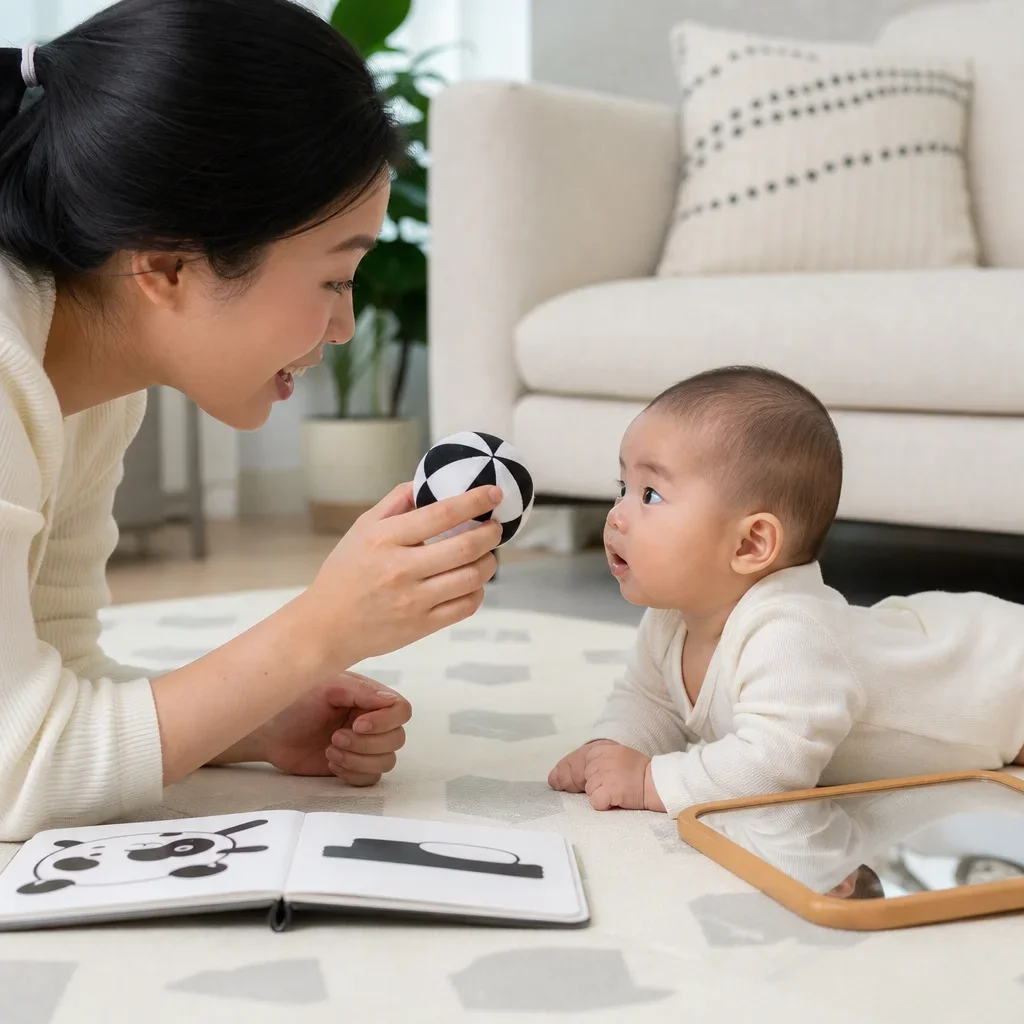
Simple interaction supports development better than complicated gear. Face-to-face talking, singing, holding, floor time, and repeated back-and-forth interaction all give babies practice in movement, attention, and communication.
For newborn to 3 months, 6 week old baby activities can stay very simple. Try short supervised tummy time, looking at your face, high-contrast images, gentle side-to-side tracking with a toy, singing, and pausing so your baby can react in return.
For 4 to 6 months, activities can involve reaching and exploring. Offer safe toys that are easy to grasp, mirror play, more floor time, object naming, and sound imitation so your baby can connect movement with people and language.
For 7 to 12 months, play can become more purposeful. Container play, simple books, peekaboo, gesture games, object permanence games, and safe furniture setup for cruising support exploration without pushing a skill before your baby is ready.
A Montessori-informed approach keeps materials simple and the environment prepared for exploration. We use that same principle in infant care by observing closely, offering age-appropriate materials, and letting the child practise with support rather than forcing performance.
Premature babies and corrected age
Corrected age means adjusting your baby’s age based on the due date rather than the birth date when the baby was born early. That adjustment can change how you read developmental milestones for infants 0 12 months because the expected timing may be different.
For example, if a baby is 6 months old by birth date but was born 2 months early, a clinician may review some milestones closer to a corrected age of 4 months. That is why milestone charts can look more reassuring once the right age is used.
Corrected age does not mean ignoring concerns. It means using the right frame when looking at progress, then still speaking with your doctor if there is regression, asymmetry, or little progress across domains.
Questions parents often ask about early development, autism concerns, and milestone timing
Autism is not diagnosed from one early behaviour at 6 weeks. If parents ask about signs of autism at 6 weeks, the responsible answer is to watch broader social-communication patterns over time and discuss persistent concerns with a clinician rather than trying to label a baby from one checklist item.
At 6 months, the same principle applies. Signs of autism at 6 months old are not confirmed through one behaviour alone, but persistent patterns in social engagement, response to name or voices, shared attention, and communication deserve discussion with a doctor.
It is normal if a baby only does a milestone sometimes when that skill is just emerging. Inconsistency is common in the first days or weeks of a new skill, so parents should look for repetition over time rather than demanding a perfect performance each day.
If a baby loses a skill they had before, that is more concerning than being somewhat later to reach a skill. Loss of smiling, babbling, movement, or responsiveness should be discussed promptly with a doctor.
When to seek help right away vs. when to monitor and mention it at the next visit
Some concerns need urgent medical attention because they are broader health issues, not just milestone questions. Trouble breathing, seizure-like activity, severe lethargy, or sudden poor responsiveness should be treated as urgent and assessed right away.
Some concerns should be booked soon with your doctor even if they are not an emergency. No progress across multiple domains, one-sided weakness or movement difference, no response to sound, persistent social disengagement, or a clear loss of skills fit this category.
Some concerns can be monitored briefly and then mentioned at the next visit if progress appears. A milestone that shows up inconsistently without regression is usually better tracked over a short period than judged in one day.
How infant care environments can support development day to day
Supportive infant care is built on responsive adults, safe floor time, clear routines, language-rich interaction, and careful observation. In a licensed setting, ratios and staff qualifications matter because they shape how closely each baby can be supervised and supported.
At Cozy Time Montessori Academy, our Infant program serves children from 6 months to 18 months at a 1:3 ratio. We are a licensed childcare centre, and our infant rooms are staffed by ECEs, assistants, and team members who are First Aid and CPR certified with clean criminal record checks.
Day to day, childcare staff support early development by observing movement, communication, sensory responses, and social engagement during routine care. That does not replace medical assessment, but it does give families another steady source of observation and communication.
Our role is practical. We prepare on-site meals, follow consistent routines, adapt materials to the child’s stage, and share what we observe with parents so home and childcare can stay connected.
If you are comparing infant daycare in Vaughan or Bolton, the best next step is to visit and see the classroom. Parents can ask about infant ratios, staff qualifications, daily routine, and how observations are shared, then decide whether the environment feels right for their child and age group.
FAQ
What are the developmental milestones for infants 0 to 12 months?
They are age-linked skills many babies show across movement, hand use, communication, social interaction, thinking, and sensory response from birth to 12 months. They help parents track patterns of progress, not diagnose a condition.
What should a 6 week old baby be doing?
A 6-week-old may begin making brief eye contact, reacting to voices, lifting the head briefly during tummy time, bringing hands near the face, and starting to smile socially. Some skills appear inconsistently at this age.
What are the red flags in a 6 week old’s development?
Poor response to sound or faces, marked stiffness or floppiness, very limited movement on one side, rare alert periods that are not improving, and loss of a previously seen skill deserve prompt follow-up.
What are the red flags in a 6 month old’s development?
At 6 months, concern rises with clusters such as no babbling, poor social engagement, weak head control, limited reaching, little rolling or sitting progress, or clear one-sided movement differences.
How do I know if my baby is on track developmentally?
Look for steady progress across several domains over days and weeks, not perfection in one item. If there is regression, no progress across multiple areas, or a pattern that feels clearly flat, speak with your doctor.
What is a developmental milestones chart for infants?
It is a guide that lists common age-based skills across developmental domains. Parents use it to observe patterns, record examples, and decide when to raise a concern at a medical visit.
What are the development stages of an infant?
In practical use, infant stages are usually grouped by domains such as gross motor, fine motor, communication, social-emotional, cognitive, and sensory development. These areas do not always progress at the same speed.
Is it normal if my baby only does a milestone sometimes?
Yes. New skills are often inconsistent at first. What matters is whether the skill begins to appear again and whether overall progress continues.
What should I do if my baby loses a skill they had before?
Contact your doctor promptly. Regression matters more than simple variation in timing.
Are there signs of autism at 6 weeks?
No single behaviour at 6 weeks can diagnose autism. Persistent social-communication concerns over time should be discussed with a clinician.
What are signs of autism at 6 months old?
There is no one-sign answer. Patterns involving social engagement, shared attention, communication, and response to people or sound should be brought to a doctor for discussion.
What activities can I do with a 6 week old baby when awake?
Try face-to-face talking, singing, short supervised tummy time, gentle visual tracking, holding your baby upright against your chest, and pausing for back-and-forth interaction.
If you are looking for a licensed infant daycare in Vaughan or Bolton and want a setting that supports ages and stages for infants through responsive care, contact the centre to confirm availability for your child’s age group or book a tour to see the infant classroom in person.