

Montessori activities for three‑year‑olds build independence, sharpen thinking, and strengthen small‑muscle control through hands‑on sensory work. Below are practical life tasks, sensorial exercises, and early language and math activities you can use at home, plus simple tips for adding them to daily routines.
What Are the Best Montessori Practical Life Activities for 3 Year Olds?
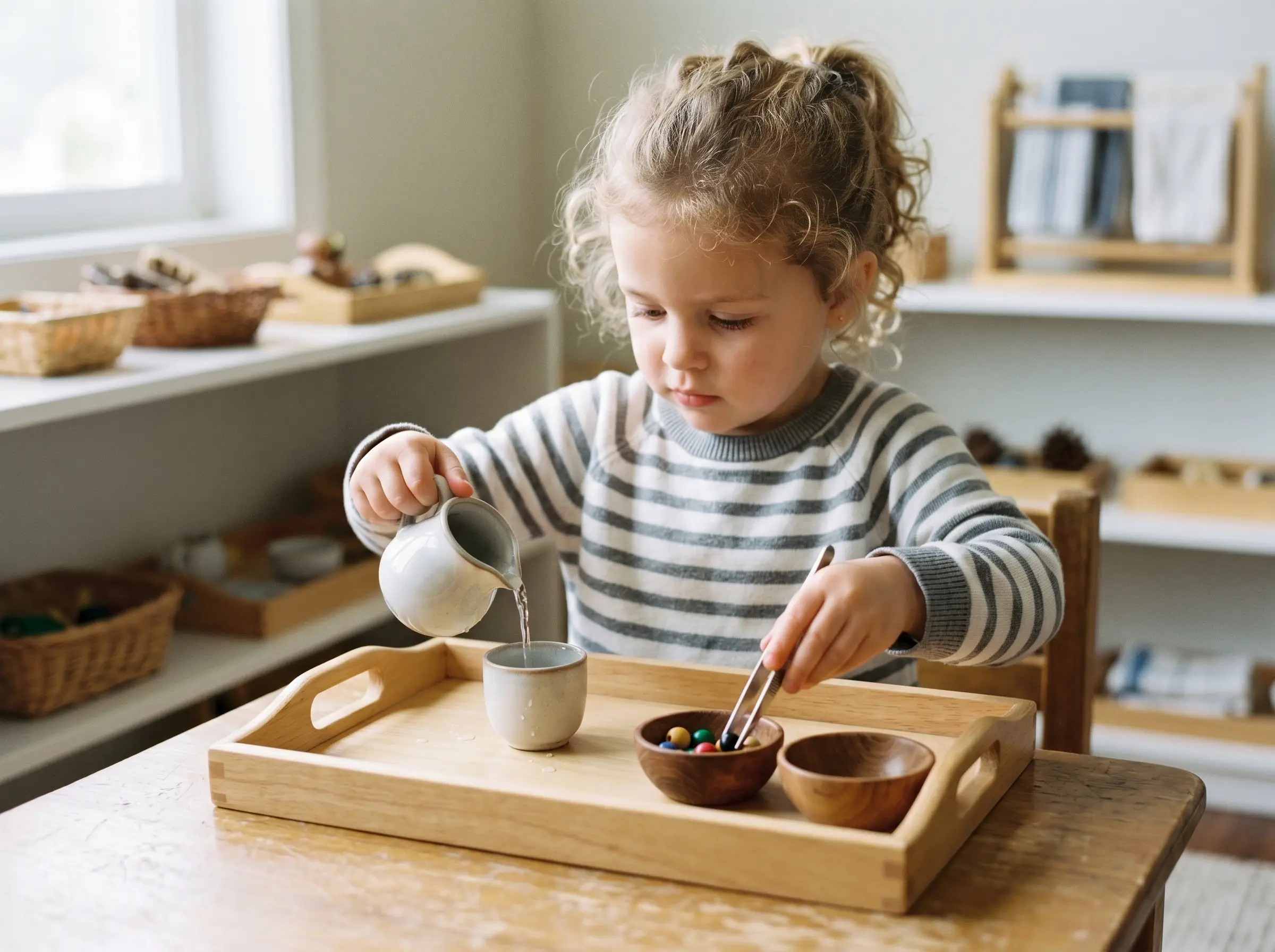
Practical life activities are everyday tasks—pouring, sweeping, buttoning—that teach coordination, sequencing, patience, and responsibility. These routines give children repeated practice and build confidence that supports learning across other areas.
How Do Practical Life Exercises Support Fine Motor Skills?
Practical exercises use precise, repeated movements to strengthen the hands and fingers. Pouring between cups improves hand‑eye coordination; tongs and tweezers build the pincer grip. That control carries over to drawing, dressing, and early writing.
Research has found measurable benefits from targeted practical life materials for developing fine motor control in young children.
Practical Life Activities and Fine Motor Skill Gains
A controlled pretest–posttest study tracked kindergarten children over six months to see how practical life materials affected fine motor development. The study used a penny‑posting test as the outcome measure. The experimental group (n = 101) received more than 50 different activity sets; teachers demonstrated and coached students in step‑by‑step use of tweezers, tongs, and spoons, and the children used these materials during center time. Although both experimental and control classrooms reported similar overall fine motor activity, the experimental group scored higher on the posttest. An overall effect size of 0.74 suggested that the specific type of fine motor practice matters for development.
Effects of practical life materials on kindergartners’ fine motor skills, AC Rule, 2002
Which Materials Are Needed for Montessori Practical Life Activities?
Choose child‑scaled, safe tools that invite repeated use. Key items include:
- Pouring tools: Small pitchers, cups, or measuring jugs sized for little hands.
- Cleaning supplies: Short brooms, dustpans, and soft cloths children can handle comfortably.
- Fastening materials: Fabric frames or dressing boards with buttons, zippers, and snaps for dressing practice.
Durable, age‑appropriate items let children focus and work independently.
How Can Sensorial Activities Enhance Sensory Play for Toddlers?
Sensorial activities invite exploration through sight, sound, touch, taste, and smell. They help children notice differences, categorize experiences, and build vocabulary—skills that support attention, comparison, and clearer thinking.
What Types of Montessori Sensorial Materials Are Ideal for 3 Year Olds?
Useful sensorial materials include:
- Sound boxes: Containers with different fillings that produce distinct sounds.
- Texture boards: Panels or cards with varied surfaces for touching and naming textures.
- Color tablets: Matching color pieces that teach recognition and gradation.
These items encourage observation and broaden sensory vocabulary and discrimination.
How Do Sensorial Activities Promote Cognitive Development?
Sensorial work trains children to compare, sort, and classify sensory input—core cognitive skills. Describing textures or matching sounds practices attention, memory, and language, which supports later problem solving.
What Are Effective Preschool Learning Activities for Language and Math Development?
Montessori introduces early language and math with tactile, engaging materials that make abstract concepts concrete, helping children build foundations for reading, writing, and number sense.
Which Montessori Language Exercises Support Early Childhood Education?
Effective language activities include:
- Storytelling: Prompt children to tell or retell stories to build narrative skills and expression.
- Letter recognition: Sandpaper letters let children trace shapes and link letters to sounds.
- Vocabulary building: Daily conversations and naming tasks introduce new words in context.
Together these practices create a supportive environment for early literacy and communication.
Studies note that Montessori materials can effectively support early reading and writing skills, even for very young learners in non‑native English settings.
Montessori Materials Supporting Early Reading & Writing
A review of Montessori tools used with young learners of English highlights materials like vowel matching cards, sandpaper letters, and sentence‑analysis signs. These resources help develop all four language skills — speaking, reading, listening, and writing — while introducing metalinguistic concepts such as phonology (phonics and sound blending), syntax (sentence structure), and morphology (word building). Presenting these ideas playfully can give children aged 4–6 a strong early foundation in English, even when learning in a non‑native environment.
The development of reading and writing based on montessori educational materials, 2023
How Do Montessori Math Activities Foster Early Math Concepts?
Montessori math uses tangible materials—counting beads, shape sorting, and number‑to‑quantity matching—so children can touch and see mathematical ideas. Moving beads to count builds number sense and reduces anxiety around numbers.
| Activity Type | Description | Benefits |
|---|---|---|
| Counting Beads | Using beads to count and sort | Enhances number recognition and fine motor skills |
| Shape Sorting | Sorting different shapes into corresponding slots | Develops spatial awareness and problem-solving skills |
| Number Cards | Matching cards with quantities | Reinforces number concepts and counting |
These hands‑on activities make math accessible and invite exploration through repetition.
To extend learning with a structured plan, consider exploring the approach in our curriculum, which supports broad developmental goals.
How Can Parents Implement Montessori Activities at Home for 3 Year Olds?
Montessori at home focuses on small, consistent habits that foster independence. Arrange reachable materials, demonstrate clearly, then allow the child to try independently. Everyday moments become learning opportunities with simple preparation.
What Are Practical Tips for Setting Up a Montessori Environment at Home?
Try these steps:
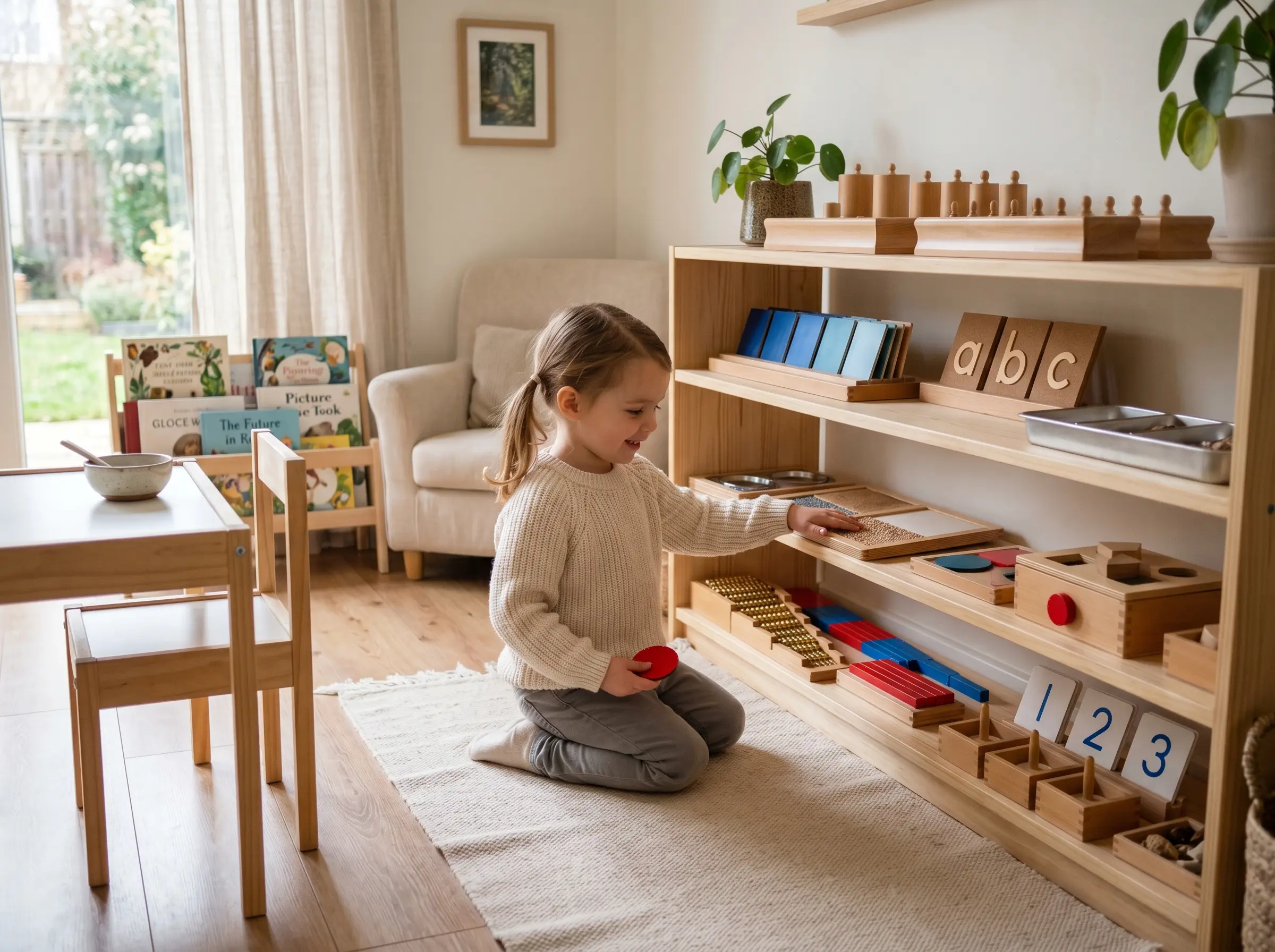
- Organize materials: Keep items visible and at child height so kids can choose and return them.
- Create learning areas: Provide a cozy reading spot, a low shelf for practical life tools, and a small table for art or sorting.
- Incorporate everyday tasks: Invite children to help with food prep, table setting, and simple cleaning to build routine and skills.
These setups encourage curiosity and frequent practice. For more on the philosophy behind our approach, visit our school philosophy.
How Do At-Home Montessori Activities Support Holistic Child Development?
Home Montessori supports cognitive, emotional, and social growth. Allowing choice, encouraging mastery, and honoring effort builds autonomy and confidence. Consistent hands‑on practice also links to better problem solving and emotional regulation.
Good nutrition supports learning; see our nutrition requirements for guidance on balanced meals and snacks.
Using Montessori principles at home strengthens learning and deepens the parent‑child relationship through shared routines and meaningful interaction.
Frequently Asked Questions
What age is appropriate for introducing Montessori activities?
Montessori can begin as early as 18 months, with ages 3–6 being especially receptive. Start simple and follow your child’s interests as skills develop.
How can I assess my child’s progress with Montessori activities?
Assessment is observational: watch for greater independence, concentration, sequential task completion, and improved fine motor or language skills. A short activity log or photos can track milestones.
Are Montessori activities suitable for all learning styles?
Yes. The hands‑on, multi‑sensory approach supports kinesthetic, visual, and auditory learners and adapts to individual pace and interest.
Can Montessori activities be adapted for children with special needs?
Absolutely. Modify materials (larger or textured objects, visual cues) and consult special education professionals to tailor activities to strengths and needs.
How do I choose the right Montessori materials for my child?
Select materials by age, interest, and ability. Begin with basic practical life and simple sensorial or counting items; introduce gradual challenges as attention and skill grow.
What role do parents play in Montessori education at home?
Parents set the environment, model tasks, offer gentle demonstrations, and observe. Provide materials, encourage independence, and step in only when guidance is needed.