
The Montessori syllabus is an educational framework designed to support the whole child from infancy through early childhood. It centers on child-led learning, allowing each child to follow interests and develop skills at their own pace. Below we unpack the curriculum’s key parts, how it’s organized by age, the materials teachers use, and the benefits families can expect. Learning more about the Montessori curriculum helps parents and educators choose the right early learning path for a child.
At its core, Montessori education seeks to nurture a child’s full growth so they become confident, socially aware, and capable learners.
Montessori Education: Fostering Holistic Child Development
Montessori education aims to guide each child toward becoming a well-rounded, socially comfortable adult by developing their natural abilities. The approach focuses on unlocking innate potential, and its lessons complement broader basic education frameworks. For successful implementation, teachers must clearly understand the nine‑year basic education curriculum so learning objectives are met and students benefit as intended.
Understanding montessori education, its implementation to revised nine year (9yr) basic education curriculum, 2021
What are the core components of the Montessori syllabus?
The Montessori syllabus is organized into several interlocking areas that support development: practical life, sensorial work, language, and mathematics. Each area encourages independence, cognitive skill building, and social confidence, producing balanced and meaningful learning experiences.
How do Practical Life Skills develop independence in children?

Practical life activities are everyday tasks that teach self-care and responsibility. Actions such as pouring, buttoning, and sweeping strengthen fine motor control and concentration while giving children a real sense of competence. Those routines build confidence and a practical independence that supports learning across all areas.
What role do Sensorial Activities play in cognitive development?
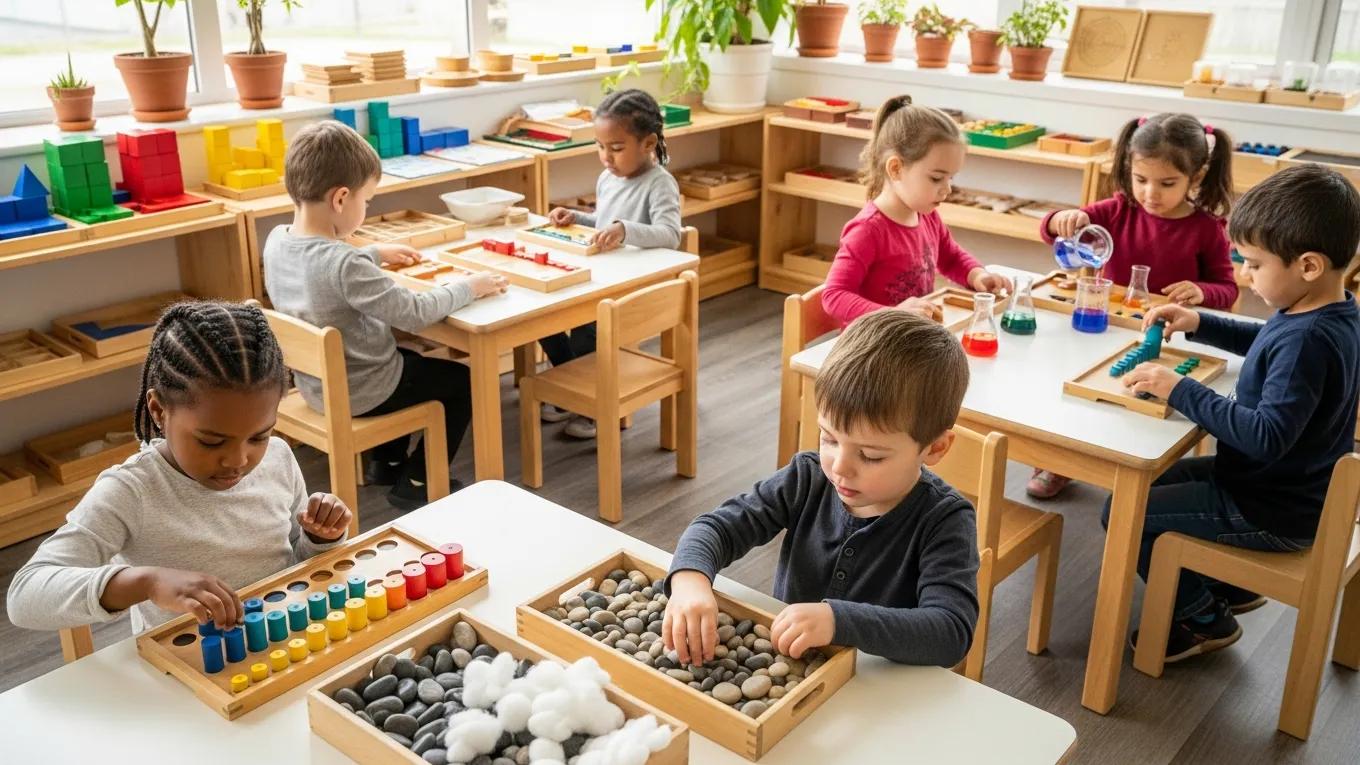
Sensorial activities refine a child’s senses and sharpen thinking. Hands-on materials let children compare colors, shapes, sounds, and textures, training their ability to observe, sort, and make connections. These sensory discoveries form a foundation for later learning in science and mathematics.
How is the Montessori curriculum structured for different early childhood age groups?
The Montessori curriculum is intentionally arranged to meet the needs of children from birth to age six. Each stage includes materials and activities targeted to its developmental priorities so children build skills progressively and meaningfully.
What adaptations are made for infants to 6-year-olds?
Environments for infants are calm and rich with safe sensory opportunities. Toddlers access activities that encourage movement, coordination, and simple social interaction. By ages 3–6, children use more complex materials to support concentration, problem-solving, and independence, alternating between focused individual work and guided group lessons.
How does the curriculum support developmental milestones?
The curriculum maps to social, emotional, and cognitive milestones so activities meet each child where they are. Lessons are designed to build communication, self-regulation, and reasoning. Teachers observe progress and adjust materials so every child receives an appropriate challenge at the right time.
What Montessori learning materials and classroom activities are used?
Montessori classrooms are stocked with specialized, tactile materials that encourage learning by doing. Each resource isolates a single concept—color, number, or letter—so children can explore and internalize ideas through repeated, purposeful practice.
Which materials support language and mathematics development?
Language learning uses tools like sandpaper letters and movable alphabets to connect sounds and symbols. For math, concrete items such as counting beads and number rods make abstract ideas visible and touchable, helping children grasp place value, quantity, and basic operations through practical experience.
Montessori materials are carefully crafted to support early language and literacy development, giving children a strong, playful foundation in reading and writing.
Montessori Materials for Early Language & Literacy Development
This review looks at common Montessori materials used with very young English learners. Tools like vowel-matching cards, sandpaper letters, and sentence-analysis markers help develop listening, speaking, reading, and writing in playful, age-appropriate ways. They also introduce basic metalinguistic concepts—phonics, sentence structure, and word building—so children gain a solid early foundation in English, even in non-immersive settings. Research shows that 4–6 year-olds in some programs build notable early skills in speaking, reading, listening, and writing.
The development of reading and writing based on montessori educational materials, 2023
How do cultural studies integrate into Montessori classroom activities?
Cultural studies expand children’s awareness of the wider world. Lessons may include maps, simple history stories, and celebrations that introduce different peoples and places. These activities cultivate respect for diversity and help children see themselves as part of a larger global community.
What are the benefits and outcomes of following a Montessori early childhood program?
Montessori programs support many areas of growth: social skills, independence, focus, and early academic readiness. Children who attend Montessori settings often leave better prepared to learn, collaborate, and adapt to new challenges.
How does Montessori education enhance school readiness and social skills?
Children who attend Montessori programs typically enter school comfortable with self-directed work and cooperative play. They practice communication, conflict resolution, and teamwork daily—skills that ease the transition to more formal schooling and social situations.
What recent studies support Montessori teaching methods’ effectiveness?
Recent research finds positive effects of Montessori on cognition and social behavior. Studies cited by Cozy Time Montessori Academy report higher engagement, motivation, and strong social outcomes among Montessori learners—evidence that the method supports meaningful early development.
Multiple reviews and meta-analyses reinforce the effectiveness of Montessori approaches during the preschool years.
Montessori Program Effectiveness in Preschool: A Meta-Analysis
This meta-analysis combined quantitative studies from Turkey and abroad published between 2002 and 2022 to measure Montessori’s impact in preschool. The review included master’s theses, doctoral dissertations, and journal articles with pre‑ and post‑test control group data. Searches of the CoHE National Thesis Center, Web of Science, and ProQuest databases identified 40 studies and 22 sub-studies that met the criteria. Effect sizes were calculated for each study; analyses used Microsoft Excel 2010, SPSS 27, and Comprehensive Meta-Analysis (CMA) software.
The effectiveness of Montessori education program in pre-school period: A meta-analysis study, B Türkoğlu, 2002
Cozy Time Montessori Academy provides childcare and early education using Montessori principles for children aged 6 months to 6 years. Enrolling in a Montessori program gives children a nurturing environment that values independence, creativity, and curiosity. Visit their program offerings and review their nutrition requirements to learn how they support a full early childhood experience.
Frequently Asked Questions
What age groups benefit from the Montessori syllabus?
The Montessori syllabus serves children from infancy to about six years, with activities tailored for each stage. Infants experience sensory-rich spaces, toddlers focus on practical skills and early social play, and preschoolers engage in longer, more complex projects that build thinking and independence.
How does the Montessori method address different learning styles?
Montessori embraces varied learning styles by offering hands-on materials and diverse activities. Children choose what interests them and learn through doing—supporting visual, auditory, and kinesthetic learners and encouraging independent, creative thinking.
What role do teachers play in a Montessori classroom?
Teachers in Montessori settings act as guides and observers. They introduce materials, monitor each child’s progress, and gently provide support or new challenges. Their role is to prepare the environment and nurture independence rather than direct every step.
How does the Montessori approach promote emotional development?
Montessori classrooms emphasize community, respect, and self-awareness. Children learn to express feelings, empathize with peers, and resolve conflicts. As they make choices and complete meaningful work, confidence and emotional maturity grow.
Are there specific assessments used in Montessori education?
Instead of standardized tests, Montessori teachers rely on ongoing observation and informal assessments. They document each child’s progress in skills, concentration, and social interaction, then tailor materials and lessons to support individual growth.
What are the long-term benefits of Montessori education?
Long-term benefits often include strong independence, problem-solving skills, and a positive attitude toward learning. Montessori students frequently show resilience, creativity, and social competence—qualities that serve them in school and beyond.