

A predictable Pre-Casa drop-off routine starts before you reach the classroom. Prepare belongings, greet the educator, acknowledge your child’s feelings, and say a clear goodbye. Leave once the educator has accepted the handoff. The goal is a supported separation, not a promise of no tears.
A Simple Pre-Casa Drop-Off Routine to Start With
Drop-off is the transfer of care from your family to the classroom team. It includes sharing relevant information and making sure an educator accepts responsibility. It is not simply leaving your child at the door.
Use this sequence as a starting point, adapted to your centre’s arrival procedures:
- Arrive with belongings ready. Put your phone away and follow the entry process.
- Complete the arrival steps. Help your child put belongings where they belong, where appropriate.
- Greet the educator. Share anything affecting care that morning, such as disrupted sleep.
- Acknowledge the feeling. Say, “You want me to stay. Goodbye feels hard.”
- Use your goodbye ritual. Offer your familiar words, gesture, hug, or wave.
- Complete the handoff. Leave after the educator accepts care and supports the transition.
| Stage | Caregiver action | Suggested words | Educator coordination |
|---|---|---|---|
| Arrival | Follow the agreed entry and sign-in process | “We’re here. Let’s greet your educator.” | Make your arrival known |
| Belongings | Support an appropriate arrival task | “Your coat goes here.” | Follow the classroom’s storage arrangements |
| Connection | Share care information briefly | “Sleep was interrupted last night.” | Pass sensitive details privately |
| Feelings | Name the feeling without demanding change | “You wish I could stay.” | Share your child’s familiar comfort cues |
| Goodbye | Use the same short ritual | “A hug, a wave, then goodbye.” | Make sure an educator accepts care |
| Transition | Leave after the handoff | “Grandpa will collect you after rest.” | Use only a return cue matching the actual plan |
A brief goodbye still includes comfort and acknowledgement. Avoid bargaining through repeated departures and returns. If the handoff cannot be completed safely, pause and work with the educator rather than walking away.
Why Children Cry at Preschool Drop-Off
Crying can happen during separation without establishing that a child is unsafe or unready. Unfamiliar surroundings, a different caregiver, tiredness, and changes at home can contribute. Tears alone cannot identify an anxiety disorder or explain what happens after departure.
The distinction is between distress at goodbye and distress continuing through the day. Educators can observe whether your child accepts comfort, explores activities, eats, rests, and participates. A child may enjoy classroom activities and still find separation difficult.
Daycare drop-off crying deserves attention, not blame. Describing tears as manipulation does not explain your child’s experience. Share observable details instead, such as clinging at the entrance or refusing a previously familiar arrival activity.
Prepare Before the First Day and the Night Before

Before care begins
Preparation makes the sequence familiar before the setting becomes familiar. Describe getting dressed, travelling, greeting an educator, playing, and being collected. Picture books and pretend play can introduce goodbye and reunion without promising that separation will feel easy.
Short separations with a familiar, trusted caregiver offer practice with leaving and returning. Keep your explanation truthful and follow through on the return plan. A classroom visit or educator introduction may also be worth discussing as part of transition planning.
The night before
Packing ahead removes practical tasks from the goodbye itself. Use the centre’s supplies list, since clothing, food, and personal-belonging arrangements differ between programmes.
- Label clothing and belongings according to the centre’s instructions.
- Pack spare clothes and appropriate weather gear.
- Replenish required personal-care supplies.
- Set out clothing that allows comfortable movement.
- Prepare any permitted comfort item.
- Agree who will drop off and who will collect.
- Plan transport and sibling arrangements.
- Keep relevant care information ready to share privately.
The morning of drop-off
A consistent daycare morning routine uses the same sequence rather than a rigid emotional expectation. Dressing, eating, travelling, and greeting the educator can stay predictable even when your child feels upset.
- Allow room for dressing, toileting or changing, and travel.
- Follow the agreed breakfast arrangements.
- Give a simple preview of the morning.
- Name the person collecting your child.
- Bring required belongings and weather gear.
- Share changes in sleep, health, or family circumstances affecting care.
- Keep your goodbye words familiar.
Sleep opportunities and breakfast arrangements belong in the preparation plan. Avoid changing bedtime, travel, and goodbye rituals together where practical. We prepare meals on-site at Cozy Time, but families should follow the programme’s arrangements for breakfast and food brought from home.
What to Say at Goodbye, by Developmental Stage
Goodbye language works best when it matches your child’s communication, not just their age. For a one-year-old, familiar tone and gestures may carry more meaning than a long explanation. For a two-year-old, a short phrase and simple ritual may be more usable than repeated reasoning. These are examples, not developmental milestones.
| Developmental stage | Caregiver action | Example script |
|---|---|---|
| Younger toddler | Use a familiar voice and gesture during the educator-supported handoff | “I love you. Goodbye. I’ll come back.” |
| Older toddler | Name the feeling and use a familiar return cue | “You want me to stay. I’m going now. I’ll collect you after rest.” |
| Preschooler | Offer a limited choice within the goodbye | “A hug or a wave? Then goodbye. Dad will collect you after outdoor time.” |
Return cues must match the actual collection plan. “After rest” is useful only when collection really follows rest. If another caregiver is collecting, name that person instead of promising your own return.
A clear goodbye is preferable to sneaking away because it tells your child you are leaving. You do not need to wait until they look happy. You do need an educator-supported handoff, with an adult ready to respond to distress.
When your child clings or cries, acknowledge the feeling and involve the educator. Avoid threats, shame, demands to stop crying, or physical-transfer techniques improvised at the doorway. Follow the team’s guidance for completing the handoff safely.
Plan the Transition With Your Child’s Educators
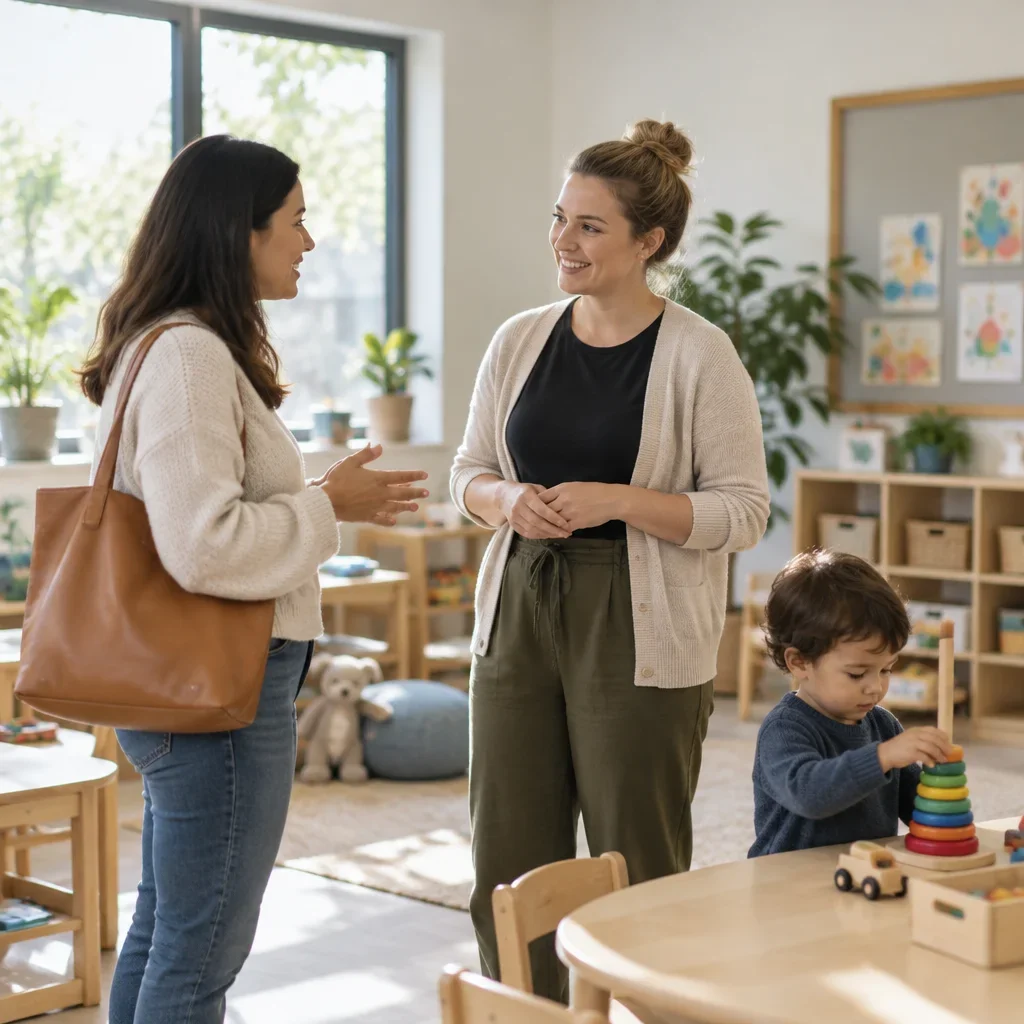
Useful transition information describes how your child communicates and receives comfort. At Cozy Time, our team includes Early Childhood Educators, or ECEs, and credentialed Montessori teachers. Observation helps educators adapt support rather than expect every child to approach arrival identically.
Share these details before the first drop-off where possible:
- Preferred name and home languages.
- Familiar comfort words, gestures, and signs.
- How your child expresses needs or refuses something.
- Interests that may offer a familiar starting point.
- Sensory preferences and situations your child finds difficult.
- Recent changes in caregivers, home life, or sleep.
- Relevant care needs and existing support strategies.
- The expected collecting caregiver.
A gradual start and an immediate full-day start involve different practical arrangements. Neither should be presented as universally better. The decision needs to account for your child’s experience, family work commitments, programme arrangements, and educator observations.
| Approach | What it involves | Practical considerations | What to review |
|---|---|---|---|
| Gradual start | Attendance builds towards the intended day, where available | Family flexibility and the centre’s transition arrangements | How arrival, participation, meals, and rest are progressing |
| Full-day start | The child begins with the intended daily attendance | Family work needs and support throughout the day | Comfort, engagement, eating, rest, and collection-time observations |
Agree on the handoff process and communication plan before relying on either approach. Identify how updates are shared and when a fuller conversation can happen. A planned discussion gives more useful information than repeatedly returning to restart goodbye.
Adapt the Routine for Your Family and Your Child
Multiple caregivers
A shared caregiver plan keeps the sequence recognisable across different adults. Co-parents and grandparents do not need identical personalities or gestures. They do need the same basic information about handoff and collection.
- Arrival sequence: Record the agreed entry, belongings, and greeting steps.
- Goodbye words: Choose a short phrase everyone can use.
- Collection message: Name the correct collecting adult and truthful return cue.
- Comfort item: Identify the permitted item and where it belongs.
- Educator communication: Agree how relevant information reaches the classroom team.
Sibling arrivals
An agreed arrival order can prevent competing handoffs. Plan with the team so each child remains supervised throughout arrival. Avoid comparing siblings’ reactions; a quiet goodbye from one child does not make another child’s distress less real.
Sensory and communication differences
Reduced language, familiar gestures, or a picture sequence can make the arrival steps clearer. For multilingual families, share comfort words and collection phrases in the home language. An educator does not need a lengthy script to use a familiar greeting consistently.
Sensory adjustments should address the particular barrier rather than a diagnostic label. Noise, crowded entrances, clothing changes, or unexpected touch may need different responses. Discuss whether a less stimulating arrival arrangement is available and coordinate with existing support professionals where relevant.
How Long Adjustment Can Take, and When to Get More Support
There is no universal settling deadline for daycare drop-off. Previous care experiences, attendance patterns, illness, temperament, and changes at home can affect adjustment. Look at the whole day and changes over time, rather than counting tear-free mornings alone.
| Observed pattern | What to discuss with educators | Next action |
|---|---|---|
| Protest at goodbye followed by comfort and engagement | What helps after departure and which activities your child accepts | Keep the agreed routine and review observations |
| Distress continues into classroom activities | Comfort offered, participation, meals, and rest | Review the transition plan together |
| Distress becomes more intense | Changes at home, changes in care, and specific triggers | Arrange a fuller discussion rather than only shortening goodbye |
| Difficulty returns after illness or a break | Changes in familiarity, sleep, health, or attendance | Reintroduce the familiar sequence and review support |
| Eating, sleep, or participation changes alongside distress | The pattern across home and care | Discuss promptly and involve your child’s healthcare professional when appropriate |
| A disclosure, unexplained injury, or fear of a particular person arises | The specific concern and immediate safety needs | Take it seriously and pursue prompt safeguarding action |
If crying continues over several weeks, review more than the doorway routine. Ask about comfort, engagement, eating, rest, and changes during the day. Repeating “leave faster” is not an adequate response to sustained distress.
Persistent, severe, or escalating distress warrants discussion with your child’s healthcare professional, particularly when daily functioning is affected. There is no need to wait for an arbitrary deadline. Educator observations can inform that conversation without diagnosing your child.
A specific safety concern must not be dismissed as ordinary separation anxiety. Listen calmly to a disclosure without suggesting answers. Prioritise immediate safety, raise concerns promptly through the appropriate safeguarding channels, and seek emergency assistance if there is immediate danger.
What Happens After Drop-Off in a Montessori Classroom
Montessori practical life means purposeful everyday activity, such as putting belongings away or wiping a table. An appropriate arrival task can give a child something familiar to do with adult support. It is an invitation to participate, not a requirement to stop crying.
A prepared Montessori environment places suitable materials where children can access them. Educators demonstrate activities, observe engagement, and adapt support. The method does not remove separation feelings or replace responsive care.
The sequence below illustrates how a toddler day can unfold. It is not a timetable for either Cozy Time location, and the order can differ by classroom.
| Part of the day | What it may include | Connection to arrival |
|---|---|---|
| Arrival | Greeting, belongings, and supported handoff | Establishes who is providing care |
| Classroom activities | Practical life, language, art, and exploration | Offers an activity to join when ready |
| Meals and snacks | Eating together and supported everyday routines | Provides familiar events within the day |
| Outdoor or movement time | Outdoor experiences or movement opportunities | Adds a change of activity and setting |
| Rest | Rest according to programme arrangements and individual needs | Forms part of the daily care rhythm |
| Later activities and collection | Further activities and reunion with the collecting adult | Completes the leaving-and-returning sequence |
Cozy Time offers Infant, Pre-Casa, and Casa programmes for children across our overall age range of 6 months to 6 years. The Pre-Casa programme sits between Infant care and Casa. Programme placement and current availability need to match your child’s age and the relevant location.
For families comparing Montessori daycare in Vaughan, arrival support belongs alongside curriculum and staff qualifications. A practical-life activity is useful only when an educator also notices whether your child needs comfort, space, or help joining in.
Fit the Routine Around Drop-Off and Pickup Procedures
The centre’s arrival and collection procedures form the boundaries of your family routine. Permitted arrival times, sign-in, relevant health communication, and authorised collection all affect the plan. Your goodbye words should reflect the collecting adult and actual pickup arrangements.
A daycare drop-off time policy may affect travel planning and sibling logistics. A drop-off and pickup policy also explains how changes in collection are communicated. Contact the centre for the procedures at your location, including permitted belongings and comfort items.
Frequently Asked Questions About Pre-Casa Drop-Off
Is it normal for kids to cry at preschool drop-offs?
Crying can occur during separation and does not explain the whole day. Ask educators whether your child accepts comfort, engages with activities, eats, and rests. Sustained or worsening distress needs review rather than automatic reassurance.
How can I make preschool drop-off easier?
Prepare belongings ahead, follow a familiar arrival sequence, and greet the educator. Acknowledge your child’s feelings, use an honest goodbye, and complete the handoff. Consistency means repeating the structure, not expecting the same emotional response each morning.
Should I leave if my child is crying at daycare drop-off?
Leave only after an educator has accepted responsibility and can support your child. Crying does not automatically mean you must restart the goodbye. If the handoff is unsafe or distress is escalating, pause and agree on the next step with the educator.
Should I sneak out when my child is distracted?
Use a clear goodbye rather than disappearing without notice. Your child needs an understandable signal that you are leaving. Keep the ritual familiar and let the educator support what follows.
How long does it take for a child to adjust to daycare drop-off?
Adjustment has no universal deadline. Attendance, previous separations, health, family changes, and the classroom experience all matter. Review the pattern across the day, and act promptly when distress is severe or worsening.
Can my child bring a comfort object?
A familiar object can be part of the transition plan if the centre permits it. Its suitability depends on the item, your child’s age, and classroom safety arrangements. Follow the centre’s guidance about use and storage.
Why has my child started crying again after previously settling in?
Illness, time away, a changed caregiver, disrupted sleep, or family changes can make goodbye difficult again. Share recent changes with educators and compare observations from home and care. Renewed tears deserve attention without assuming the programme has stopped fitting.
What should I do if my child’s drop-off distress is getting worse?
Arrange a fuller conversation about the entire day and revise the transition plan together. Persistent, severe, or escalating distress also warrants healthcare guidance, especially when eating, sleep, or participation is affected. Treat any specific safety concern separately and promptly.
Talk With Cozy Time About Your Child’s Start
Bring your child’s familiar comfort words, current routine, and collection plan to a tour discussion. Contact our Vaughan or Bolton team about programme fit, current availability, and arrival arrangements. Every child settles at their own pace. The next step is understanding how we can support the handoff together.