
Pre-Casa gross motor activities can start with tape-path walking, soft-ball rolling, action songs, and light basket carrying. You do not need climbing equipment or a large playroom. Start with movements your child already chooses comfortably, then offer a manageable variation.
Quick picks: Pre-Casa gross motor activities by skill and setting
Choose by starting ability, not by difficulty or age alone. A child who enjoys floor play can roll a ball. A steady walker might follow a marked path. These home-play suggestions offer different entry points without requiring jumping, catching, or racing.
| Activity | Setting | Main practice | Materials | Starting ability |
|---|---|---|---|---|
| Tape-path walking | Indoor | Balance and direction | Floor-safe tape | Comfortable walking |
| Partner ball rolling | Indoor | Whole-body coordination | Large soft ball | Comfortable supported or independent sitting |
| Soft-ball basket toss | Indoor | Arm coordination | Soft ball, broad basket | Comfortable sitting or standing |
| Action songs and freeze movement | Indoor | Starting and stopping | Familiar song or visual cue | Any comfortable movement |
| Animal-inspired movements | Indoor | Body awareness | Clear floor space | Comfortable reaching or moving |
| Floor-level tunnel play | Indoor | Crawling coordination | Purpose-made play tunnel | Comfortable crawling |
| Large shape targets | Indoor | Reaching and turning | Large paper shapes | Comfortable sitting or standing |
| Flat-marker stepping | Indoor | Balance and foot placement | Secure, non-slip flat markers | Comfortable stepping |
| Chalk-path walking | Outdoor | Direction and balance | Chalk | Comfortable walking |
| Stop-and-go movement | Outdoor | Movement control | Visual stop cue | Comfortable walking or wheeling |
| Ball rolling or kicking | Outdoor | Ball coordination | Large soft ball | Comfortable sitting or walking |
| Colour-and-shape hunt | Outdoor | Moving towards a target | Existing visual landmarks | Comfortable walking or wheeling |
| Cone-weaving walk | Outdoor | Changing direction | Stable, flexible cones | Comfortable walking or wheeling |
| Ground-level obstacle course | Outdoor | Movement sequences | Flat markers, ball, optional tunnel | Readiness for the selected stations |
| Light basket carrying | Indoor or outdoor | Carrying while moving | Light basket, soft items | Comfortable carrying and walking |
| Low-surface wiping | Indoor | Broad arm movements | Damp cloth, stable surface | Comfortable reaching |
| Returning soft toys | Indoor | Bending, reaching, carrying | Large soft toys, low shelf | Comfortable handling the chosen toy |
| Purpose-made push toy | Indoor or outdoor | Pushing while moving | Suitable stable push toy | Meets the product’s use guidance |
Pre-Casa and pre-K are not interchangeable program labels. This guide centres on toddler participation. Preschool extensions add choices or movement sequences rather than making every activity faster. For our program context, see [Pre-Casa learning at Cozy Time](#pre-casa-learning-at-cozy-time).
Indoor gross motor activities for small spaces
Indoor play works best when the movement fits the available floor space. Move breakable objects, separate ball play from walking routes, and remove materials afterwards. An adult should remain close enough to supervise the activity actively.
Tape-path walking
Materials and setup: Apply floor-safe tape to a clean, dry surface. Make a clear path without crossing doorways. Walking along a route offers practice with balance and direction.
- Demonstrate walking beside or along the tape.
- Invite your child to follow it at a comfortable pace.
Easier: Use a straight route with room beside it. Harder: Add a gentle turn or a stopping place. Supervision and cleanup: Check that tape stays flat and does not make the surface slippery. Remove lifting edges immediately and take up the tape after play.
Soft-ball rolling to a partner
Materials and setup: Choose a large, lightweight soft ball suitable for your child. Sit facing each other on clear floor space. Rolling offers practice directing an object towards another person.
- Roll the ball gently towards your child.
- Invite them to send it back, helping only when welcomed.
Easier: Move closer or let your child push from a comfortable supported position. Harder: Roll towards a broad target beside the partner. Supervision and cleanup: Keep the ball away from stairs and walking traffic. Put it away when either player finishes.
Soft-ball basket toss
Materials and setup: Place a broad, stable basket on the floor. Use a large soft ball. Tossing towards a target offers practice coordinating arm movement with looking.
- Demonstrate a gentle underarm toss from nearby.
- Invite your child to toss, drop, or roll the ball towards the basket.
Easier: Hold the basket close enough for a simple drop. Harder: Move the basket slightly farther away. Supervision and cleanup: Keep the target away from faces, windows, and walking routes. Retrieve the ball before another child enters the throwing space.
Action songs and freeze movement
Materials and setup: Use a familiar song or your own quiet singing. Leave enough space for arms to move freely. This game offers practice starting and stopping a chosen movement.
- Demonstrate swaying, marching, or seated arm movements.
- Pause and show a clear stop gesture, then begin again.
Easier: Keep the same movement throughout. Harder: Invite your child to choose the next movement. Supervision and cleanup: Avoid sudden loud cues. A raised hand or picture can replace music entirely. Return any cue cards to their storage place afterwards.
Animal-inspired movements
Materials and setup: Clear a comfortable floor area. No costume or equipment is needed. Animal-inspired play offers practice changing body position without requiring a particular animal walk.
- Demonstrate a gentle cat-like reach or a slow elephant-style arm swing.
- Let your child copy, adapt, or invent a comfortable movement.
Easier: Try seated reaches or standing arm movements. Harder: Offer hands-and-knees crawling if already comfortable. Supervision and cleanup: Do not require hands-and-feet walking, deep stretches, or jumping. Stop movements that appear uncomfortable and clear the play area afterwards.
Floor-level tunnel play
Materials and setup: Use a purpose-made play tunnel according to its instructions. Place it on a suitable, clear surface. Crawling through a tunnel offers practice coordinating the arms, legs, and trunk.
- Let your child inspect the tunnel while both openings remain visible.
- Invite them to crawl through towards a familiar adult.
Easier: Explore an opening without entering. Harder: Add a simple destination beyond the exit. Supervision and cleanup: Never block an exit, pull a child through, or crowd the tunnel. Follow its use guidance and fold it away after play.
Reaching for large shape targets
Materials and setup: Secure large paper shapes to a stable surface within comfortable reach. Keep shapes and fasteners out of mouths. Reaching offers practice moving the arms and turning the body.
- Demonstrate touching a nearby shape.
- Invite your child to choose another, including one slightly across their body if comfortable.
Easier: Bring targets closer and offer seated participation. Harder: Change the target order without increasing reach excessively. Supervision and cleanup: Never hold a child’s body still to force a reach. Remove paper and fasteners after play.
Stepping between flat markers
Materials and setup: Place secure, non-slip flat markers on a dry floor. Keep them close enough for comfortable steps. Moving between markers offers practice placing the feet deliberately.
- Demonstrate stepping from a clear starting space towards a marker.
- Invite your child to follow the route or choose a marker.
Easier: Use a simple route with generous space around each marker. Harder: Add a gentle change of direction. Supervision and cleanup: Avoid loose paper, raised stepping objects, or sliding mats. Remove any marker that shifts, and clear the route afterwards.
Outdoor gross motor activities for toddlers and preschoolers
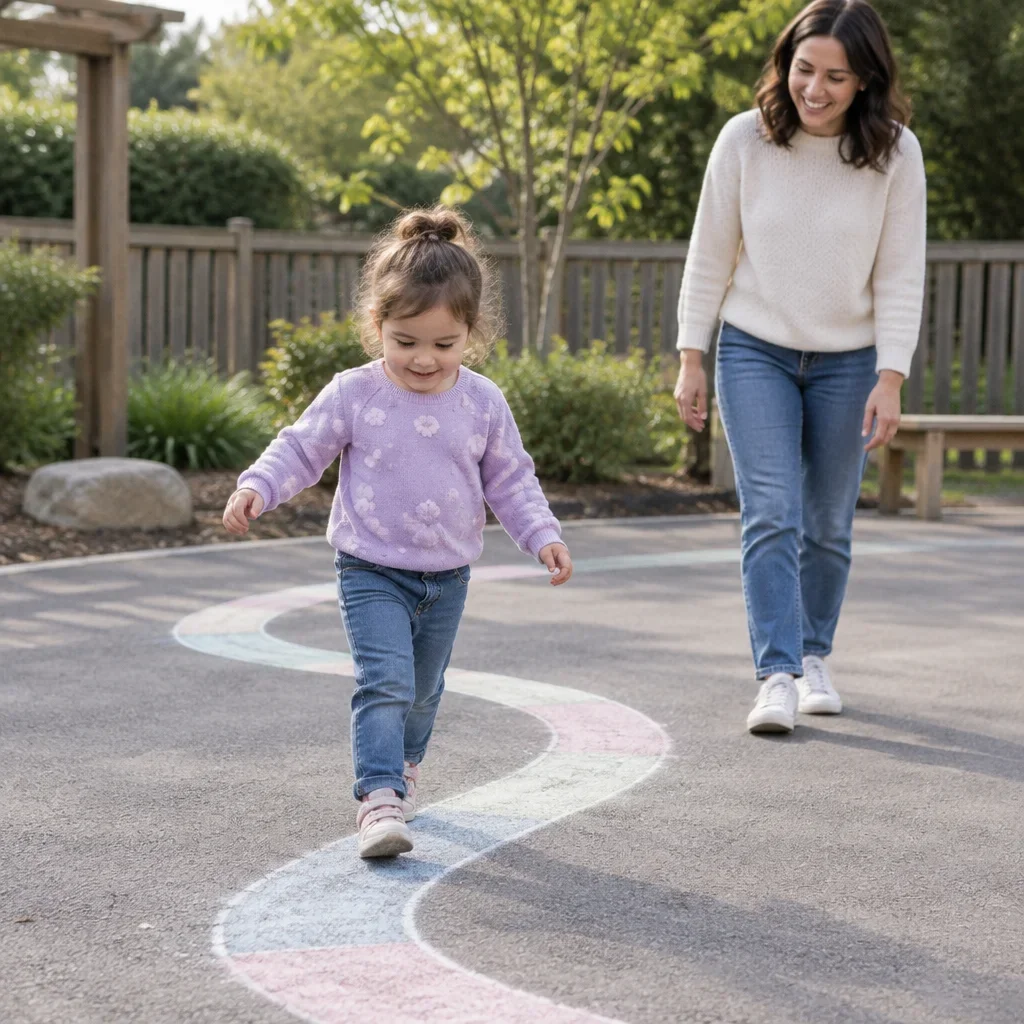
Outdoor movement needs a clear boundary and a suitable surface. Check for holes, debris, slippery patches, and nearby traffic. Choose footwear suited to the ground. Consider shade, drinking water, clothing, and weather before starting. These are home-play suggestions, not childcare outdoor-space specifications.
Chalk-path walking
Materials and setup: Draw a broad chalk route on suitable, dry ground away from vehicles. Following it offers practice with direction changes and balance.
- Walk the route slowly to demonstrate.
- Invite your child to follow, stop, or choose where to begin.
Easier: Draw a short, straight route. Harder: Add curves or a simple direction change. Supervision and cleanup: Keep children within the play boundary. Remove chalk pieces afterwards. Seasonal shapes, such as leaves or snowflakes, can decorate a dry route without using slippery snow or ice.
Outdoor stop-and-go movement
Materials and setup: Choose a level, bounded space. Use a visible hand signal or large cue card. Stopping and restarting offers practice controlling a chosen movement.
- Demonstrate walking or wheeling when the start signal appears.
- Show the stop cue and pause together without making it a race.
Easier: Move beside your child and use predictable signals. Harder: Add a turn before restarting. Supervision and cleanup: Do not use elimination rules or sudden shouted instructions. Keep routes away from roads and remove cue materials afterwards.
Rolling or kicking a large soft ball
Materials and setup: Choose a large soft ball and a level, enclosed play area. Rolling or kicking offers different ways to direct an object.
- Roll the ball gently towards your child.
- Invite a return roll or, for a comfortable walker, a gentle kick.
Easier: Roll while seated with the ball nearby. Harder: Aim towards a broad ground-level target. Supervision and cleanup: Avoid steep slopes, traffic, and crowded paths. Do not require balancing on a leg to participate. Retrieve the ball and store it after play.
Colour-and-shape walking hunt
Materials and setup: Select visible landmarks within a clear boundary, such as a coloured wall panel or leaf-coloured chalk shape. Moving towards a chosen landmark offers practice navigating space.
- Point out an easy-to-see colour or shape.
- Walk or wheel together towards it, then choose another.
Easier: Offer a nearby target and accompany your child. Harder: Remember a short sequence of landmarks. Supervision and cleanup: Look rather than collect unknown plants, berries, or small objects. Remove any temporary markers when finished.
Cone-weaving walk
Materials and setup: Arrange stable, flexible cones with generous space between them. Keep the route clear of other activities. Weaving offers practice changing direction while moving.
- Demonstrate a slow route around the cones.
- Invite your child to walk or wheel through without racing.
Easier: Travel past a simple line of widely spaced cones. Harder: Add a return route or change direction. Supervision and cleanup: Keep turns broad enough for the child’s movement or mobility equipment. Remove fallen cones immediately and collect them after play.
Ground-level obstacle course
Materials and setup: Use secure flat markers, a large soft ball, and an optional purpose-made tunnel. A ground-level course combines familiar movements without adding climbing.
- Establish a clear walking or wheeling route with a visible finish.
- Add a stepping station using secure flat markers; leave a bypass route.
- Place a ball-roll station away from through traffic.
- Add an optional crawling station only when suitable equipment and space are available.
- Demonstrate the route, then invite your child to try the parts they choose.
Easier: Offer a selected station on its own. Harder: Follow a longer sequence or change direction. Supervision and cleanup: Keep stations separated, prevent crowding, and remove equipment immediately after the course closes.
Montessori-aligned practical-life movement activities
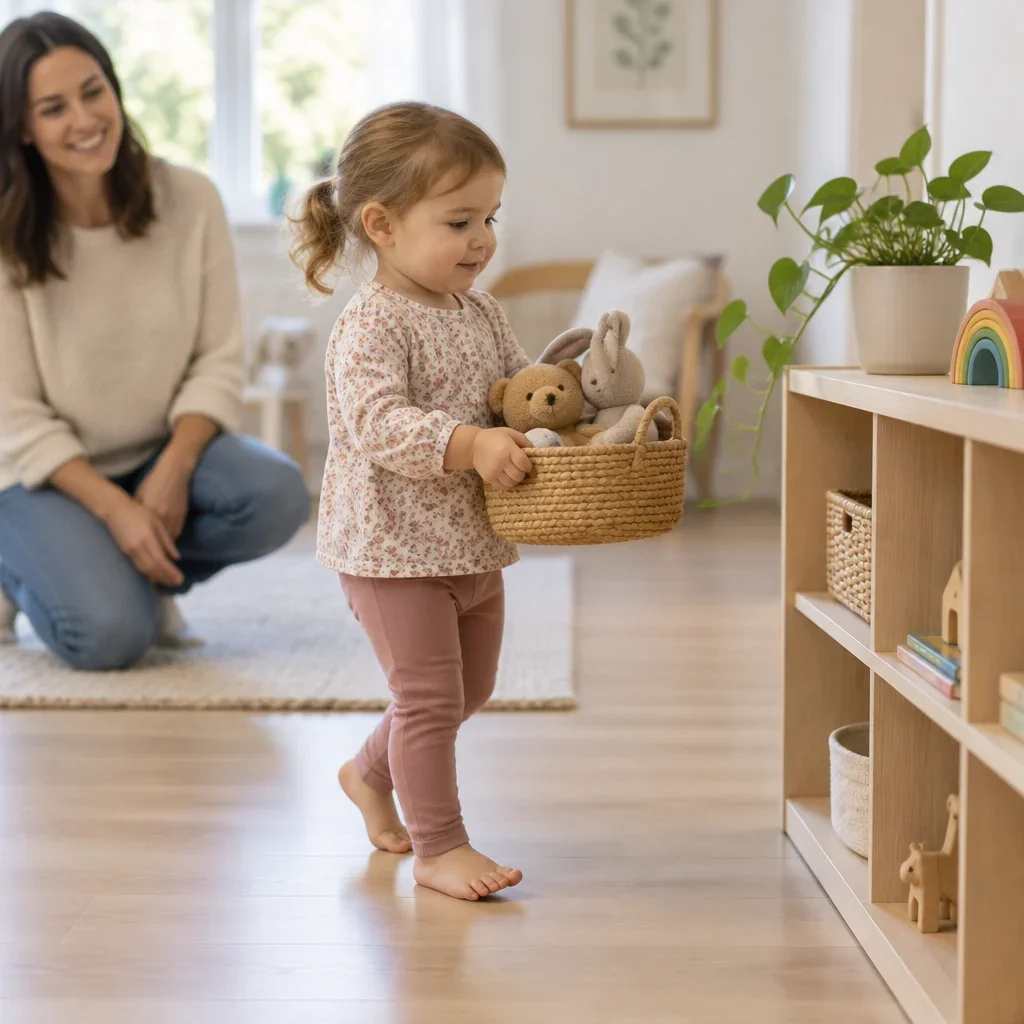
Practical life means purposeful everyday activity, such as carrying materials or wiping a table. Montessori gross motor activities can connect movement with a real task. Demonstrate slowly, offer a choice, and show where materials belong. Not every movement game is a formal Montessori lesson.
Pushing and carrying involve muscle effort, sometimes called heavy work. Here, that means ordinary, manageable play and participation. It does not mean weighted exercise, prescribed resistance, or occupational therapy. Children should be able to stop, put an object down, or choose something else.
Carrying a light basket of soft items
Materials and setup: Put comfortably manageable soft items in a light, easy-to-hold basket. Clear the route to a low destination. Carrying offers practice coordinating movement while holding an object.
- Demonstrate lifting the basket and walking slowly.
- Invite your child to carry it and place it at the destination.
Easier: Carry an individual soft item instead. Harder: Add a gentle turn, not extra weight. Supervision and cleanup: Keep the load low enough to see the route. Stop if carrying looks strained. Return the basket and items to their places.
Wiping a low, stable surface
Materials and setup: Offer a clean cloth dampened with water at a stable, reachable table. Broad wiping movements offer practice reaching across a surface.
- Demonstrate wiping a small area slowly.
- Invite your child to wipe another reachable area, then put the cloth away.
Easier: Work from a comfortable seated position or reduce the area. Harder: Follow a simple wiping pattern. Supervision and cleanup: Keep cleaning chemicals out of this activity. Wipe up drips promptly and keep the floor dry. Do not encourage leaning beyond a stable position.
Returning large soft toys to a low shelf
Materials and setup: Choose light, large soft toys and a stable, accessible shelf. Returning toys offers practice reaching, bending, and carrying with a clear purpose.
- Demonstrate picking up a toy in a comfortable way.
- Carry it to its place and invite your child to choose another.
Easier: Bring the storage basket within reach. Harder: Match each toy to a designated place. Supervision and cleanup: Keep shelves stable and routes uncluttered. Do not encourage climbing or reaching above a comfortable height. Finish by clearing remaining toys from walking routes.
Pushing a purpose-made stable toy
Materials and setup: Select a stable push toy designed for the child’s current ability and intended surface. Follow its age and use guidance. Pushing offers practice moving while applying manageable effort.
- Demonstrate a slow movement along a clear, level route.
- Invite your child to push, pause, and stop voluntarily.
Easier: Choose another activity if the toy moves too freely or requires strain. Harder: Add a broad turn only if the toy remains controllable. Supervision and cleanup: Keep away from stairs and slopes. Never add weights or substitute movable furniture. Park the toy safely afterwards.
What gross motor skills are children practising?
Gross motor skills involve large muscle groups, including those used for sitting, walking, reaching, and moving the trunk. Fine motor skills involve smaller, more precise movements, such as manipulating a fastening. An activity can involve both, but this guide focuses on whole-body participation.
| Skill or movement area | Plain-language meaning | Examples from this guide |
|---|---|---|
| Balance | Maintaining a stable position while still or moving | Tape path, flat-marker stepping |
| Whole-body coordination | Organising different body movements together | Ball rolling, ground-level course |
| Trunk control | Managing the position of the torso | Comfortable seated reaching, crawling |
| Using both sides | Involving both sides of the body in a task | Basket carrying, ball rolling |
| Body awareness | Noticing body position in relation to surrounding space | Tunnel exploration, cone weaving |
| Reaching across the body | Moving a hand towards the opposite side | Comfortable shape-target reaching, wiping |
These activities provide opportunities to practise, not a timetable for improvement. Choose according to current ability, interest, comfort, and surroundings. A child may prefer ball rolling in a busy space and a walking route when the area is quiet.
Choose the right challenge for your child’s stage
Readiness is shown through comfortable participation, not a compulsory performance. Start with a movement your child already uses. Simplify if they repeatedly struggle, tire, avoid the task, or become distressed. A suitable invitation leaves room to pause or decline.
| Starting stage | Suitable starting movements | Useful adaptations |
|---|---|---|
| Infants: 6–12 months, as a broad audience grouping | Supervised, awake floor play using existing abilities | Offer a reachable suitable toy or gently roll a suitable ball within reach; do not require sitting, standing, or crawling |
| Emerging walkers | Comfortable floor play and supported participation | Clear routes; stay close; offer seated alternatives; never force standing or walking |
| Steady walkers | Walking, stopping, light carrying, ball rolling | Keep turns gentle and targets nearby; add a choice of destination |
| Preschoolers | Familiar movement routes and simple sequences | Add direction changes, a longer sequence, or optional jumps only when already comfortable |
For families seeking gross motor skills activities for 1–2-year-olds, floor-level ball play, action songs, and light carrying offer different starting points. The age grouping does not establish readiness. Choose the seated, walking, or reaching version that matches existing abilities.
For 3–4-year-olds, extend a familiar activity before adding equipment. Try remembering a route or alternating between rolling and walking stations. Outdoor gross motor activities for 3–5-year-olds can use the same paths and ball games with more child-led planning. These remain optional preschool extensions, not Pre-Casa placement criteria.
Infant movement remains separate from the toddler activity list. Keep it awake, supervised, and floor-based, using abilities the infant already shows. Do not position an infant to complete a toddler task or use movement play as a reason to change their sleep arrangement.
Keep movement play safe, inclusive, and child-led
Accessible play changes the task rather than requiring every child to move identically. Seated ball rolling, reachable targets, wider routes, and alternative roles can preserve participation. Follow any existing individual support plan rather than replacing it with a generic activity suggestion.
- Clear floor space and separate throwing from walking routes.
- Use stable equipment and materials suitable for the child’s current ability.
- Inspect materials and remove damaged items immediately.
- Choose footwear appropriate to the surface and activity.
- Supervise actively, including during setup and cleanup.
- Offer seated participation, an accessible route, or a target at comfortable reach.
- Use supported standing only when already appropriate for the child.
- Change a single feature at a time: speed, route, target size, sound, or sequence.
- Demonstrate quietly, make turns predictable, and offer breaks.
- Never force touch, spinning, jumping, stretching, or participation.
Persistent movement concerns deserve an individual conversation with a healthcare professional. Seek guidance for loss of previously acquired skills, pain, or marked difficulty with movement. An activity guide cannot assess a child’s development or determine which supports they need.
Build a simple movement routine and printable activity plan
A flexible sequence gives movement play a recognisable beginning and finish. It need not become a compulsory exercise session. Alternate adult invitations with child-led choices, and leave out any stage that does not suit the moment.
- Gentle warm-up: Sing a familiar action song with comfortable swaying or reaching.
- Chosen activity: Offer tape-path walking or partner ball rolling.
- Optional challenge: Invite a familiar ground-level course or another child-selected activity.
- Quiet finish: Try comfortable seated reaches, relaxed arm movements, or simply resting together.
Use the planning table to record the setup and an adaptation before starting. In the observation column, note enjoyment, willingness to repeat, and anything that needs simplifying. Record what happened rather than scoring the child.
| Day or occasion | Activity | Setting | Materials | Skill focus | Easier option | Observation |
|---|---|---|---|---|---|---|
| Rainy afternoon | Partner ball rolling | Clear indoor floor | Large soft ball | Directing a roll | Sit closer | Enjoyed returning the ball; keep the same setup |
For a paper activity plan, copy this table into a document and print it. If you prefer a gross motor skills activities PDF, save your own completed document in that format. The table is usable without a separate download.
Frequently asked questions about Pre-Casa movement play
Easy starting activities
Partner ball rolling, familiar action songs, and nearby shape targets need little setup. Choose a movement your child already enjoys. Introduce the material first, then demonstrate without requiring an immediate turn.
Pre-Casa compared with pre-K
Pre-Casa is not another name for pre-K. Program labels describe different learning groupings, while movement readiness remains individual. Preschool extensions add complexity to a familiar task; they do not change the underlying program label.
Movement in a small room
Seated ball rolling, shape-target reaching, and quiet action songs work without a running route. Clear enough space for the chosen movement. If arms or equipment could contact furniture or another person, reduce the movement or change activities.
Indoor recess without special equipment
A familiar song, a damp cloth, or a light basket can support movement indoors. Offer separate spaces for wiping, reaching, and carrying rather than combining them into a crowded course. Children can choose an activity or observe first.
Adapting for younger toddlers
Use the easiest version of an existing movement: nearby ball rolling, simple reaching, or an uncluttered walking route. Avoid combining carrying with a complicated path. Emerging walkers should not be required to stand or walk to participate.
Adding challenge for preschoolers
Add a direction change, remembered sequence, or child-designed destination before increasing speed. A familiar chalk path can become a route with stopping places. Jumping remains optional and should not be necessary to complete the game.
Participation without pressure
A child can watch, choose the next target, or help return materials without joining the movement. Demonstrate, offer an easier version, and leave the invitation open. Refusing a particular game does not require turning it into a test.
Pushing and carrying for toddlers
Ordinary pushing and carrying can be offered when the object is comfortably manageable. Use light materials and purpose-made equipment. Avoid added weights, resistance prescriptions, and any task that requires visible strain.
Participation with limited mobility
Offer seated ball play, comfortable reaches, accessible routes, or a role choosing destinations. Keep mobility routes clear and follow the child’s existing support plan. The shared activity can remain the same while the movement changes.
Printing a simple plan
Copy the planning table into a document, add activities and adaptations, then print it. Keep the observation column focused on comfort and participation. You can reuse the same plan when an activity remains enjoyable.
Pre-Casa learning at Cozy Time
At Cozy Time Montessori Academy, our Montessori-based early learning includes practical-life participation and individual observation. We offer Infant, Pre-Casa, and Casa programs. The activities above are ideas for home play, not a list of guaranteed classroom equipment or lessons.
If you are considering care in Vaughan or Bolton, contact us about our Pre-Casa program and a tour. Bring your child’s interests, familiar routines, and questions about settling in. We can discuss current availability and how we support the transition into care.