

Parents often think gross motor play needs equipment. It does not. Infant gross motor activities usually start on the floor, with close supervision, simple position changes, and time to move at the baby’s own pace.
What infant gross motor activities are and why they matter
Gross motor skills use the large muscles of the neck, trunk, shoulders, arms, and legs. In the first year, that includes head control, rolling, pushing up, sitting, crawling, pulling to stand, cruising, and early walking patterns.
Gross motor skill activities for infants are simple movement experiences that let a baby practise those patterns. Floor time on a firm mat, supervised tummy time, side-lying play, reaching for a toy, turning toward a voice, and moving in and out of positions all count.
Infant large motor activities do not need to push a milestone. They support body awareness, balance, strength, and coordination by giving the baby safe chances to move, pause, and try again.
Gross motor play also connects with sensory regulation and early communication. When a baby turns toward a caregiver, shifts weight to reach, or pushes up to see more of the room, movement and interaction are working together.
Gross motor skills are different from fine motor skills. Gross motor uses large body movements. Fine motor uses smaller hand and finger movements such as grasping, transferring, and picking up small objects.
Infant development does not follow one exact script. The useful question is not whether a baby is doing what another baby does at the same month. The useful question is whether the baby is gradually gaining new ways to move over time.
Infant gross motor milestones from 0 to 12 months
Gross motor development in infants 0-12 months is best understood in broad age bands, not rigid deadlines. The table below shows common patterns from 0-3 months, 3-6 months, 6-9 months, and 9-12 months.
| Age band | Common emerging skills | Sample activities | What to watch for |
|---|---|---|---|
| 0-3 months | Lifts head briefly in tummy time, turns head side to side, brings hands toward midline, kicks on back | Chest-to-chest tummy time, short floor tummy time, side-lying play, visual tracking | Tolerance for brief floor play, turning toward sound, smoother head movement |
| 3-6 months | Stronger head control, pushes up on forearms or hands, rolls, reaches across body, begins supported sitting | Tummy time reach, mirror play, rolling invitations, kick play, lap sitting with support | Weight shifting, reaching with both sides, interest in turning and moving |
| 6-9 months | Sits with less support, pivots on tummy, may belly crawl or crawl, moves in and out of positions with help | Reaching from sitting, toy trails, cushion paths, tunnel play, supported kneeling | Trunk control, moving toward toys, trying different positions |
| 9-12 months | Crawls or uses another mobile pattern, pulls to stand, cruises, lowers down with help, may take early steps with support | Cruising along stable furniture, squat-and-reach, push toys if stable, climbing over low cushions | Balance in standing, side-stepping, safe transitions down to the floor |
Some babies skip crawling or use another movement pattern, such as scooting. That can still fall within a typical range. The main point is steady progress in strength, control, and changing positions over the first 12 months.
Early independent steps may happen somewhere around 9-15 months. That range is broad on purpose. Walking is only one part of infant movement, and it should not be rushed.
Gross motor activities for infants 0-3 months
Gross motor activities for infants 0 3 months should be short, calm, and fully supervised. At this stage, the best work usually happens through tummy time, side-lying, back play, and gentle position changes on a firm floor mat.
Tummy time is one of the easiest activities for infants gross motor skills in the early weeks. Start with a brief tummy time session on your chest or on a mat, place your face close to the baby, and stop when the baby shows fatigue cues such as turning away, fussing, or flattening down.
Side-lying play helps a young baby bring hands together and shift weight in a new way. Place the baby on one side on a flat mat, support the back lightly with a rolled blanket only if needed and only while directly supervising, and offer a soft visual target near the hands.
Visual tracking supports head turning and early trunk activation without forcing a position. Lie the baby on the back or tummy, move your face or a simple toy slowly from one side to the other, and pause so the baby can follow with the eyes and head.
Floor kicking on the back is a real gross motor activity for infants 0 6 months, not just downtime. A flat surface gives the baby room to kick, turn the head, lift the arms, and begin bringing feet upward.
These youngest infant gross motor skills activities work best in short rounds across the day rather than one long session. If a baby becomes upset, stiff, sleepy, or overstimulated, the useful next step is a break, not more practice.
Gross motor activities for infants 3-6 months
Gross motor activities for infants 0 6 months become more active once head control improves. This is often the stage for pushing up, rolling, reaching across the body, and early supported sitting.
A tummy time reach game builds strength through the shoulders and trunk. Place a toy just in front of the baby or slightly to one side, keep it close enough to be motivating, and let the baby shift weight to look and reach.
Rolling invitations help babies practise turning without being physically rolled through the full movement. Start with the baby on the back, speak from one side or hold a toy at shoulder level, and let the baby begin the turn with the eyes, head, and shoulders.
Mirror play encourages longer floor time because it gives the baby a clear visual target. Place an unbreakable baby-safe mirror at floor level during tummy time or side-lying, and watch for pushing up, reaching, and turning toward the reflection.
Supported sitting on a caregiver’s lap can be useful when done briefly and with full support at the trunk. It gives the baby a new view and lets the body practise upright control, but it should not replace active floor play.
Kick play is another easy activity to promote gross motor skills in infants. On the back, a baby can kick at a scarf, touch a soft ball with the feet, or move under a hanging visual target placed safely out of reach of the face.
Floor time usually offers more movement freedom than long periods in restrictive equipment. Babies learn movement by moving, changing position, and shifting weight, so open mat space matters.
Gross motor activities for infants 6-9 months
Gross motor activities for infants 6 12 months need to match what the baby can already do, not what adults hope comes next. In the 6-9 month range, some babies are stable sitters, some pivot on the floor, and some are just beginning to move across space.
Reaching from sitting is one of the simplest indoor gross motor activities for infants 6 12 months. Sit the baby on the floor with close supervision, place a toy slightly to one side or in front, and let the baby shift weight to grab it and return upright.
Supported transitions in and out of sitting help a baby learn how positions connect. Start from side-sitting or a partly supported seat, place your hands at the hips or trunk as needed, and let the baby do as much of the movement as possible.
Belly crawling invitations work well for babies who can pivot or push backward but are not yet moving forward. Place a favourite object a short distance away, keep the floor clear, and give the baby time to reach, rock, and problem-solve.
Cushion paths are useful gross motor skill activities for infants when kept low and stable. Arrange firm couch cushions or folded blankets on the floor, supervise at arm’s length, and let the baby move over changing textures and small height differences.
Tunnel play can support weight shifting, reaching, and forward movement. A soft play tunnel or a sturdy open-ended tunnel made for infant use works better than a tight space, and the opening should stay wide enough for easy visual supervision.
Supported kneeling at a low surface gives early movers a chance to bear weight through the arms and hips. Use a low shelf or stable box, place one toy on top, and help the baby stay balanced without pulling the body into position.
Gross motor activities for infants 9-12 months
Gross motor activities for mobile infants usually focus on climbing, cruising, balance, and moving between surfaces. In the 9-12 month range, some babies are crawling quickly, some are pulling to stand, and some are beginning supported walking or early independent steps.
Cruising along a stable sofa is a practical way to support side-stepping and weight shifting. Place one or two interesting objects along the cushion line, stay close, and let the baby move sideways while holding the furniture.
Moving between two secure surfaces helps standing balance without forcing walking. Keep the surfaces close enough for the baby to transfer with confidence, and avoid widening the gap just to create a bigger challenge.
Climbing over low cushions is a strong form of gross motor play for infants who already crawl or creep. It supports planning, trunk rotation, pushing, and controlled changes in body position.
Squat-and-reach games work well for babies who pull to stand or cruise. Place a toy low on the floor near stable furniture, let the baby lower with support as needed, and then rise again.
A sturdy push toy can be useful if it is stable, slow, and matched to the baby’s current control. If the toy tips easily or slides too quickly, it is not the right choice for that stage.
Some babies are still happiest crawling at 12 months. That alone is not a reason to panic. Progress matters more than comparison, and concern is best based on the full pattern of movement, not one skill in isolation.
Activities by mobility stage: newborn, roller, sitter, crawler, cruiser
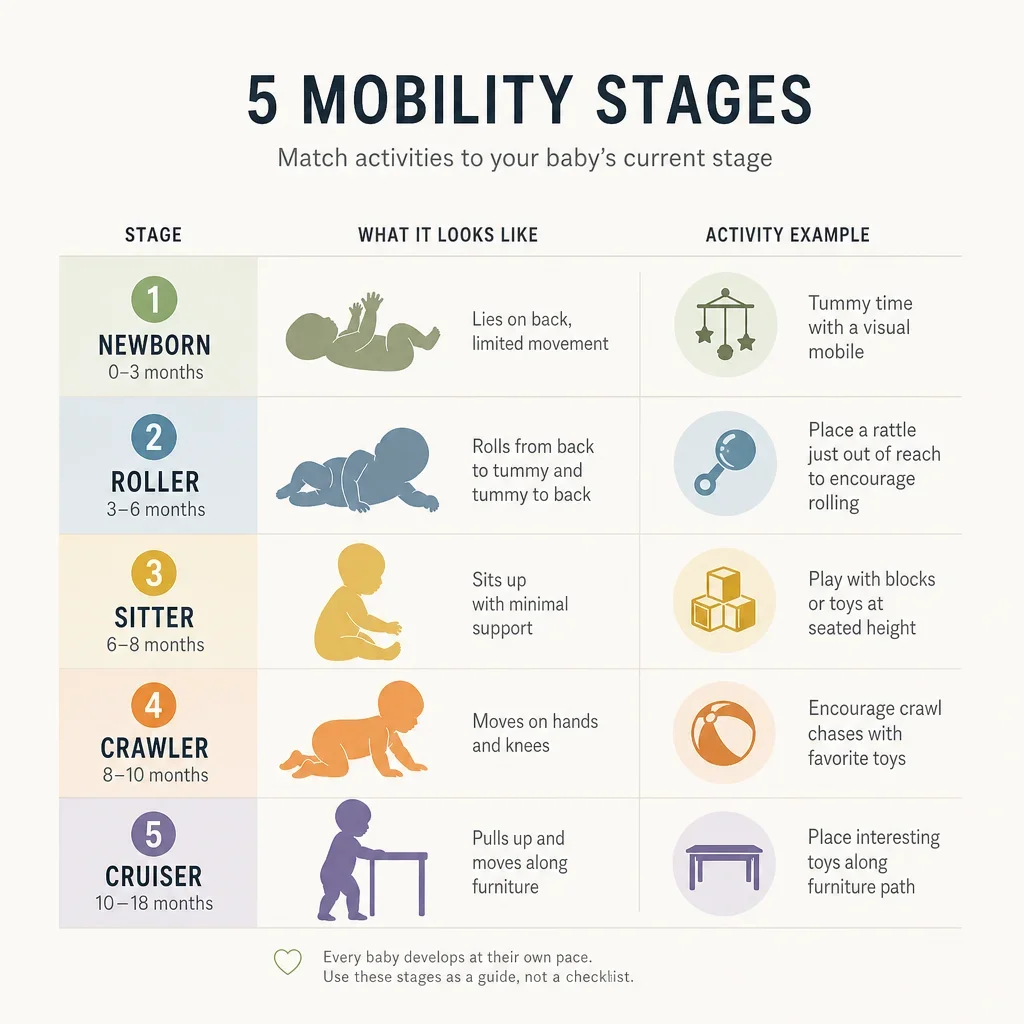
Gross motor activities for infants 0 12 months make more sense when grouped by mobility stage. Age helps, but current ability is the safer guide for choosing an activity.
| Mobility stage | Signs baby is ready | Best activities | Safety note |
|---|---|---|---|
| Newborn | Brief alert periods, turns head, kicks on back | Chest-to-chest tummy time, side-lying, visual tracking | Keep sessions brief and fully supervised |
| Early roller | Pushes up more strongly, turns onto side, starts rolling attempts | Tummy time reach, rolling invitations, mirror play | Give floor space and never use raised surfaces |
| Independent sitter | Sits with less help, reaches outside base of support | Side reaches, toy transfer in sitting, supported transitions | Stay close in case of tipping |
| Belly crawler or scooter | Moves across floor in some way | Toy trails, tunnel play, cushion path | Check floor hazards and keep pathways open |
| Hands-and-knees crawler | Crawls with more speed and purpose | Obstacle routes, climbing over low cushions, chase games | Secure furniture and supervise closely |
| Pull-to-stand or cruiser | Pulls up, side-steps, lowers with help | Cruising, stand-and-play at low shelf, squat-and-reach | Use only stable furniture |
Newborn activities should stay close to the body and the floor. Mobile infant activities can include more distance, more obstacles, and more standing work, but they still need direct supervision and a prepared space.
One activity can often be made easier or harder. A reach game can happen in tummy time for a pre-crawler, in sitting for a sitter, and at a low shelf for a cruiser.
Indoor gross motor activities for infants
Indoor gross motor activities for infants work well when the space is simple. A clear floor area, a firm mat, a few stable objects, and adult supervision are usually enough.
For younger babies, indoor activities for gross motor skills for infants can include tummy time stations, side-lying with a mirror, lap songs with gentle position changes, and back play with reaching and kicking. These all fit in a condo, apartment, or small room.
For sitters and early crawlers, indoor gross motor activities for infants 6 12 months can include ball rolling, cushion paths, tunnel crawling, reaching from sitting, and pulling up at a low stable shelf. The setup matters more than the size of the room.
For winter indoor play in Canada, repetition helps. A baby does not need a new activity every day. The same tunnel, mirror, low shelf, and mat can support different movements as the baby grows.
Texture can add sensory interest when materials are clean, age-appropriate, and supervised. A soft blanket, a smooth mat, a ribbed cushion cover, or a crinkly fabric panel can encourage reaching, shifting, and crawling.
Music-and-movement lap games are useful when floor time needs a short reset. Gentle bouncing, swaying, and upright holding can give vestibular input, which means movement input that helps the body notice balance and position.
Outdoor gross motor activities for infants
Gross motor outdoor activities for infants do not need playground equipment. For pre-crawlers, outdoor movement often means blanket time on the ground, caregiver-held position changes, visual tracking of leaves, and supervised tummy time in a calm shaded spot.
Outdoor activities for infants gross motor skills can start in the first months with simple observation and position changes. A baby can lie on a clean blanket, turn toward natural light and sound, and practise lifting the head in a different environment.
For babies who sit or crawl, grass crawling, ball rolling, moving across a picnic blanket, and pulling to stand at a very stable low surface can work well. The surface should be even, clean, and checked first.
Gross motor outdoor activities for mobile infants can include cruising along a secure bench, crawling up a gentle grassy slope, or moving around soft natural obstacles like a folded blanket or low foam block. The key is staying within the baby’s current ability.
Ontario weather changes the setup. On hot days, shade and shorter outdoor periods are usually more comfortable. On cool days, bulky clothing can limit movement, so families often get better practice with a brief outdoor session and more active floor play indoors.
Younger babies and mobile infants need different outdoor plans. A pre-crawler needs protected floor space and calm sensory input. A crawler or cruiser needs room to move, stable support, and close visual supervision the whole time.
Low-cost gross motor play at home using everyday items
Gross motor activities for infants at home do not require expensive gear. A blanket, mirror, ball, couch cushion, laundry basket, and cardboard box can cover a lot of movement play.
A blanket can support tummy time, side-lying, rolling space, and outdoor floor play. A folded blanket can also soften a hard floor, but it should stay flat enough that the baby can still move safely.
A couch cushion on the floor can become a low obstacle for a crawler or a stable support for kneeling play. It should not be used on the couch or bed, because raised surfaces increase fall risk.
A soft ball supports tracking, reaching, rolling, and early chasing. For older infants, ball rolling back and forth also supports turn-taking, which is an early social pattern.
A baby-safe mirror encourages pushing up, pivoting, and longer floor play. It is one of the easiest low-cost activities to promote gross motor skills in infants at home.
A laundry basket can hold toys at standing height for a cruiser if the basket is stable and weighted enough not to tip. It can also become a visual target for putting toys in and taking them out during standing play.
Painter’s tape can mark a simple floor path for a mobile infant to crawl along or move toward. It should stay out of reach for mouthing and be removed fully after play.
A cardboard box with both ends open can become a tunnel for older mobile infants if the cardboard is sturdy, dry, and large enough for clear supervision. If the box crushes, tears sharply, or smells musty, skip it.
A simple screenshot checklist is enough for most families: floor mat, mirror, soft ball, low cushion, stable shelf, shaded blanket for outdoors, and time each day for supervised movement.
Gross motor activities for infants in daycare or childcare settings
Gross motor activities for infants daycare rooms work best when movement is part of the whole routine. In a licensed infant room, floor play can happen after arrival, between care routines, during one-to-one interaction, and outdoors when conditions allow.
Activities for gross motor skills for infants in childcare need to work for mixed mobility levels at once. One baby may be doing tummy time, one may be sitting and reaching, and one may be cruising along a low shelf, so the environment needs clear sight lines and defined movement areas.
At Cozy Time Montessori Academy, our Infant program serves children from 6 months to 18 months with a 1:3 ratio. That ratio matters because infant movement play needs close observation, safe spacing, and quick support during transitions.
A licensed childcare setting should also be staffed by qualified adults. At our centre, infant classrooms are supported by ECEs, assistants, and staff who are First Aid and CPR certified with clean criminal record checks.
Gross motor activities for infants in childcare are usually simple rather than elaborate. Clear floor space, soft mats, low shelves, stable cruising surfaces, and a predictable routine allow educators to observe, adapt, and supervise safely.
An ECE, which means an Early Childhood Educator, does more than set out toys. ECEs observe how a baby moves, notice readiness for the next challenge, adjust the setup, and communicate with families about what the child is practising in the room.
A simple weekly gross motor lesson plan for infants
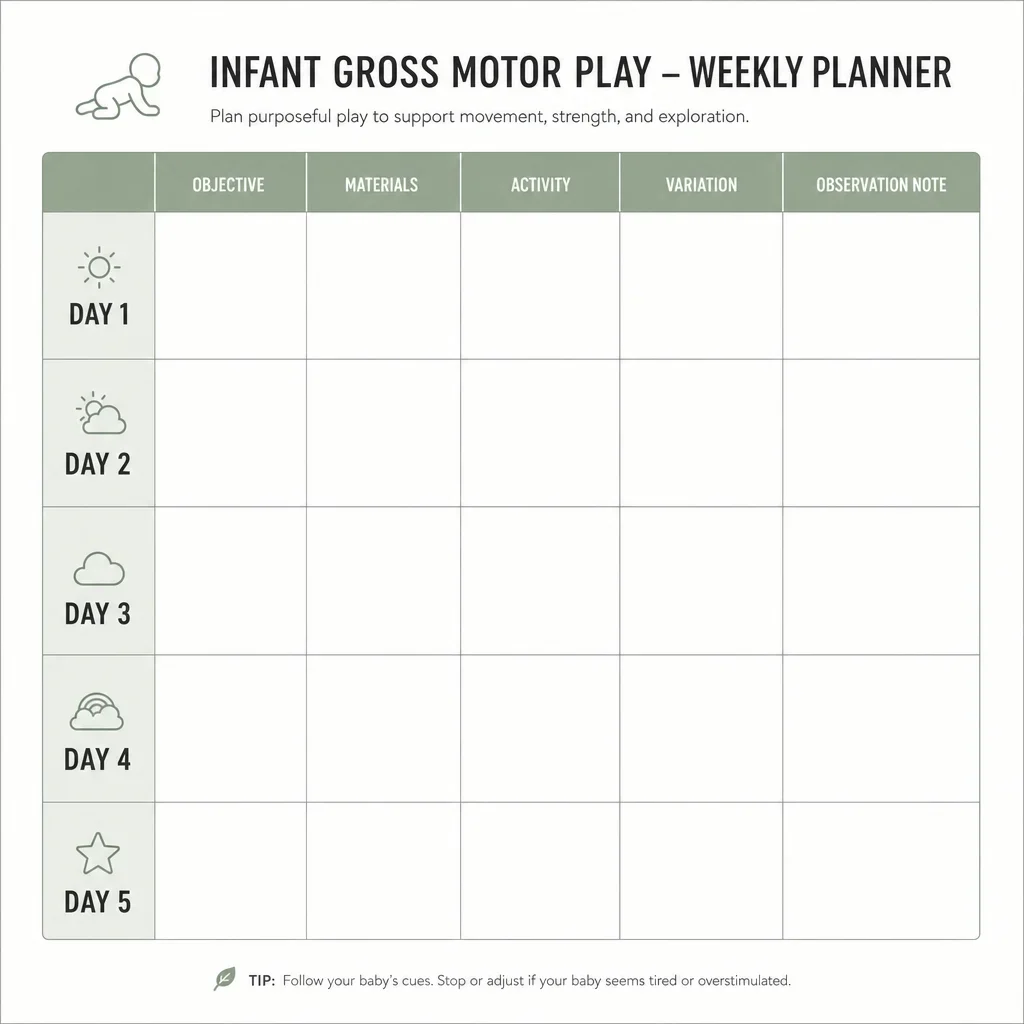
Gross motor lesson plans for infants do not need to be academic to be useful. A simple 5-day template can help parents and educators repeat good activities, observe cues, and make small adjustments.
Here is a basic format for gross motor skills for infants lesson plans: objective, materials, setup, activity, variation, and observation note. That keeps the plan practical and easy to follow.
| Day | Objective | Materials | Activity | Variation | Observation note |
|---|---|---|---|---|---|
| Day 1 | Build tummy time tolerance | Mat, mirror | Short supervised tummy time with mirror | Chest-to-chest version | How long baby stayed calm and alert |
| Day 2 | Encourage rolling and turning | Mat, toy | Side reach and rolling invitation | Use caregiver voice instead of toy | Which side baby turned toward |
| Day 3 | Support sitting balance | Mat, 2 toys | Reach from sitting with close support | Do activity on caregiver lap | How baby recovered balance |
| Day 4 | Promote forward movement | Mat, favourite object | Toy trail for belly crawl or crawl | Shorter distance | What movement strategy baby used |
| Day 5 | Practise standing or cruising if ready | Low shelf, stable toy | Stand-and-play at shelf | Cruising to one side | How much support was needed |
For pre-crawlers, the same weekly plan can stay close to tummy time, side-lying, and reaching. For mobile infants, the plan can add tunnels, cushions, cruising, and squat-and-reach games.
The observation note is the most useful part of the lesson plan. It helps adults notice whether the activity matched the baby’s current stage, whether the setup was too hard, and when to stop.
Safety tips: what makes an infant gross motor activity appropriate
An appropriate infant activity starts with direct supervision and a safe surface. The floor should be firm, clear, and clean, and the adult should stay close enough to respond right away.
Pre-crawlers need protection from falls and forced positions. That means no leaving a baby on a bed, couch, or change table for movement play, and no propping a baby into a position the baby cannot yet hold safely.
Crawlers need more floor checks because they can reach more hazards. Small objects, cords, unstable decor, pet bowls, and open stairs matter much more once a baby moves across the room.
Cruisers need stable furniture. A sofa, fixed shelf, or secure activity surface can work. A light chair, rolling table, or tipping basket cannot.
Materials should be age-appropriate and large enough not to create a choking risk. If an item is cracked, sharp, loose, or hard to clean, it should not be part of infant play.
Raised surfaces are not the place for gross motor practice. Babies should not practise rolling, sitting, crawling, or climbing on beds, sofas, counters, or any surface where a fall could happen quickly.
If a child has a diagnosed condition, low tone, high tone, limited mobility, or a movement concern already being followed, the right adaptation should come from the family and that child’s health professionals. A centre or article can describe general options, but individual guidance matters.
When to be concerned about gross motor delay
Concern is usually based on patterns, not one isolated milestone. If a baby shows very uneven movement, seems extremely floppy or very stiff, loses skills that were already present, or is not making gradual progress across the first year, it is reasonable to speak with a pediatrician.
Persistent head lag beyond the expected early months, little interest in pushing up or moving against gravity, strong preference for one side, or trouble bearing weight through the legs when supported are examples that can justify a check-in. These are observations, not a diagnosis.
By 12 months, three examples that can prompt a conversation are loss of earlier motor skills, marked asymmetry in how the body moves, or not moving toward any form of mobility such as rolling, scooting, crawling, or another clear way of getting around. A pediatrician can decide whether a physiotherapist or occupational therapist should assess further.
Parent intuition matters. If something feels off, asking early is reasonable. A calm conversation with a pediatrician, physiotherapist, or occupational therapist is more useful than comparing with online milestone videos.
Activities can still stay gentle and supportive while you seek advice. The goal is not to push the baby harder. The goal is to understand what kind of movement support fits that child best.
How Montessori-style environments support infant movement
A Montessori infant space supports movement by preparing the environment rather than directing every action. That usually means clear floor space, child-height materials, simple visual choices, and time for observation.
In Montessori, we do not try to rush a child into the next position. We prepare the room, observe readiness, and support practical movement in ways that respect the baby’s current stage.
This approach fits infant gross motor activities well because babies learn through repetition, freedom on the floor, and calm adult support. The environment does part of the work when it is uncluttered, safe, and scaled to infant use.
In a licensed Montessori childcare setting, that prepared environment still sits alongside class ratios, supervision, staff credentials, and daily care routines. Montessori method is not a substitute for safety standards. It works inside them.
FAQ
What are some gross motor activities for infants?
Good infant gross motor activities include supervised tummy time, side-lying play, visual tracking, rolling invitations, reaching from sitting, crawling toward a toy, cruising along stable furniture, and ball rolling. The right activity depends on the baby’s current mobility stage, not age alone.
What are gross motor skills in babies?
Gross motor skills are large body movements. In babies, that includes head control, rolling, sitting, crawling, pulling to stand, cruising, and early walking patterns.
What activities should a baby be doing at 0 to 6 months?
From 0-6 months, simple floor play is usually best. Try tummy time, chest-to-chest tummy time, side-lying, visual tracking, kicking on the back, rolling invitations, and short supported sitting once head and trunk control are improving.
What are the best gross motor activities for infants 6 to 12 months?
For 6-12 months, useful activities include reaching from sitting, toy trails for crawling, cushion paths, tunnel play, kneeling at a low surface, cruising, squat-and-reach games, and standing play at a stable shelf. Babies in this range vary widely, so adjust to the child’s current movement pattern.
What are some indoor gross motor activities for infants?
Indoor gross motor activities for infants include tummy time stations, mirror play, kick play, ball rolling, cushion paths, tunnel crawling, reaching from sitting, and low-shelf standing. These can work in small homes and childcare rooms.
What are some outdoor gross motor activities for infants?
Outdoor ideas include tummy time on a clean blanket, visual tracking of trees and light, grass crawling, ball rolling, moving across a picnic blanket, and cruising at a stable outdoor surface if the baby is ready. Outdoor plans should match the baby’s mobility stage and the weather.
How can I promote my baby’s gross motor skills at home?
Use simple daily floor time, rotate a few safe materials, and repeat activities often. A mat, mirror, ball, low cushion, and stable support surface are enough for many gross motor activities for infants at home.
What are red flags for gross motor delay?
Examples include strong stiffness or floppiness, clear asymmetry, loss of skills, little progress over time, or concern about head control, weight bearing, or movement across the first year. If you notice those patterns, speak with a pediatrician or ask whether a physiotherapist or occupational therapist should assess.
Many parents want to know how movement is supported in a real infant classroom, not only at home. The best next step is to visit and see the environment. If you are looking for licensed infant care in Vaughan or Bolton, contact Cozy Time Montessori Academy to ask about the Infant program, current availability for your child’s age group, and what floor play, routines, and supervision look like day to day.