
Many parents start with one worry: is the pre casa daycare difference just a new label, or is it a real program difference? At a licensed Montessori daycare in Vaughan, the answer is practical. Pre-Casa is still child care, but it is child care organized around the Montessori method, daily routine, observation, and growing independence.
Pre-CASA vs daycare at a glance
Pre-CASA vs daycare comes down to program design. Pre-CASA is a Montessori early learning stage between Infant and Casa, while daycare is a broader child care category that can range from routine-based supervision to strong educational programming depending on the centre.
At our centre, both are forms of care, but they are not the same type of classroom. A Pre-Casa room uses Montessori materials, practical life activities, sensorial work, and teacher observation, while a daycare room may use a wider mix of group activities, free play, and teacher-led transitions.
The choice is not about one label being better. The better fit depends on your child’s age, the classroom structure, your family’s schedule, and whether the program is licensed.
| Area | Montessori Pre-CASA | Licensed daycare |
|---|---|---|
| Main purpose | Care plus Montessori early learning | Care, supervision, routine, and developmental activities |
| Classroom style | Prepared environment with defined materials | Varies by centre and teaching model |
| Teacher role | Observe, guide, present activities | Supervise, support, plan activities, manage group routine |
| Child experience | More choice within structure | Varies from play-based to more teacher-led |
| Independence | Daily self-help routines are built into the program | Supported in many centres, but approach varies |
| Routine | Often includes longer uninterrupted work periods | Often more segmented by group times and transitions |
| Meals and rest | Included or centre-specific; ask each school | Included or centre-specific; ask each centre |
| Flexibility | Depends on the licensed Montessori program | Depends on the centre’s schedule and spaces |
What Pre-CASA means in Ontario childcare terms

Pre-Casa is a school term, not a province-wide legal category. Different schools use Pre-Casa, toddler, preschool, or Jr Casa differently, so parents should confirm what a centre means before enrolling.
At Cozy Time Montessori Academy, the program path is clear. We offer Infant for 6 months to 18 months at 1:3, Pre-Casa for 18 months to 30 months at 1:5, and Casa for 30 months to 6 years at 1:8.
Casa age at our centre begins at 30 months and continues to 6 years. In Montessori language, Casa is the preschool and kindergarten stage, usually in a multi-age classroom where younger and older children learn alongside each other.
Jr Casa is not a universal term. Some Montessori schools use it for children below the main Casa range, but that label is not part of our stated program structure, so the best next step is to ask the centre how a specific classroom is organized.
Pre-primary is also not the same as daycare by default. In Canada, families often use pre-primary, preschool, and daycare loosely, but the actual meaning depends on the province, school system, and the centre’s own program names.
| Program at Cozy Time | Age range | Ratio | Plain-English stage |
|---|---|---|---|
| Infant | 6-18 months | 1:3 | Early care for babies |
| Pre-Casa | 18-30 months | 1:5 | Montessori toddler stage |
| Casa | 30 months-6 years | 1:8 | Montessori preschool and kindergarten stage |
Plain-English terminology box
Daycare means child care provided in a licensed or unlicensed setting. In this article, we are comparing licensed programs because licensing affects ratios, safety oversight, and staffing.
Preschool usually means an early learning program before kindergarten. In Canada, some preschools run half days, while others are part of full-day licensed child care.
Pre-Casa means the stage before Casa in a Montessori school. At our centre, that is the 18 to 30 month program.
Casa means the Montessori classroom for children aged 30 months to 6 years at our centre. It includes practical life, language, sensorial work, early math, and a multi-age classroom structure.
Pre-primary does not have one fixed meaning across all schools. Some families use it to mean preschool, and some use it for the year before primary school, so it should always be clarified on a tour.
Side-by-side comparison: Pre-CASA vs daycare
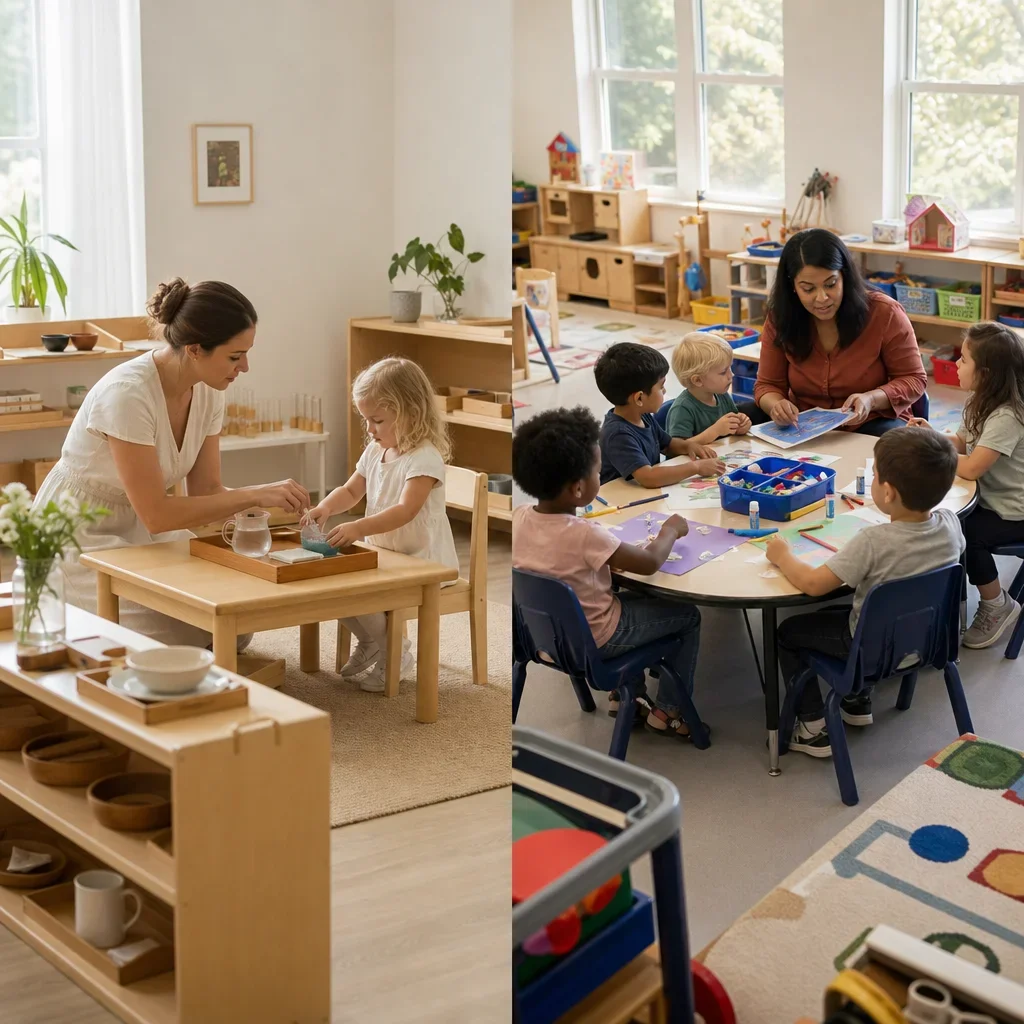
The biggest pre casa daycare difference is consistency of method. A Montessori Pre-Casa classroom is built around a prepared environment, where materials are arranged by purpose and children are guided toward hands-on tasks in a predictable order.
Traditional daycare is broader as a category. A licensed daycare may be play-based, theme-based, routine-based, or blended, and that is why parents should compare centre to centre rather than assume every daycare works the same way.
In Pre-CASA vs daycare, the teacher’s role feels different in practice. Montessori teachers observe closely, present materials one step at a time, and repeat lessons as needed, while ECEs in daycare often balance planned activities, supervision, care routines, and group management across the day.
The classroom setup also differs. A Montessori toddler program Vaughan parents tour will usually have low shelves, child-sized tools, practical life materials, and defined spaces for movement and work, while a daycare room may have broader toy stations, dramatic play, and rotating group activity areas.
The routine in Montessori is usually less interrupted. Children work with materials, repeat tasks, tidy up, and move through self-care routines with support, while daycare schedules may move the whole group more often from play to snack to circle to outdoor time.
That difference does not make daycare less educational. A strong licensed daycare Vaughan families choose can include language-rich conversation, sensory play, early numeracy, music, art, and outdoor learning within a different structure.
A typical day in Pre-CASA compared with daycare
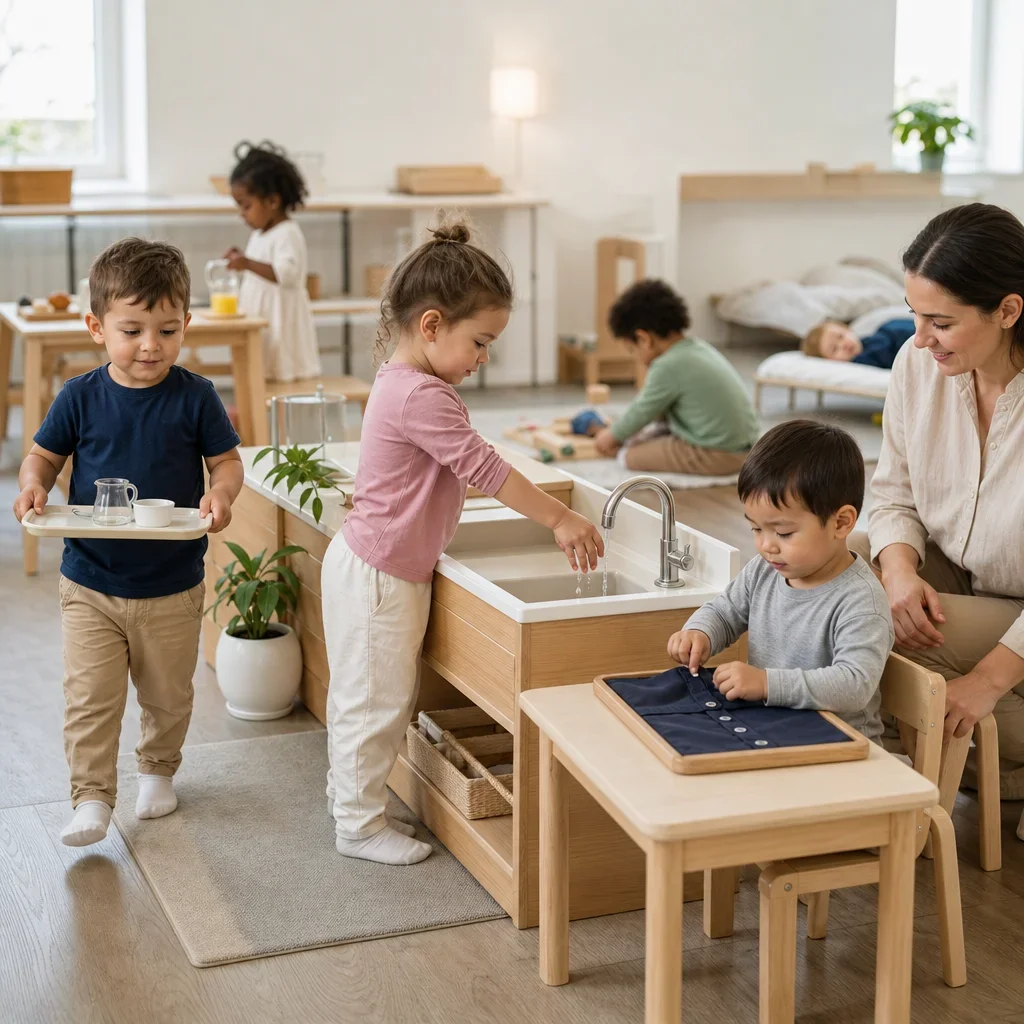
A Montessori Pre-Casa day usually gives toddlers longer stretches for purposeful activity. That means more time to repeat one task, carry a tray, wash hands, practise spooning, match objects, look at books, and transition with less rushing.
A typical licensed daycare day often uses more whole-group rhythm. Children may move through arrival play, snack, a group activity, outdoor time, lunch, nap, and afternoon play on a schedule designed for the room as a whole.
The Montessori work period is one of the clearest differences. It is an uninterrupted block where children choose from prepared activities, and the teacher observes, redirects, or gives a short lesson instead of stopping the room for frequent group changes.
Daily care still remains part of both models. Meals, diapering or toileting support, handwashing, rest, outdoor supervision, and pickup routines are basic parts of licensed child care whether a room is Montessori or non-Montessori.
| Part of the day | Sample Pre-Casa flow | Sample daycare flow |
|---|---|---|
| Arrival | Calm greeting and transition into classroom work | Arrival play and settling in |
| Morning | Montessori work period with short individual presentations | Play centres, group activity, or mixed free play |
| Snack | Handwashing, seated snack, cleanup routines | Snack with group supervision |
| Midday | Outdoor play, lunch, care routines | Outdoor play, lunch, care routines |
| Rest | Nap or quiet rest based on the room’s routine | Nap or quiet rest based on the room’s routine |
| Afternoon | Practical life, language, sensorial work, outdoor time | Play, art, stories, music, outdoor time |
| Pickup | Calm handoff and parent updates | Parent handoff and daily updates |
Learning and development differences parents actually notice
Pre-CASA does not mean formal academics for toddlers. It means daily practice with practical life, language, sensorial work, movement, and order through hands-on materials and predictable routines.
Daycare can also include educational activities. Songs, stories, art, sensory bins, puzzles, outdoor play, and conversation are common tools in licensed child care, even when the classroom is not Montessori.
Independence is usually more explicit in Montessori. Children are shown how to carry materials, sit for a task, tidy a shelf, wash hands, help with dressing steps, and complete simple sequences with support.
Language support looks different in style, not in importance. Montessori teachers tend to name objects precisely, model short clear phrases, and give individual presentations, while daycare educators may build language through songs, stories, group discussion, and play interactions.
Social growth is supported in both settings, but the method can differ. Montessori classrooms use grace and courtesy lessons, careful modeling, and mixed-age peer learning in Casa, while daycare rooms may lean more on group games, shared routines, and teacher-facilitated play.
Motor development and hands-on learning are central in both quality models. Montessori uses practical life tools, sensorial materials, and movement with purpose, while daycare may use climbing, art, manipulative toys, dramatic play, and outdoor exploration.
Behaviour guidance in a licensed program should be supervised and consistent. In Montessori, adults redirect, model, simplify the environment, and repeat routines, while in daycare the approach may include clear group expectations, visual cues, and calm coaching through transitions.
Licensing, safety, ratios, and staff qualifications
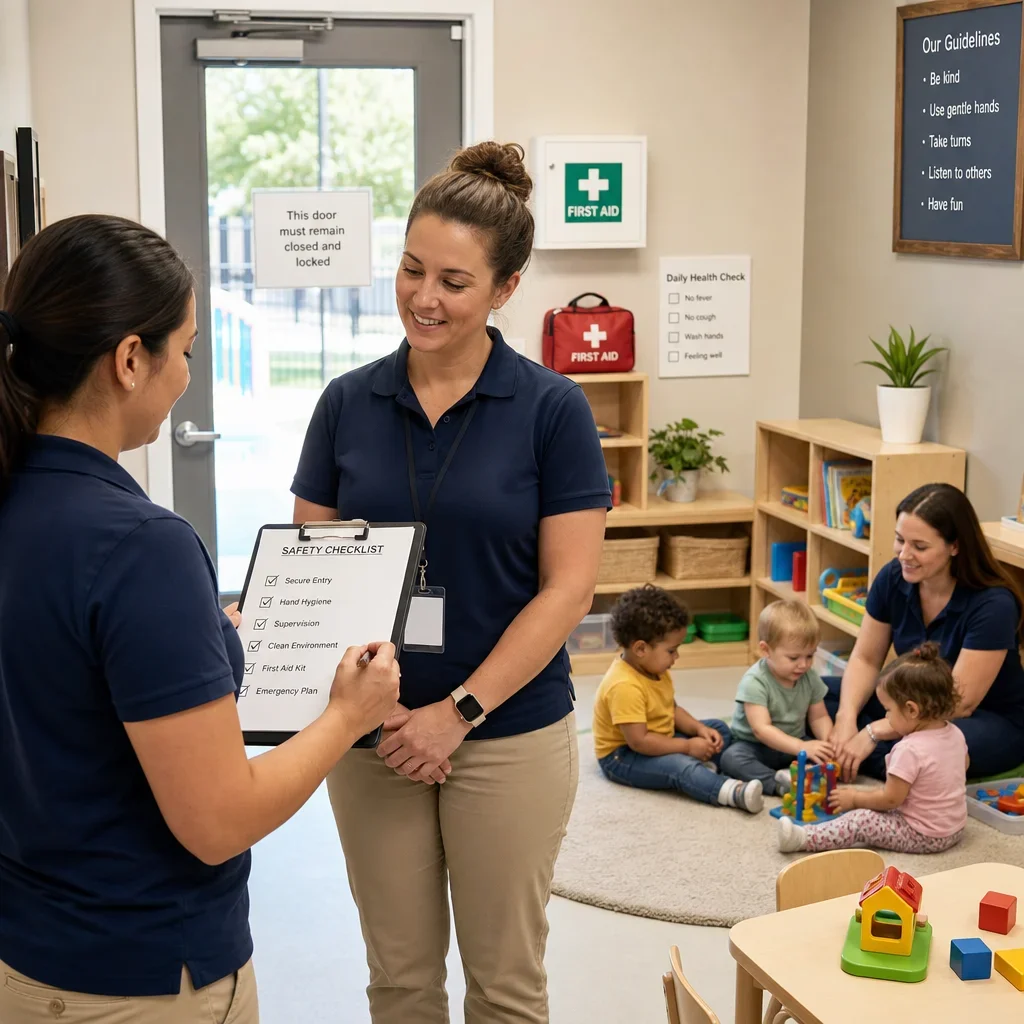
Licensed care is the fairest comparison point. A licensed Montessori daycare Vaughan parents tour and a licensed daycare are both accountable to childcare oversight, staffing rules, and inspection standards, while unlicensed care does not follow the same framework.
Ratios are one of the clearest quality facts to verify. At our centre, the Infant ratio is 1:3, Pre-Casa is 1:5, and Casa is 1:8.
Qualifications matter because they shape what staff can observe and support. Our team includes Early Childhood Educators, certified Montessori teachers, and assistants, and all are First Aid/CPR certified with clean criminal record checks.
ECE means Early Childhood Educator. An ECE has formal early childhood training, while a Montessori teacher has Montessori-specific training in how to present materials, observe children, and prepare the classroom environment.
Neither title should be treated as a substitute for the other. In a strong program, families should look for supervision, credentials, ratios, daily routine, and how the adults speak to children in real time.
Some safety details are centre-specific and should be confirmed directly. Ask how the school handles supervision coverage, emergency procedures, allergy communication, medication, illness exclusions, and pickup security rather than assuming those policies are identical everywhere.
How to choose: which children and families may prefer Pre-CASA or daycare?
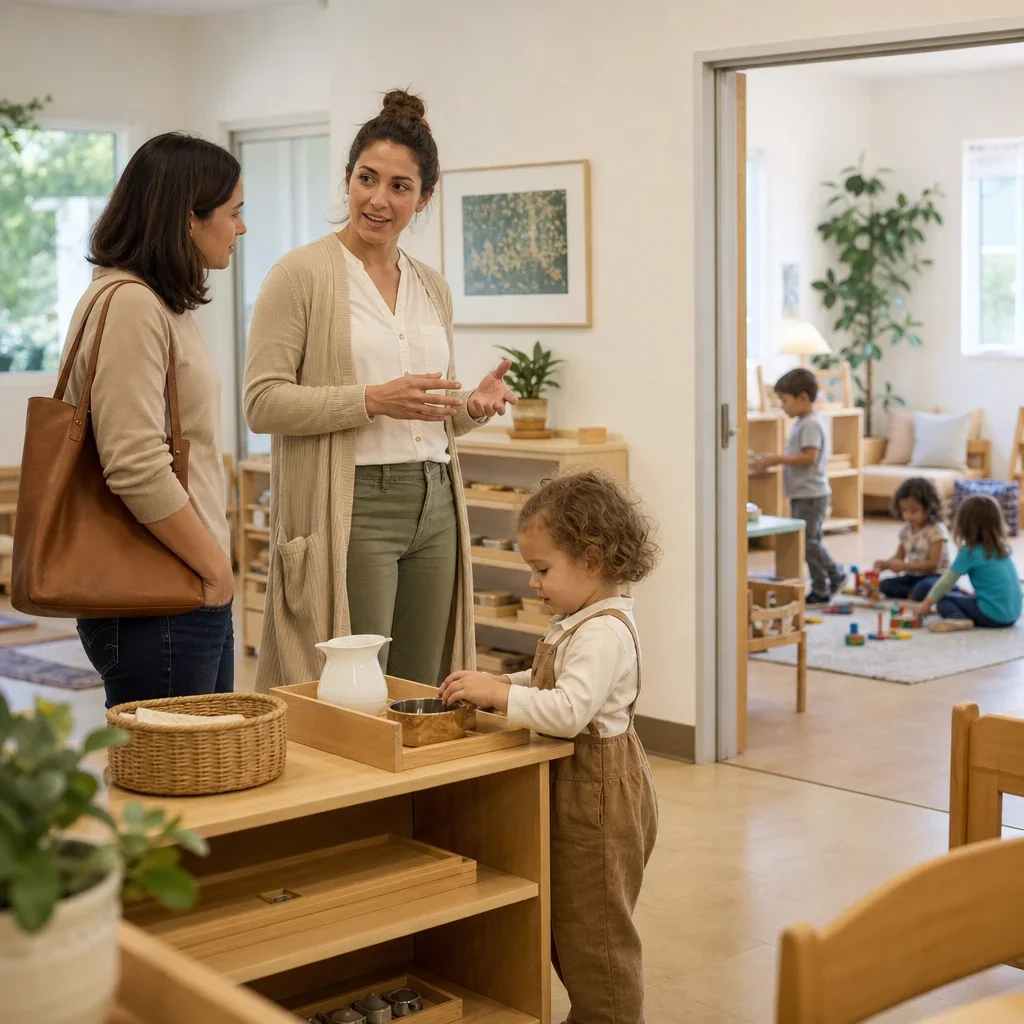
The best fit usually starts with structure. Families who want a more ordered toddler environment often compare a Montessori toddler program Vaughan parents can visit, because the room is intentionally prepared and routines are repeated in the same way each day.
Daycare may suit families who want a wider range of schedule models. Since daycare is a broad category, some centres offer flexibility that a specific Montessori school may or may not offer, so hours and attendance options should be confirmed directly.
A child who likes repetition, familiar steps, and hands-on self-help tasks may settle well into Pre-Casa. A child who enjoys a more mixed group rhythm may also do well in daycare, provided the classroom is calm, supervised, and responsive.
Family logistics matter as much as classroom philosophy. Commute, meals, sibling drop-off, nap timing, full-day coverage, and availability by age group can shape the right decision just as much as the curriculum.
Both in sequence can also work well. Some families start with daycare and move into Pre-Casa later, while others choose a licensed Montessori daycare from the beginning so care and early learning stay in one setting.
| Decision factor | Pre-Casa may fit if you want | Daycare may fit if you want |
|---|---|---|
| Classroom style | Order, repetition, defined materials | A model that may be more varied by centre |
| Daily rhythm | Longer uninterrupted activity periods | More group-based transitions |
| Independence practice | Self-help built into the day | Self-help supported within a broader routine |
| Family priorities | Montessori method plus full-day care | Comparing multiple care formats and schedules |
| Transition path | Clear move from Pre-Casa to Casa | Flexible route, then change later if needed |
Costs, subsidies, and practical care logistics

Cost matters, but this is where parents need current centre information. Tuition, fee reductions, part-time options, deposits, and subsidy pathways are accuracy-sensitive, and they vary by age group, schedule, municipality, and the centre’s current policies.
The main price drivers are usually the child’s age, number of days, full-time versus part-time care, meals, and the program model. Infant care, toddler care, and preschool-age care are not always priced the same, even within one school.
Practical logistics should be compared line by line. Ask whether meals are prepared on-site, how naps work, what support is offered around toileting routines, what the arrival and pickup windows are, and which dates the centre is closed.
At our centre, on-site meals are part of the program. For exact tuition, funding participation, hours, and attendance options, contact the centre to confirm what is current for your child’s age group.
When to move from daycare to Pre-CASA, and from Pre-CASA to Casa
A move into Pre-Casa often makes sense when a child is age-eligible and showing interest in routine, self-help, and purposeful hands-on activity. At our centre, Pre-Casa begins at 18 months.
The transition into Casa follows the same idea of readiness plus age fit. At our centre, Casa begins at 30 months and continues to 6 years.
Transitions do not need to happen on one rigid timeline. The program, the child’s prior care experience, the current opening, and the family’s schedule all affect when a move feels manageable.
A child can absolutely start in daycare and move into Pre-Casa later. That path is common because parents often begin with the care option that is available first, then shift once they find the classroom style they want.
Settling in takes time in any model. Many children adjust within the first 2 to 4 weeks, but every child settles at their own pace, and that is why a calm handoff and clear parent communication matter.
For families asking about a 4 year old, the label matters less than the actual classroom and school-entry plan. Kindergarten timing depends on local school rules, so the best next step is to verify the current requirement with your school board and compare it with the program your child is already in.
Questions to ask on a tour: Pre-CASA or daycare?
A good tour should show you the room in action, not just tell you what the philosophy is. Ask to see how children are greeted, how transitions are supervised, and how the adults respond when a child needs help.
Use this checklist to compare a Pre-Casa program Vaughan families are considering with any other licensed daycare.
- Is the program licensed, and can you explain your classroom ratios?
- What age range is this room designed for?
- Are the lead teachers ECEs, Montessori-trained, or both?
- What does a normal morning look like from arrival to lunch?
- How are naps, toileting, and meal routines handled?
- Are meals prepared on-site or brought from home?
- How do you support a child who is new to group care?
- How do you guide behaviour during sharing, transitions, or frustration?
- In Montessori rooms, how long is the work period and how are materials presented?
- In daycare rooms, how much of the day is group-based versus child-chosen?
- How do you communicate with parents about the day?
- How do pickup, supervision coverage, and emergency procedures work?
What you see matters as much as what you hear. Look for children who are engaged, adults who are close enough to supervise well, shelves and materials that match the age group, and routines that feel calm rather than rushed.
Why some GTA families choose a Montessori daycare model
Some parents do not want to choose between care and early learning. They look for a licensed Montessori daycare Vaughan or Bolton families can use for full-day child care while still getting a real Montessori structure.
That is the role our program is designed to fill. We offer licensed care for children 6 months to 6 years through Infant, Pre-Casa, and Casa, with ratios of 1:3, 1:5, and 1:8.
Our classrooms are staffed by ECEs, certified Montessori teachers, and assistants. We also provide on-site meals and serve families across Vaughan, Maple, Woodbridge, Thornhill, Newmarket, Bolton, and the wider GTA.
The best next step is to visit and see the classroom. A tour lets you compare the Pre-Casa room, the Casa environment, the daily routine, and the staff approach in person before you decide.
FAQ
What is the difference between Pre-CASA and daycare?
Pre-CASA is a Montessori toddler program, while daycare is a broader child care category. Pre-Casa uses a prepared environment, Montessori materials, and more structured independence practice, while daycare models vary by centre.
Is Pre-CASA the same as daycare?
No. Pre-CASA includes child care, but it is not the same as generic daycare because it follows a Montessori classroom model.
Is pre-primary the same as daycare?
Not necessarily. Pre-primary is used differently by different schools and provinces, so families should ask how a centre defines it.
What is the difference between daycare and preschool in Canada?
Daycare usually emphasizes full-day care, supervision, and routine, while preschool usually refers to an early learning program before kindergarten. Some programs combine both.
What age is Pre-CASA for?
At our centre, Pre-Casa is for 18 months to 30 months.
What age is pre-primary in Canada?
There is no single Canada-wide age label for pre-primary. Schools and provinces use the term differently, so parents should confirm the exact age band at each program.
What is Casa age?
At our centre, Casa is 30 months to 6 years.
Does Pre-CASA focus on academics, or just care and play?
Pre-Casa focuses on care plus Montessori early learning. That includes practical life, language, movement, sensorial work, and daily routines, not formal academics for their own sake.
Does daycare include educational activities?
Yes, many licensed daycares do. The format may be play-based, group-based, or theme-based rather than Montessori.
How do child-to-staff ratios compare?
At our centre, ratios are 1:3 in Infant, 1:5 in Pre-Casa, and 1:8 in Casa. Parents should verify ratios at every centre they tour.
Can my child move from daycare into Pre-CASA later?
Yes. Many families move from daycare into Montessori later when a Pre-Casa space opens or when they want a different classroom structure.
Should I choose Montessori, daycare, or both in sequence?
Choose the program that fits your child’s age, your family’s schedule, and the quality of the classroom you can actually verify. For some families, both in sequence is the most practical path.
If you are comparing options in Vaughan or Bolton, bring your questions to a tour. We can show you how the Infant, Pre-Casa, and Casa classrooms work, and help you confirm age fit, routine, meals, ratios, and current availability for your child’s age group.