
Pre-Casa for speech delay can offer everyday opportunities to communicate and participate. It does not diagnose or treat a speech or language disorder. A suitable classroom can work alongside professional support, not replace it.
The right fit depends on your child’s communication methods and support needs. It also depends on what educators can provide throughout the day. You do not need to wait for childcare to resolve a concern before seeking assessment.
Can Pre-Casa for Speech Delay Be a Good Fit?
A responsive Pre-Casa classroom can support participation through play, routines and adult interaction. Children can request help, share interests and join activities using different communication methods. Spoken words, gestures, signs, pictures and communication devices all deserve a response.
Classroom fit requires more than a Montessori label. Educator responsiveness, sensory demands, group routines and available support all matter. A child who needs help understanding transitions may need different arrangements from a child whose speech sounds are unclear.
Montessori for speech delay should mean educational support, not a treatment claim. A teacher can model language while helping a child pour water. That interaction creates practice; it does not establish that Montessori treats the underlying concern.
Speech Clarity, Expressive Language and Understanding Are Different
Speech concerns and language concerns describe different aspects of communication. Separating them helps families explain what they notice without diagnosing their child.
| Area of concern | Plain-language meaning | Everyday example | Professional support |
|---|---|---|---|
| Speech sounds and clarity | How sounds are produced and words are understood by listeners | A child uses a phrase, but listeners struggle to understand it | A speech-language pathologist assesses speech production |
| Expressive language | How a child communicates ideas, needs and messages | A child has difficulty expressing a request or combining ideas | A speech-language pathologist assesses language expression |
| Understanding language | How a child understands words, sentences and directions | A child struggles with a familiar spoken instruction | A speech-language pathologist assesses understanding; hearing assessment may also be relevant |
| Access to communication | How a child gets a message across using available methods | A child points to a picture to request a drink | Family, educators and clinicians identify accessible communication supports |
At age 2, unclear speech alone does not establish a delay. Speech clarity develops over time, and assessment considers the broader communication profile. Understanding, gestures, spoken language, hearing and participation provide important context.
Speech or language delay can occur without autism. Delayed speech alone cannot establish or exclude an autism diagnosis. Assessment considers broader developmental patterns rather than treating one communication difference as a diagnosis.
When Assessment Matters More Than Waiting
Loss of communication skills, hearing concerns and persistent communication difficulties warrant professional attention. These concerns should not be put on hold while a child starts Pre-Casa.
- Loss of skills: Previously used words, gestures or communication abilities disappear. Discuss this promptly with a healthcare professional.
- Hearing concerns: Responses to sound seem inconsistent, or hearing difficulties are suspected. Hearing assessment can help clarify access to sound.
- Understanding concerns: Familiar spoken language or routines remain difficult to understand. Share examples, including the language and setting involved.
- Difficulty expressing needs: A child struggles to communicate help, discomfort or refusal. Accessible communication support matters alongside assessment.
A speech-language pathologist assesses speech and language and recommends individualized support. A primary care clinician can consider broader health and developmental concerns. An audiologist assesses hearing, which is relevant when investigating speech or language difficulties, even when a child responds to some sounds.
The best treatment depends on the assessed concern and the child’s needs. Speech-sound difficulties, language difficulties and hearing-related needs do not share one universal treatment. Professional recommendations may include direct intervention, caregiver coaching and communication tools.
There is no reliable catch-up age for all late talkers. There is also no guaranteed way to “reverse” speech delay. Classroom observations can inform an assessment, but childcare alone cannot determine the cause or replace indicated intervention.
How Montessori Creates Everyday Communication Opportunities

Montessori language development takes place through materials, conversation and everyday activity. Educators name objects, describe actions and respond to children’s interests. Practical life means familiar tasks such as pouring, carrying and tidying. Sensorial work involves exploring qualities such as texture, shape and size.
The examples below illustrate communication-supportive interactions, rather than a prescribed therapy plan. Materials and responses should match the child’s age, interests and access needs.
| Activity or routine | Educator interaction | Communication opportunity | Accessible response options |
|---|---|---|---|
| Real-object naming | Name the object the child is exploring: “Cup” | Share attention and connect an object with language | Look, reach, point, sign, picture or word |
| Shared picture books | Comment on an interesting picture: “The dog is sleeping” | Share an interest or respond to a familiar image | Gesture, sound, word or AAC selection |
| Songs | Pause at a familiar point without demanding a response | Join a shared routine | Movement, gesture, vocalization or words |
| Snack choices | Present available choices and name them | Express a preference or refusal | Point, sign, picture, device or speech |
| Practical-life pouring | Describe the action: “Pour water” | Request help, comment or indicate completion | Gesture, word, sign or AAC |
| Sensorial exploration | Comment on a safe material: “This feels smooth” | Explore and describe an experience | Touch, gesture, picture or speech |
| Supported peer play | Model a useful message: “My turn” | Join play, request an object or decline | Gesture, sign, word or AAC |
Responsive modelling adds language without turning interaction into a test. If a child says “car,” an adult might respond, “Car goes.” The adult can then pause and follow the child’s interest, rather than repeatedly asking for imitation.
Pre-Casa also offers learning opportunities beyond spoken language:
- Independence: Practising familiar tasks with adult support.
- Fine motor activity: Handling suitable tools and materials under supervision.
- Social participation: Playing alongside peers and joining supported shared activities.
- Creative expression: Exploring art, music and movement.
- Preschool familiarity: Experiencing group routines, materials and transitions.
Fine motor work is not a speech treatment. Pouring, transferring and manipulating materials offer hands-on practice, but they do not establish that speech production will improve. Likewise, familiarity with classroom routines does not guarantee preschool readiness.
AAC, Signs and Active Adult Support
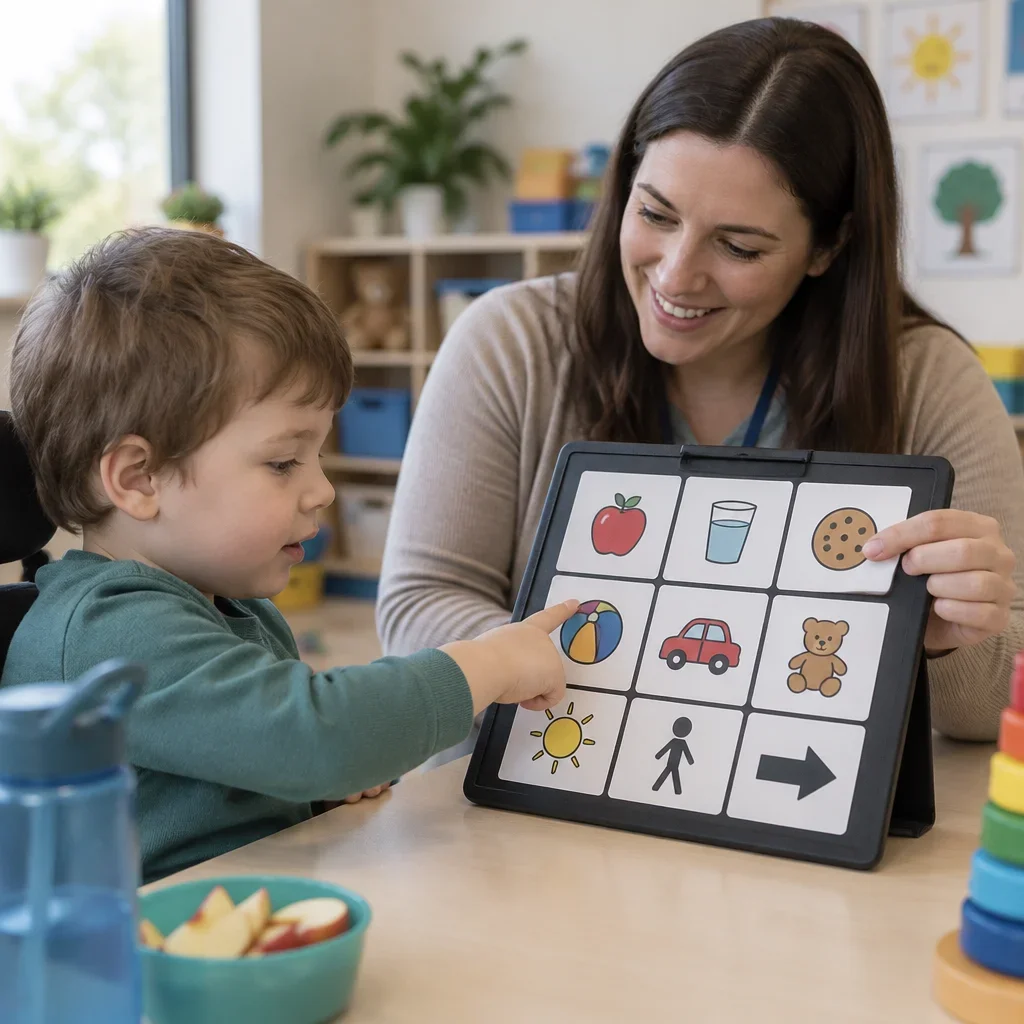
Augmentative and alternative communication, or AAC, means communication that supplements or replaces speech. It can include gestures, signs, picture boards and speech-generating devices. A child does not need spoken words for their message to matter. The American Speech-Language-Hearing Association’s AAC information explains these communication options.
A supportive classroom considers access throughout the day, not just during activities. Possible supports include visual schedules, accessible choice boards, shorter spoken instructions and response time. These arrangements should reflect the child’s familiar methods and professional recommendations.
Following the child does not mean leaving the child unsupported. An adult may need to interpret a gesture, model a useful message or help a child enter play. Predictable routines and calm acknowledgement can support participation when communication becomes frustrating.
Communication support should never depend on making a child speak first. Withholding necessities, removing AAC to encourage speech, demanding eye contact or publicly correcting a child are not appropriate participation strategies. Neither are comparisons with classmates.
Using an existing communication plan requires practical coordination. Families and educators need to discuss materials, training, daily access and consent for clinician communication. The exact arrangements must be agreed before assuming a program can provide them.
Pre-Casa, Other Daycare and Speech Therapy Have Different Roles
Montessori and other licensed childcare approaches can both provide responsive language interactions. Montessori emphasizes a prepared environment, hands-on materials and observation-led activity choices. Other daycare approaches may organize play and group learning differently. Neither label alone establishes the quality of communication support.
| Setting | Primary purpose | Communication opportunities | Assessment and clinical goals |
|---|---|---|---|
| Montessori Pre-Casa | Early learning and care through a Montessori-based environment | Practical life, material choices, conversation and peer participation | Educator observations inform teaching; they are not clinical diagnosis or treatment |
| Other licensed childcare | Early learning and care through the program’s educational approach | Play, books, meals, group activities and responsive conversation | Educators observe participation; clinical assessment is a separate service |
| Speech-language therapy or early intervention | Assess and address identified communication needs | Individualized activities and strategies linked to assessed goals | Clinical assessment and goals are established by qualified professionals within their roles |
Staffing ratios describe staffing, not continuous individual instruction. Cozy Time’s Pre-Casa ratio is 1:5. That does not mean a child receives uninterrupted adult attention. Group size, educator availability and support needs still affect classroom fit.
Educator credentials and clinical credentials are different. Our team includes Early Childhood Educators, or ECEs, and credentialed Montessori teachers. Those qualifications support early education; they do not confer speech-language pathology qualifications.
Pre-Casa names and age eligibility differ between providers. Cozy Time offers Infant, Pre-Casa and Casa programs for children from 6 months to 6 years. Program placement requires a discussion of age, current availability and classroom needs, not a competitor’s age chart.
A specialized school placement should not be selected from delayed speech alone. When comparing a school for a child with speech delay, consider the full learning profile, assessment recommendations and available supports. Proximity is useful, but daily accessibility matters more than the name of the setting.
What a Communication-Supportive Day Can Look Like
A predictable sequence creates repeated opportunities to understand and communicate. This is an illustrative day, not Cozy Time’s clock-based schedule or a promise of specific accommodations.
| Part of the day | Communication opportunity | Possible support |
|---|---|---|
| Arrival | Greet, seek comfort and understand the next activity | Familiar greeting and visual arrival cue |
| Activity choices | Select materials, request help or finish an activity | Accessible choices and educator modelling |
| Snack or meals | Express hunger, preference, refusal or “finished” | Familiar signs, pictures or AAC within reach |
| Books or songs | Share attention and participate in a group routine | Repetition, gestures and response time |
| Outdoor play and movement | Request equipment, join play or ask for help | Short language models and supported peer interaction |
| Art and practical life | Choose materials, describe actions and participate | Safe materials and adult demonstration |
| Rest and transitions | Communicate comfort needs and understand a change | Predictable cues and familiar comfort information |
| Departure | Share an interest and transition to family care | A consistent departure routine and relevant observations |
Physical safety requires suitable materials and active supervision. Small traditional Montessori objects are not automatically suitable for toddlers. Educators need to consider mouthing, handling skills and each activity’s demands rather than offering materials solely because they are Montessori-associated.
Food and toileting messages are everyday care needs, not speech-readiness tests. A child may communicate them through gestures, signs, pictures or a device. Cozy Time prepares meals on-site; individual mealtime needs require a separate discussion from general menu provision.
Preparing for Pre-Casa and Sharing Useful Observations
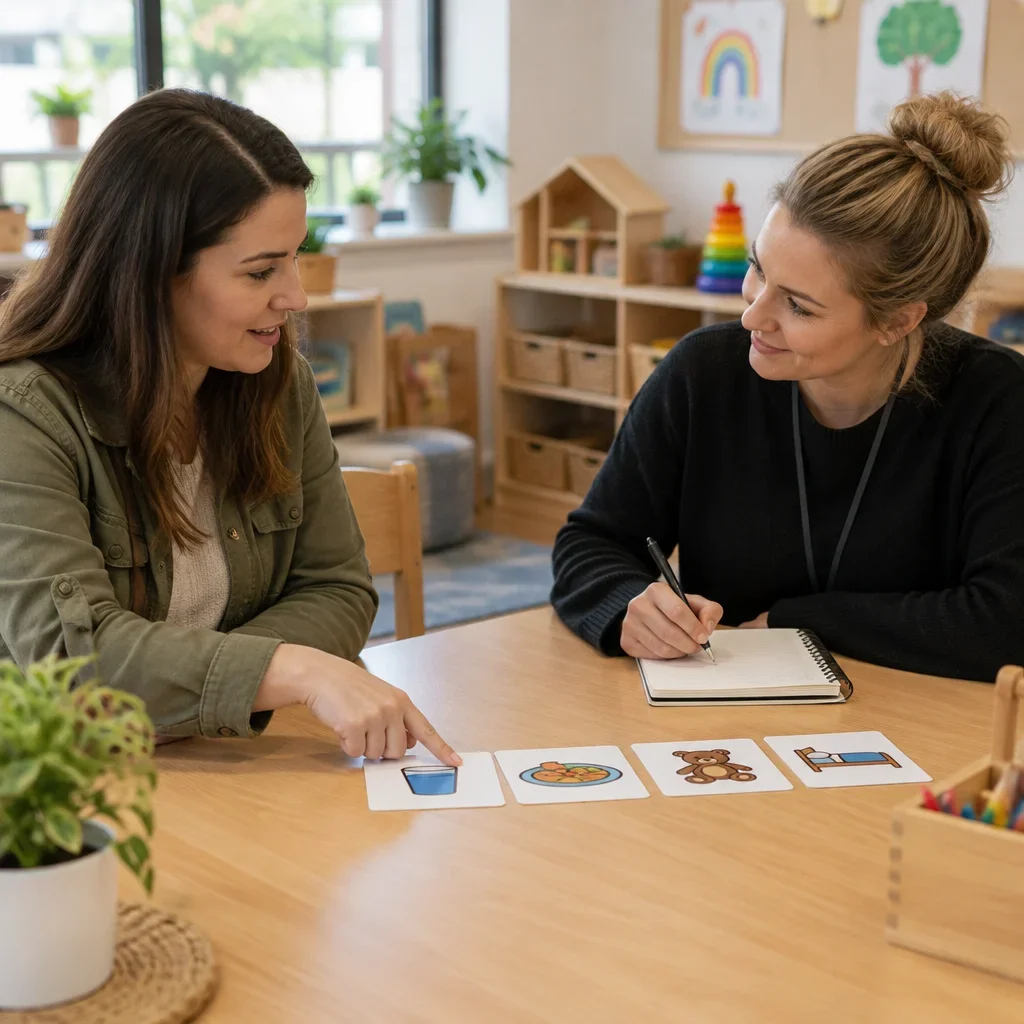
A useful transition plan explains how your child communicates across daily routines. Written examples give educators more practical information than the label “speech delay” alone.
- Describe communication methods. Include words, gestures, signs, pictures and devices your child uses or understands.
- Explain essential messages. Describe how your child communicates hunger, pain, help, refusal and toileting needs.
- Share languages and familiar wording. Include home languages, meaningful phrases and familiar names for objects.
- Describe interests and comfort strategies. Note preferred activities, sensory needs and what helps during transitions.
- Share relevant professional information. Include hearing or assessment information and existing recommendations, with attention to privacy and consent.
- Practise familiar routines. Rehearse manageable parts of arrival and use a predictable goodbye. Avoid making spoken responses a condition of leaving or joining in.
Useful observations describe what happened, where it happened and what support helped. “Pointed to the water picture during lunch” is more informative than “communicated better.” Other observations may describe initiating interaction, taking turns or understanding a familiar routine.
Educator observations and clinical progress measures serve different purposes. Teachers can document participation across words, gestures, signs and AAC. A treating clinician assesses progress against clinical goals. Any shared review should respect family consent and the purpose of exchanging information.
Settling into childcare is separate from speech progress. Temperament, previous care experience, communication access and familiarity with routines all affect the transition. Every child settles at their own pace; there is no reason to promise a standard adjustment or speech timeline.
Low-Pressure Communication at Home
Everyday interaction gives families opportunities to acknowledge messages and model useful language. These examples complement individualized professional guidance; they are not a therapy prescription.
- Shared reading: Follow the picture your child notices. Comment, “Big bus,” instead of testing every picture’s name.
- Pretend play: Join the action and say, “Bear sleeps.” Respond to gestures or sounds as part of the exchange.
- Dressing: Name an action such as “Socks on.” Accept pointing, reaching or another familiar response.
- Snack preparation: Offer available choices and acknowledge the selection: “You chose banana.” Do not withhold food to obtain speech.
- Songs: Leave a natural pause for participation. Movement or a gesture can be a turn.
- Household routines: Describe what you are doing: “Wash the cup.” Keep language connected to the shared activity.
Multilingualism does not itself cause a speech or language disorder. Children’s skills can be distributed across their languages, so assessment needs that context. Families can continue meaningful interaction in their home languages rather than dropping a language as treatment.
Pressure and repetitive testing are not substitutes for responsive interaction. Follow interests, acknowledge messages and keep communication tools available. Avoid self-prescribed oral-motor exercises or drills presented as a general solution to speech delay.
Choosing Pre-Casa in Vaughan or Bolton: Tours, Reviews and Cost
A local search should lead to a discussion about classroom practice. For families comparing Montessori daycare in Vaughan or Bolton, travel time matters alongside staffing, accessibility and daily routines. Nearby care is only suitable if the program can address the child’s actual participation needs.
Use a tour to discuss specific arrangements rather than broad reassurance:
- Ask educators to describe how they respond to pointing, signs or AAC.
- Ask how visual supports and accessible choices could fit into daily routines.
- Discuss current ratios, group size and adult availability during transitions.
- Ask how educators support a child who cannot make a message understood.
- Discuss what following an existing clinician’s recommendations would involve.
- Ask how observations are shared and how consent for outside communication works.
- Discuss material safety, supervision and the centre’s specific safety processes.
- Clarify which supports are available and which require further planning.
Pre-Casa reviews are most useful when they describe observable care. Look for accounts of responsive educators, clear communication and consistent routines. A review describing a “speech breakthrough” cannot establish clinical effectiveness or predict another child’s experience.
Pre-Casa cost and speech-language therapy cost are separate considerations. Childcare tuition does not automatically include therapy. A fee discussion should distinguish tuition, any applicable registration charges, separately arranged therapy and any agreed additional support costs.
At Cozy Time Montessori Academy, our Vaughan and Bolton locations offer licensed childcare with Montessori-based early learning. Our programs include Infant, Pre-Casa and Casa, with ECEs and credentialed Montessori teachers. We prepare meals on-site and observe children to adapt learning activities. These are childcare provisions, not a claim of specialist speech treatment.
Further Answers About Speech Delay and Pre-Casa
Attending without spoken words
Not using spoken words does not, by itself, determine classroom suitability. The discussion should cover how the child communicates, understands routines and accesses support. It should also establish what the program can provide; admission and accommodation should not be assumed from a general description.
Vitamins, deficiencies and speech delay
No vitamin should be presented as a general treatment for speech delay. Nutritional deficiencies can affect health and development, but speech concerns alone do not identify a deficiency. Supplements or dietary changes should address clinically identified needs, not an assumed explanation for delayed speech.
Repeated phrases and difficulty following directions
Echolalia means repeating words or phrases. Repetition may have different functions, so useful observations include what was said, the setting and what happened next. Difficulty following directions also needs context, including hearing, understanding, attention, sensory demands and language familiarity. Neither observation establishes a diagnosis alone.
Mealtime preferences and feeding concerns
Food preferences are different from feeding or swallowing difficulties. Educators can document choices, communication and participation without treating feeding concerns. Coughing or choking during meals, pain or difficulty managing food warrants appropriate professional attention rather than classroom language activities alone.
Speech-language support for older children
Age 7 is not inherently too late for speech-language assessment or support. Recommendations depend on the child’s current needs, not a belief that an opportunity has permanently closed. Cozy Time’s programs serve younger children, but that does not define the limits of speech-language care.
The “3 3 3 rule” search phrase
The “3 3 3 rule” is ambiguous and should not be used as a speech-delay screening tool. A memorable phrase cannot replace assessment of speech, language, hearing and everyday communication. Decisions should reflect the child’s communication profile rather than an unclear internet rule.
Explore Whether Cozy Time Is the Right Fit
The best next step is to visit and see the classroom. Contact our Vaughan or Bolton team to discuss your child’s age group, communication methods and support needs. Bring familiar routines and existing professional recommendations into that conversation.
We can explain program availability, fees and the arrangements needed for participation. Choosing childcare and seeking professional assessment can happen alongside each other. Neither needs to be treated as a test your child must pass first.