
Many parents worry that talking starts with first words. It starts much earlier. Infant language development begins with crying, eye contact, body movements, cooing, babbling, gestures, and back-and-forth interaction long before clear words appear.
What infant language development includes
Infant speech and language development includes more than talking. Communication development in infants starts with how a baby looks at you, reacts to your voice, cries differently for different needs, smiles, coos, babbles, gestures, and takes turns with sounds or facial expressions.
Language is about meaning. Speech is about sounds. Receptive language means what a child understands. Expressive language means what a child says, signs, or otherwise communicates. Social communication means the back-and-forth use of those skills with another person.
Many children understand more than they can say. That is why infant language skills are not measured by words alone. We look at understanding, gestures, shared attention, play, sound-making, and how a child tries to connect.
Infant and toddler speech milestones by age
The clearest speech development chart by age is one that looks at understanding, communication, sounds, and practical concerns side by side. The age bands below cover language development milestones 0 3 years in a parent-friendly way, but they are not a diagnosis tool.
| Age | What a child may understand | How a child may communicate | Sounds or words that may appear | What may be concerning |
|---|---|---|---|---|
| 0-3 months | May quiet to a familiar voice and notice different sounds | Cries, startles, looks at faces, begins social smiling by about 2 months | Cooing may begin around 2 months | Little response to sound, very limited eye contact, or loss of early interaction |
| 4-6 months | May notice tone of voice and familiar routines | Smiles, vocalizes to get attention, takes turns with sounds | Babbling often starts around 4-6 months | No vocal play, no response to voices, or very limited interest in interaction |
| 7-9 months | May recognize their name and familiar words used often | Reaches, looks back and forth, uses facial expressions, may gesture | Repetitive babbling such as “ba-ba” or “da-da” may appear | No babbling, little response to sound, or no back-and-forth interaction |
| 9-12 months | May understand simple routine words and “no” in context | Points, reaches, waves, shows objects, responds to name | First words often appear around 12 months | No gestures, no pointing, no response to name, or loss of sounds or social skills |
| 12-18 months | May follow simple one-step directions in context | Points to request or show, brings items, uses more gestures and sounds | A few words may appear by 12 months, and some children use about 20-50 words by 18 months | No words, very limited understanding, no pointing, or loss of words |
| 18-24 months | May understand simple questions and common directions | Uses words often, imitates, joins in songs, starts pretend play | Around 24 months, many children use at least 50 words and begin 2-word phrases | No words, no word combinations by the end of this range, or very limited understanding |
| 24-36 months | May understand more of daily conversation and simple concepts | Answers simple questions, comments, requests help, takes short turns | Uses short phrases and sentences, though clarity still develops | Very hard to understand most of the time, no 2-word combinations, loss of skills, or little interest in communicating |
A quieter baby can still be developing normally. What matters is progress across several areas. In infants and language development, gestures, shared smiles, attention to voices, and back-and-forth exchanges count as much as early words.
Typical vs concerning: red flags for language and speech delay

Red flags are usually patterns, not one isolated moment. A missed milestone matters more when it appears alongside limited social communication, weak understanding, hearing concerns, or loss of skills already learned.
Under 6 months, concerns include very limited vocalizing, little response to sound, and little social engagement. From 6-12 months, stronger concerns include no babbling, no response to name, no back-and-forth sound play, or little use of gestures.
From 12-18 months, concerns include no pointing, no attempt to communicate needs, no words emerging, or little understanding of familiar routine language. From 18-24 months, concern grows if a child is not using words meaningfully, is not following simple directions, or is losing words or interaction skills.
From 24-36 months, concern grows if a child is not combining words, has very limited understanding, rarely tries to communicate, or loses language or play skills. Loss of skills at any age is a stronger concern and deserves timely follow-up.
Red flags checklist
- Little or no response to sound or voice
- No babbling by the later part of the first year
- No pointing, waving, or showing by around 12 months
- No meaningful words by around 16 months
- No 2-word combinations by around 24 months
- Very limited understanding of simple language
- No attempt to get attention or share interest
- Loss of words, sounds, gestures, or social interaction
How many words by 12, 18, 24, and 36 months?
Word counts are rough guides, not pass-fail tests. Infant vocabulary development depends on understanding, gestures, sound play, hearing, temperament, and whether a child is learning one language or more than one.
Around 12 month speech milestones, some children are just starting first words, while others still rely mostly on gestures and sounds. At this age, a few meaningful words may appear, but understanding familiar routines and using gestures also matter.
Around 18 month speech milestones, a commonly used range is about 20-50 words. Some children sit near the lower end and still make steady progress. What matters is that words are growing, gestures are present, and communication is expanding.
Around 24 month speech milestones, many children use at least 50 words and start combining 2-word phrases such as “more milk” or “mommy come.” A child who understands a lot but says little may still need a closer look if spoken words are not increasing.
By 36 months, children usually use short phrases and simple sentences more often, ask for things, comment, and join short conversations. Exact counts vary widely, so it is safer to look at phrase use, understanding, play, and interaction rather than chase one number.
For children in multilingual homes, total meaningful words across languages can give a more accurate picture than words in only one language. If you are concerned, share all words your child uses with the professional you speak to.
How infants develop language
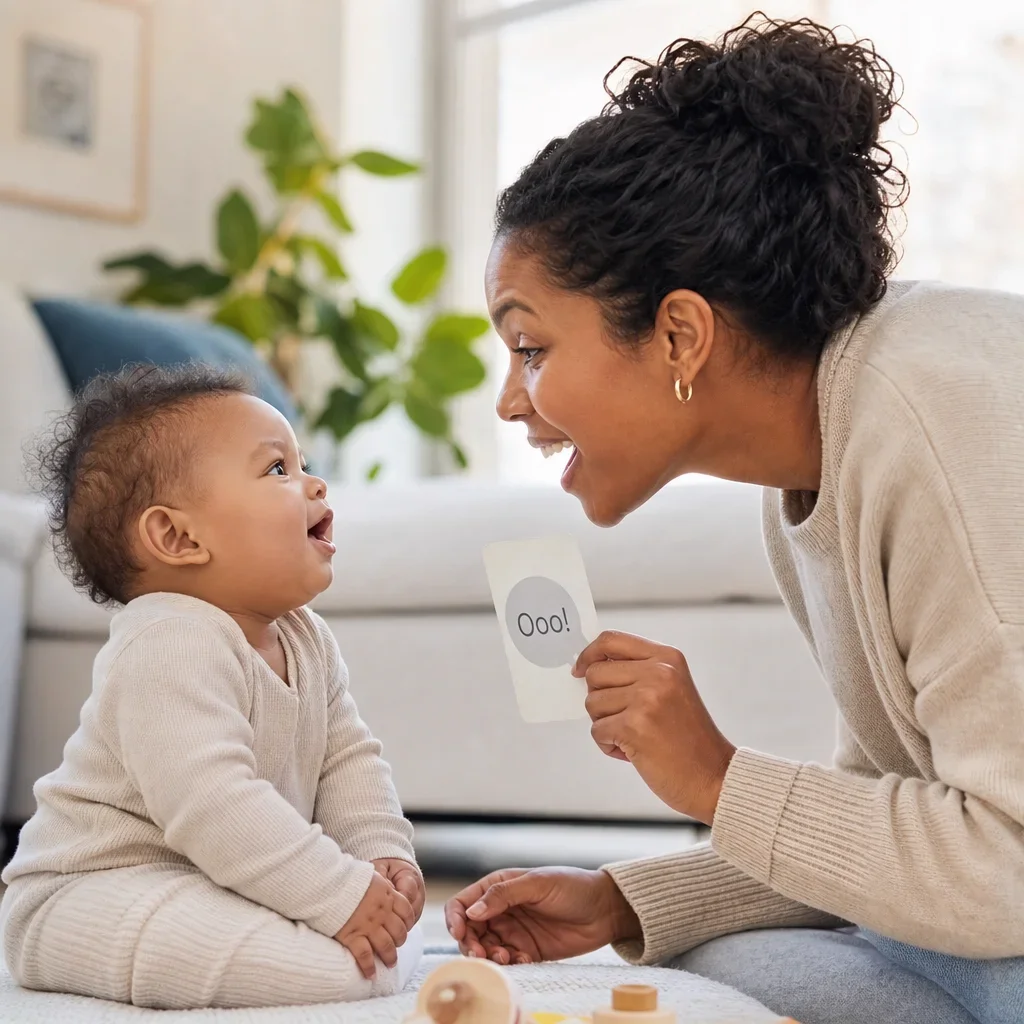
Language development during infancy grows through repeated, responsive interaction. Babies hear voices, watch faces, connect sounds with actions, and learn that their noises, looks, and gestures change what happens next.
Serve-and-return interaction is one of the clearest ways to picture this. A baby coos, looks, kicks, or points. The adult notices it, answers, labels it, and pauses. Then the baby responds again. That back-and-forth is how infant language learning is built in daily life.
The usual order is broad and overlapping rather than rigid. Children often move from crying and body cues, to cooing, to babbling, to gestures, to first words, to combining words, while receptive language often grows ahead of expressive language.
Speech vs language, and receptive vs expressive language
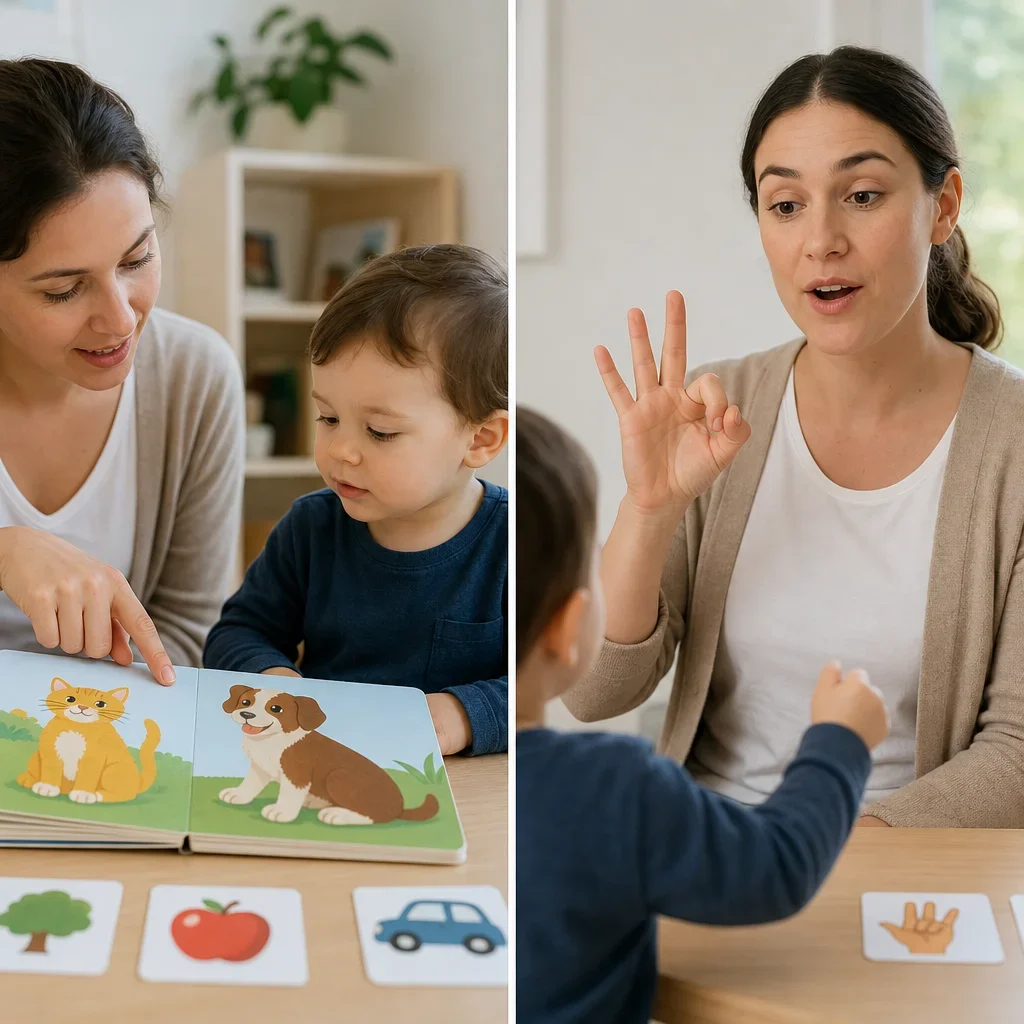
Speech refers to how sounds are made. Language refers to understanding and using words, ideas, and grammar. A child can have clear speech sounds but limited language, or strong understanding with unclear speech.
Receptive language is what a child understands. Expressive language is what a child communicates through sounds, words, signs, or gestures. In infant speech development, it is common for receptive skills to come before expressive skills.
A child who understands more than they can say is not automatically showing a problem. It does mean we should look at the whole picture, including gestures, play, imitation, social connection, and steady progress over time.
When is a child a late talker?
Late talker usually means a child is slower to use spoken words than expected, while other areas may look more typical. It is a descriptive term, not a diagnosis.
Some late talkers make strong gains over time. Some need support. That is why watching understanding, gestures, play, hearing, and social communication matters more than waiting for words alone.
Late talking does not automatically mean low intelligence. It also does not tell you, on its own, why speech is late. A bigger concern is when limited talking appears together with weak understanding, no pointing, little pretend play, poor response to name, or loss of skills.
Speech delay, language delay, hearing concerns, or autism-related communication differences
These areas can overlap in early childhood, and a web page cannot diagnose the reason. The safest approach is to notice the pattern and bring concerns to your child’s doctor, an audiologist, or a speech-language pathologist.
| Pattern you notice | What it may suggest more strongly | Why follow-up matters |
|---|---|---|
| Child wants to communicate but speech sounds are hard to understand | Speech sound issue may be part of the picture | Speech clarity and sound use can be assessed |
| Child says few words and also seems to understand little | Broader language delay may need review | Both receptive and expressive language matter |
| Child does not respond consistently to sound, voice, or name | Hearing should be considered | Hearing supports speech and language learning |
| Child rarely points to share interest, has limited back-and-forth interaction, or loses social communication skills | Social communication differences need professional review | Patterns across communication and play matter |
No single sign proves autism, hearing loss, or any other condition. If your child does not babble, point, or respond to their name, the next step is not online guessing. The next step is timely professional follow-up.
Hearing and communication: think beyond speech alone
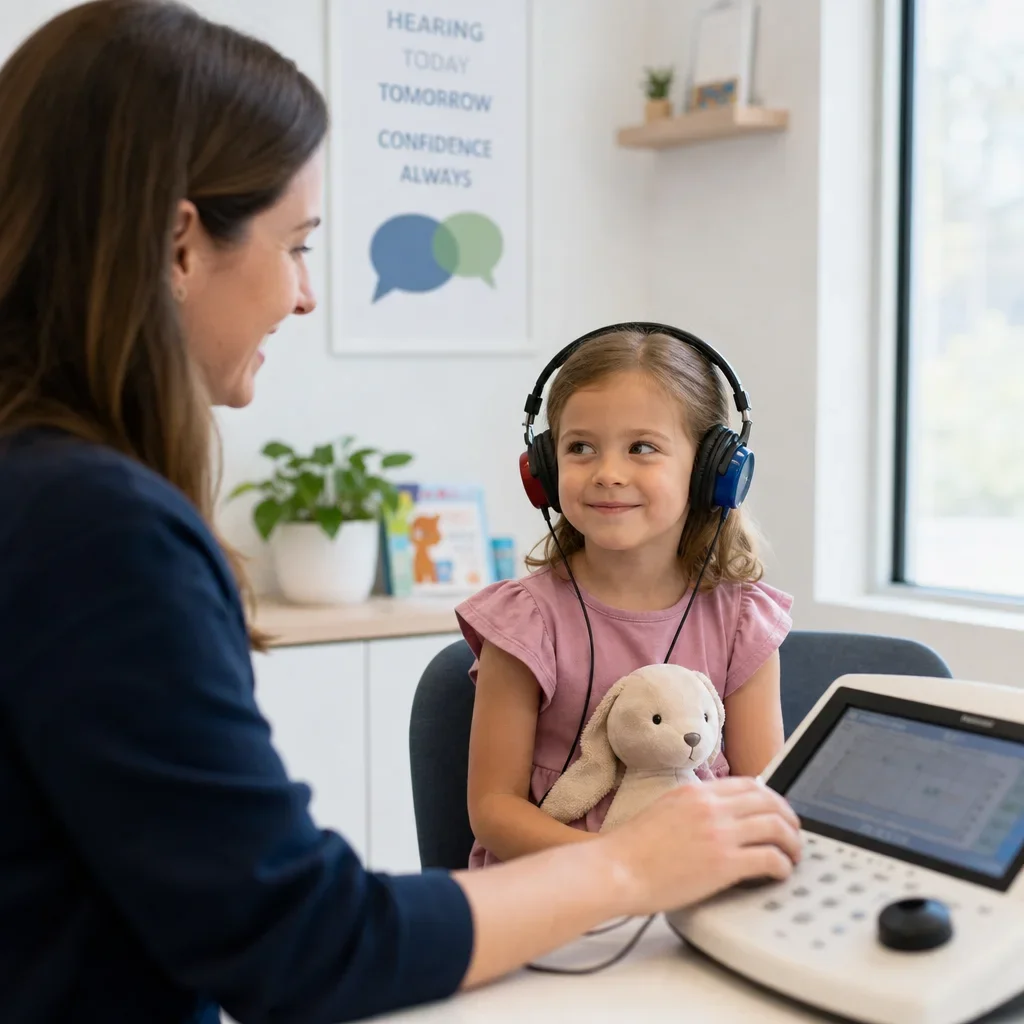
Hearing is part of infant speech and language development because children learn from what they hear around them. If sound is not getting in clearly or consistently, language growth may also be affected.
Signs parents may notice include not startling to sound, not turning toward voices, not noticing familiar sounds, or seeming to hear sometimes but not others. Those patterns do not confirm a hearing problem, but they do belong in the conversation.
Repeated ear infections are also worth mentioning to your child’s doctor if language progress is a concern. The important point is simple: when communication milestones are delayed, hearing should be considered rather than speech alone.
How to support infant language development at home
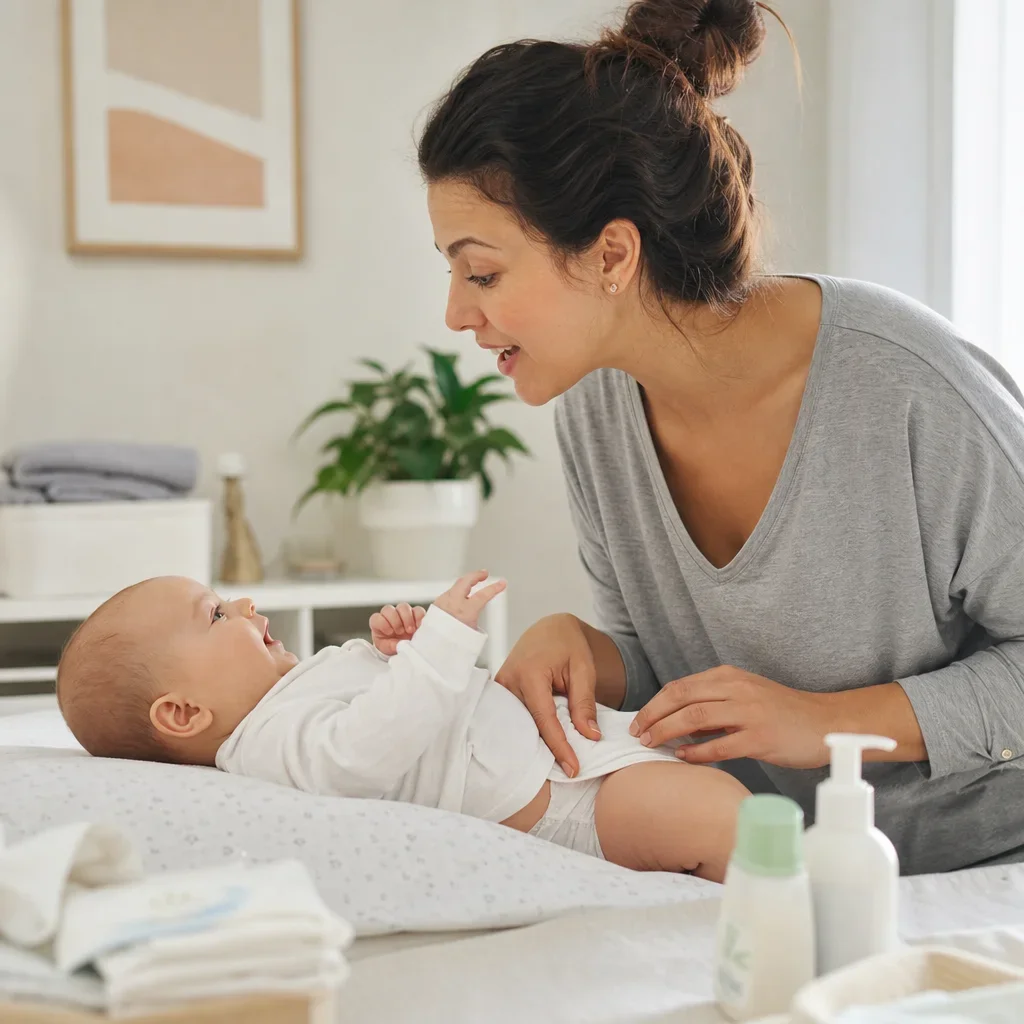
The most effective support is responsive interaction woven into ordinary routines. You do not need special flashcards or long lessons. You need frequent, face-to-face moments that connect words with real life.
With newborns and young infants, use eye contact, simple facial expressions, sing short songs, and copy your baby’s sounds. During diapering, feeding, and bath time, name what is happening with short phrases such as “warm water,” “wipe feet,” or “milk is coming.”
With older infants, follow your child’s focus. If your baby looks at a dog, say “dog,” “big dog,” or “dog running.” Pause after you speak. That pause gives room for a look, sound, smile, or gesture back.
With young toddlers, expand what they say without forcing repetition. If your child says “ball,” you can say “red ball” or “roll ball.” In language development in infancy and toddlerhood, short expansions help children hear the next step clearly.
With older toddlers, use routines that repeat every day. At meals, name foods, actions, and choices. During dressing, label body parts and clothing. On stroller walks, notice vehicles, people, weather, and sounds. Repetition in real contexts supports infant language learning better than isolated drilling.
Books, songs, gestures, and play that build language
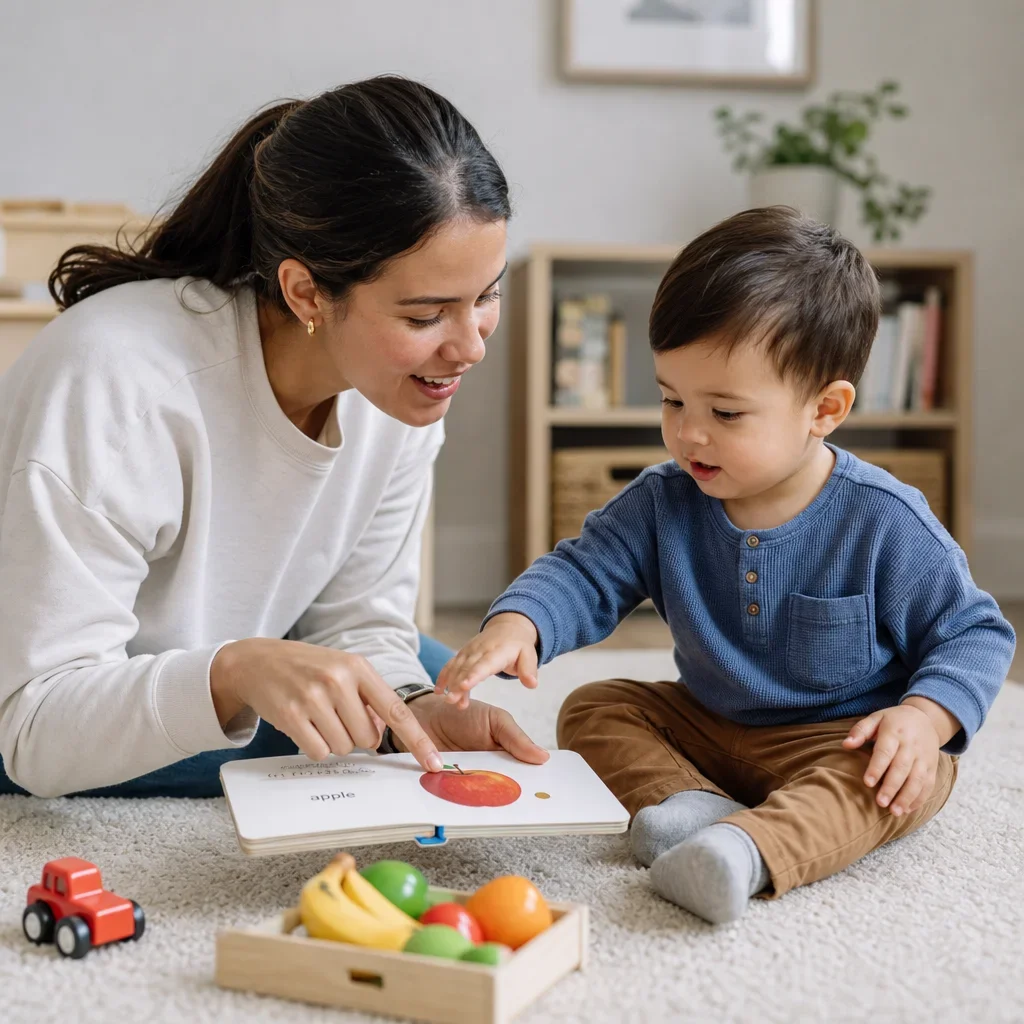
Books work best when they are interactive. Point to one picture, label it, pause, and let your child react. Repetition is useful, so reading the same board book again is not a problem. It is practice.
Songs and rhymes support rhythm, sound patterns, and turn-taking. Finger plays, action songs, and repeated lines give children a predictable place to join in with a look, motion, sound, or word.
Play builds more than nouns. Toy food can support action words like eat, cut, stir, and pour. Dolls can support body words, routines, and social phrases. Cars can support go, stop, fast, in, out, and under.
Pretend play becomes more important through the toddler years. Feeding a doll, washing a toy cup, or putting a bear to bed gives children language tied to meaningful actions. In a Montessori setting, we also use real objects and practical life routines because children learn language best when it connects to what they can see and do.
Does baby sign help? What about bilingual or multilingual homes?
Simple signs can support infant communication milestones when they are used alongside spoken language. Signs like “more,” “milk,” “all done,” “eat,” or “help” can give a child another way to express a need before speech is easy.
Baby sign is not required, and it does not replace talking with your child. The helpful part is the pairing: adult says the word, uses the sign, and responds consistently in context.
Bilingual or multilingual exposure does not automatically cause delay. Children can learn more than one language at the same time, and families do not need to avoid their home language to support communication development in infants.
If your child hears more than one language, count meaningful words across languages when you discuss progress. The best language to use at home is the one your family uses most naturally and most responsively.
Screen time, environment, and caregiver interaction
Live interaction teaches language more directly than passive exposure. Babies and toddlers learn from faces, timing, shared attention, and turn-taking, which screens do not provide in the same way.
The useful shift is not guilt. It is replacement. A few minutes of singing during diaper changes, talking in the car, naming foods at meals, or reading before bed gives language development during infancy many more chances to grow.
A language-rich environment does not need to be noisy or complicated. It needs real conversation, repetition, responsive pauses, and adults who notice what the child is trying to communicate.
When to seek professional help and what happens next
Seek help earlier when you notice several concerns together, or when your child loses skills at any age. Starting with your family doctor or pediatrician is reasonable, and hearing should be part of the discussion if responses to sound seem inconsistent.
A speech-language assessment often includes parent questions, play-based observation, understanding, gestures, social interaction, and sound use. The clinician is not only listening for words. They are looking at the whole communication system.
It helps to bring concrete examples. Note whether your child babbles, points, follows simple directions, responds to name, uses gestures, says any words, combines words, and reacts to sound. Videos from home can also help you describe what you are seeing.
If you are in Ontario and need the right local next step, contact your child’s doctor or a registered speech-language pathologist. If your concern includes hearing, ask whether an audiology referral makes sense.
How early communication connects to preschool learning
Early communication supports everyday participation. Children use it to express needs, join play, follow simple directions, enjoy books, and take turns with others.
That does not mean there is one perfect milestone timeline. It means language development in infancy and early childhood is built through daily life, not only through formal teaching.
In our licensed Montessori daycare in Vaughan and Bolton, we support early communication through songs, books, one-on-one interaction, practical life activities, and consistent routines. Our Infant program serves about 6-18 months at a 1:3 ratio , Pre-Casa serves about 18-30 months at a 1:5 ratio , and Casa serves about 30 months to 6 years at a 1:8 ratio . Those small licensed ratios give educators more room to observe, respond, and support communication during the day.
FAQ: common parent worries about infant language development
What are typical baby speech milestones? Typical infant communication milestones move from crying and eye contact to cooing, babbling, gestures, first words, and then short word combinations. The exact timing varies, but steady progress across several areas matters most.
How many words should a 12 month old baby be saying? Some 12-month-olds have a few words, and some are just beginning. At this age, gestures, response to name, shared attention, and understanding familiar routines matter too.
What is considered a late talker? A late talker is usually a child who is slower to use spoken words than expected but may otherwise seem to be developing more typically. It is a description, not a diagnosis.
At what age is speech delay a concern? Concern depends on the whole pattern, not one number. No babbling in the later part of the first year, no pointing around 12 months , no words by the middle of the second year , no 2-word combinations by around 24 months , or any loss of skills deserve timely follow-up.
What is the red flag for language delay? Red flags include weak understanding, no gestures, no pointing, very limited attempts to communicate, or loss of words or social interaction. Patterns matter more than one isolated behaviour.
What is the red flag for speech delay? A child may have a speech concern when they want to communicate but use very few sounds, are very hard to understand for age, or show little progress in producing new sounds or words. A full evaluation looks at speech and language together.
Is it normal for a 2 year old to not say any words? No words at 24 months is a stronger concern and should be discussed with a doctor and a speech-language professional. Hearing should also be considered.
Is it normal for a 2.5 year old not to talk? Very limited or absent spoken language at 30 months deserves prompt professional follow-up. The goal is not to label the child online. It is to understand what support or assessment is needed.
How can I help my baby develop speech and language skills? Talk during routines, follow your child’s lead, pause for responses, imitate sounds, read simple books, sing repetitive songs, and use real-life words in real moments. Short, frequent interactions work well.
Does bilingual exposure delay language development? No, bilingual exposure does not automatically delay language. Count meaningful words across languages and use the languages your family speaks most naturally.
Does baby sign help infants communicate? It can help some children express needs earlier when signs are paired with spoken words. It should be used with speech, not instead of speech.
How do I know if my child is speech delayed or autistic? You cannot know that from one sign or from a checklist alone. If concern includes speech plus limited gestures, weak response to name, little shared attention, unusual play, or loss of skills, seek professional evaluation rather than trying to sort it out online.
What should I do if my child does not babble or point? Bring it up promptly with your child’s doctor and ask whether speech-language and hearing follow-up are appropriate. No babbling and no pointing are both important communication signs.
If you want to see how early communication is supported through daily routines, books, songs, and one-on-one interaction, the best next step is to visit and see the classroom. We welcome families in Vaughan, Bolton, and across the GTA to contact the centre and ask about Infant, Pre-Casa, or Casa availability for your child’s age group.