
How do babies actually learn in the first year? Cognitive development in infants 0 12 months is simpler than the jargon makes it sound. It is how babies notice, remember, explore, and begin to solve very small problems through daily experience.
What cognitive development in infants means
Cognitive development during infancy means learning through attention, memory, exploration, cause and effect, and early problem solving. In plain language, cognition in infants includes recognizing a familiar face, turning toward a voice, expecting part of a routine, or trying again to reach a toy.
Cognitive development happens through the senses, movement, repetition, and responsive care. Babies learn by seeing, hearing, touching, mouthing, reaching, kicking, and repeating actions that get a result.
Cognitive growth overlaps with language and social development, but it is not the same thing. A baby who babbles is showing language development, a baby who smiles back is showing social-emotional development, and a baby who looks for a hidden toy is showing cognitive development.
Development is gradual across infancy and toddlerhood, not a pass-or-fail test on one date. The best way to read cognitive milestones for infants is as common patterns over time, not promises about one specific child.
A quick note on stages: where infancy fits in cognitive development
Infancy fits mainly within Piaget’s sensorimotor stage, which runs from birth to about age 2 years. This stage is described as learning through the body and senses rather than through abstract thinking.
Birth and infancy intellectual development are easiest to understand through what you can see. Babies watch, listen, reach, mouth objects, repeat actions, and test what happens next.
The first period of cognitive development is not about worksheets or flashcards. It is about real experiences, safe exploration, and an adult who notices the baby’s cues and responds.
Cognitive development of a newborn: what parents may notice in the first 0 to 2 months
The cognitive development of a newborn starts with attention, sensory learning, and recognition within the first 0 to 2 months. Newborns do not solve problems the way older babies do, but they do take in patterns, voices, touch, light, and routines.
A newborn may pause at a familiar voice, stare at a caregiver’s face during feeding, or react to a change in sound. Those are early cognitive changes in infancy because the baby is taking in information and beginning to recognize repeated experiences.
The cognitive development of newborn babies often shows up as brief visual attention and early tracking of nearby movement. Parents may notice the baby looking at a face, a window’s light contrast, or a slow-moving object held close.
Newborn learning is built through repetition during ordinary care. Feeding, diapering, rocking, and face-to-face time give the baby repeated chances to hear the same voice, feel the same touch, and begin building memory for familiar patterns.
Infant cognitive milestones by age: 0 to 12 months checklist
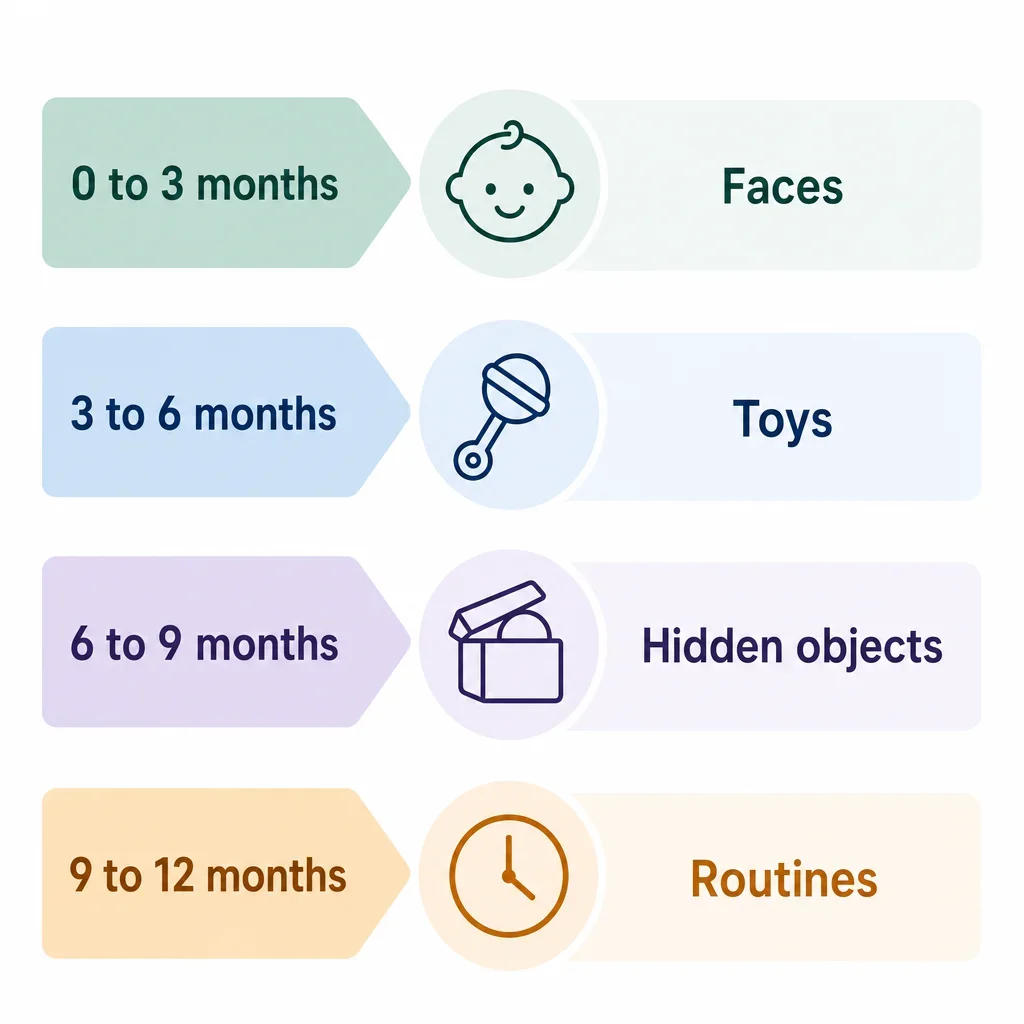
The clearest way to understand cognitive development examples for infants is to look at age bands from 0 to 3 months, 3 to 6 months, 6 to 9 months, and 9 to 12 months. These are common examples, not strict deadlines.
| Age band | What baby may notice | How baby learns | What parents may observe | Simple support ideas |
|---|---|---|---|---|
| 0 to 3 months | Faces, voices, light, movement | Sensory experiences and repeated routines | Watches faces, quiets to a familiar voice, tracks some movement, studies hands | Face-to-face talking, songs, contrast images, supervised tummy time |
| 3 to 6 months | Toys, sounds, familiar games, repeated actions | Reaching, grasping, repetition, early cause and effect | Reaches for objects, gets excited before a familiar game, repeats actions for a result | Rattles, mirror time, textured toys, simple peekaboo |
| 6 to 9 months | Hidden objects, dropped items, action-result patterns | Trial and error, floor exploration, object play | Looks for a toy, lifts a cloth, drops objects to watch what happens | Hide-and-find, container play, safe floor exploration |
| 9 to 12 months | Familiar routines, locations, simple problems | Memory, imitation, experimenting with different actions | Searches for hidden items, copies clapping, puts items in and out, tries more than one way | Nesting cups, action songs, simple object hunts |
0 to 3 months: early attention, sensory learning, and recognition

From 0 to 3 months, early cognitive development in infancy is mostly about attention and recognition. Babies often learn by watching a face, responding to a voice, noticing movement, and settling into repeated routines.
One of the best cognitive examples for infants in this age band is quieting when a familiar routine begins. A baby may relax when picked up in a familiar way, turn toward a parent’s voice, or stare at a face during feeding.
Support at this stage should stay simple and slow. Face-to-face talking, singing, supervised tummy time, and gently moving a safe object across the baby’s field of view all give the brain repeated information to process.
3 to 6 months: exploration, anticipation, and cause and effect beginnings

From 3 to 6 months, babies often begin connecting actions with outcomes. This is an early form of cognitive learning for infants, sometimes called cause and effect in plain language.
A baby in this stage may kick to make something move, shake a toy for sound, or show excitement before a familiar song reaches the favourite part. These are signs that the baby is beginning to expect what comes next.
Play works best when it is repetitive and interactive. Rattles, textured objects, mirror time, simple peekaboo, and songs with pauses help babies notice that their actions and other people’s actions lead to predictable results.
6 to 9 months: object permanence starts to emerge

From 6 to 9 months, object permanence often begins to emerge. Object permanence means a baby starts understanding that a person or object still exists even when it is out of sight.
Parents often notice this when a baby looks for a dropped spoon, lifts a cloth to find a toy, or leans to see where something went. This is one of the most recognized cognitive development examples in infants because it shows memory and mental representation starting to work together.
Activities in this stage should invite safe searching and trial and error. Hide-and-find games, container play, cause-and-effect toys, and supervised floor exploration all give babies a reason to test ideas and repeat actions.
9 to 12 months: memory, imitation, and simple problem solving
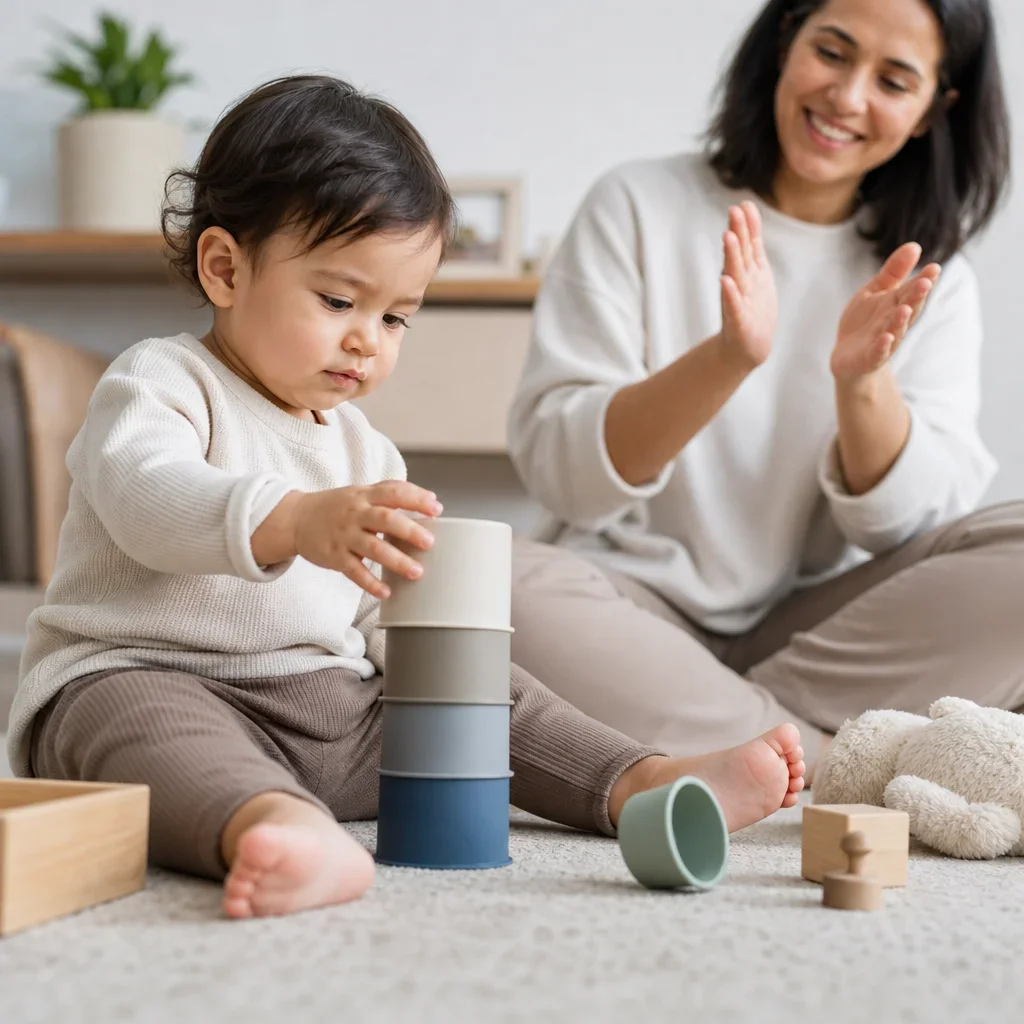
From 9 to 12 months, babies often show stronger memory, more imitation, and simple problem solving. They may search for hidden objects, copy clapping, put objects into containers, and try different ways to reach something they want.
A strong example of cognitive development in babies at this stage is using more than one action to solve a simple problem. A baby may crawl around a cushion for a toy, pull a cloth closer, or open a container after trying a first approach.
Support works best when daily routines and play stay predictable but flexible. Nesting cups, action songs, simple baby-safe puzzles, object hunts, and safe household exploration can all support this stage.
Examples of cognitive development in infants parents can observe at home
Real-life examples of cognitive development in infancy are easiest to spot during ordinary routines. Parents usually see cognition in infants during feeding, play, bath time, walks, and bedtime.
- During feeding, a baby may stare at a parent’s face or calm when the routine begins. This may show recognition and early memory.
- During play, a baby may study their hands or repeat a movement with a toy. This may show attention and cause-and-effect learning.
- During meals, an older infant may drop a spoon again and again. This may show experimentation rather than mischief.
- During bath time, a baby may splash to repeat a sound or reaction. This may show learning through action and result.
- During a stroller walk, a baby may watch shadows, trees, or passing light. This may show sensory attention and pattern noticing.
- At bedtime, a baby may respond before the usual song or sleep routine finishes. This may show memory for routine cues.
Cognitive vs language vs social-emotional milestones: how to tell the difference
Parents often feel less confused when these three areas are separated clearly. Cognitive development in infancy and early childhood is about thinking and learning, language is about understanding and using communication, and social-emotional development is about relationships, expression, and shared interaction.
| Domain | What it includes | Example |
|---|---|---|
| Cognitive | Attention, memory, cause and effect, problem solving | Looking for a hidden toy |
| Language | Babbling, listening, understanding words, early gestures | Babbling back during conversation |
| Social-emotional | Attachment, smiling, eye contact, shared enjoyment | Smiling back at a caregiver |
One activity can support more than one area at the same time. Peekaboo can support cognitive development through object permanence, language through turn-taking sounds, and social-emotional growth through shared delight.
What helps infant cognitive development
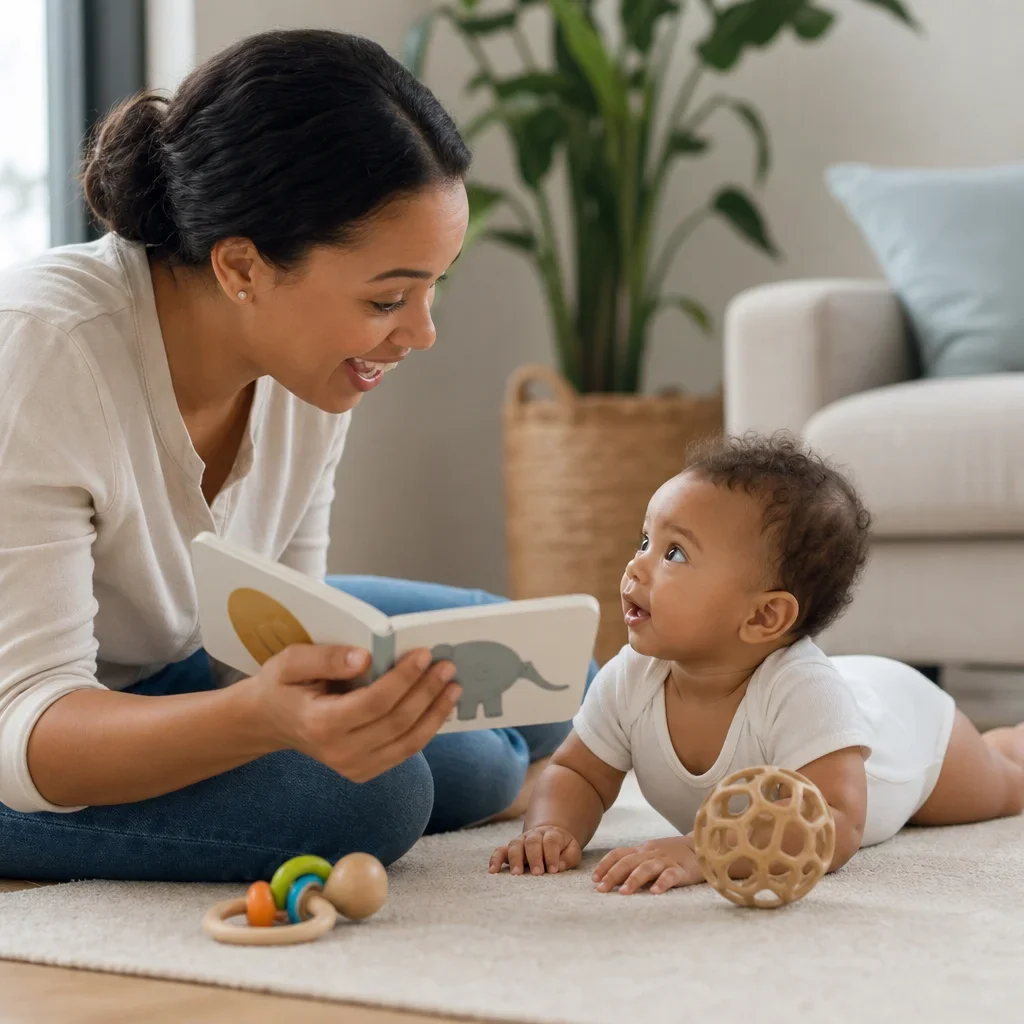
The strongest support for cognitive development during infancy is responsive interaction. When an adult notices the baby’s cue, responds, and repeats the exchange, the baby gets practice with attention, expectation, memory, and communication.
Talking, singing, naming objects, and reading simple books give babies repeated language and sensory patterns. These are useful forms of cognitive learning for infants because they connect sound, rhythm, faces, and objects over time.
Safe floor time supports learning because movement changes what a baby can notice and reach. Babies learn differently when they can roll, pivot, reach, sit, crawl, and explore within a supervised space.
Repetition and predictable routines help babies organize experience. Feeding, diapering, songs, and bedtime rituals create a sequence the baby begins to recognize and remember.
Overstimulation is not necessary for learning. A calm space, a few simple materials, and warm adult attention often support better observation and engagement than constant noise or too many toys at once.
Simple cognitive activities for infants by age
The best cognitive activities for babies are low-cost, short, and repeated. Each age band benefits from simple materials, close supervision, and stopping when the baby shows they need a break.
For 0 to 3 months, try 4 simple activities: face-to-face talking, black-and-white contrast cards, slow song routines, and supervised tummy time with an adult nearby. These help with attention, recognition, and sensory learning.
For 3 to 6 months, try 4 simple activities: rattles, mirror play, textured fabric exploration, and pause-and-wait songs. These help babies connect action with sound, sight, and response.
For 6 to 9 months, try 4 simple activities: cloth-over-toy games, container play, rolling a ball back and forth, and supervised exploration on the floor. These help with searching, object permanence, and trial-and-error learning.
For 9 to 12 months, try 5 simple activities: nesting cups, putting objects in and out, simple imitation games, object hunts, and action songs with gestures. These help with memory, imitation, and simple problem solving.
Safety matters more than complexity. Household items should be clean, too large to choke on, and used only with active supervision.
Parent-friendly cognitive goals for infants
Useful cognitive goals for infants are broad developmental aims, not strict targets for one exact week. They help parents focus on what the first year is for.
A practical set of 5 cognitive goals for infants includes noticing people and patterns, learning that actions have results, remembering familiar routines, exploring safely, and beginning simple problem solving. These goals fit the full arc of cognitive development in infancy 0 2 years, even though the article focuses on the first 12 months.
These goals work best as observation guides. They tell you what kind of learning is unfolding, not whether a baby has passed or failed.
What if my baby is not doing this yet?

One missed milestone does not automatically mean a delay. The more useful question is whether the baby is making progress over time, showing interest in people or surroundings, and building skills across more than one routine.
A simple decision path can help. First, observe for a short period such as several days to a few weeks and write down specific examples. Second, consider whether prematurity, illness, poor sleep, or a recent change in routine may be affecting what you are seeing.
If the concern is mild and the baby is still progressing, bring your notes to the next medical visit. If several areas seem affected, or if a skill that was present has been lost, seek medical advice sooner rather than waiting.
Prematurity can shift how milestones are viewed in the early months. For babies born early, clinicians often use corrected age rather than birth date when reviewing development.
Early signs of possible cognitive concerns
Possible warning signs are patterns that deserve attention, not proof of a problem. The safest approach is to notice repeated concerns and discuss them with a qualified health professional.
Examples can include limited interest in faces or surroundings over time, very little response to sound or voice, difficulty tracking movement as months pass, little curiosity during play, or not using both hands to explore as expected for the baby’s overall development. Hearing, vision, motor, sleep, and medical issues can also affect how cognitive skills appear.
Loss of previously seen skills is more urgent than simple variation. If a baby used to do something consistently and no longer does it, prompt medical advice is the right next step.
What can affect cognitive development in infants
Cognitive development in infancy and toddlerhood can be influenced by many factors, and not all of them are within a parent’s control. Broad factors include prematurity, birth complications, hearing or vision differences, genetic factors, chronic medical conditions, severe stress, sleep difficulties, nutrition concerns, and limited chances for back-and-forth interaction.
Cause is not something parents should try to diagnose on their own. If concerns continue, a doctor or nurse practitioner can help sort out whether the issue appears cognitive, sensory, motor, medical, or a mix of several areas.
When to talk to a pediatrician or other professional
The right time to ask for help is whenever a concern keeps repeating or your instinct tells you something is off. Parents do not need to wait for certainty before bringing a question to a pediatrician, family doctor, nurse practitioner, or public health provider.
Specific notes make the conversation more useful. Bringing 3 to 5 examples of what you are seeing, and when it happens, helps a professional understand the pattern better than a general statement like “something seems wrong.”
Videos can also help when a behaviour is hard to describe. If concerns continue, a health professional may suggest developmental screening, follow-up observation, or referral for further assessment.
How infant cognition connects to later learning
Early cognition matters because attention, memory, exploration, and simple problem solving become the groundwork for later learning. This does not mean one infant milestone predicts a fixed future outcome, but it does mean the first year gives children repeated chances to build learning habits through everyday experience.
In a Montessori infant setting, we think about this in practical terms. We prepare calm spaces, observe how each child explores, and support repeated hands-on experiences rather than rushing children through activities. In our Infant program, children are typically 6 to 18 months and the ratio is 1:3, which gives staff time to respond closely to cues, routines, and early exploration.
Licensed infant care should also be concrete about qualifications and structure. At Cozy Time Montessori Academy, our Infant, Pre-Casa, and Casa programs run from 6 months to 6 years, with ratios of 1:3, 1:5, and 1:8. Our team includes ECEs, Montessori teachers, and assistants, all with First Aid/CPR certification and criminal record checks.
FAQ
What is cognitive development during infancy?
It is the development of attention, memory, recognition, cause and effect, and early problem solving during the first year.
Do babies have cognition?
Yes. Babies show cognition from birth by noticing voices, faces, touch, patterns, and repeated routines.
What are cognitive milestones for infants?
They are common signs of learning, such as tracking movement, recognizing familiar people, repeating actions for a result, looking for hidden objects, and copying simple actions.
What cognitive development do newborns have?
Newborns show early attention to faces, voices, sound changes, light contrast, and repeated caregiving routines in the first 0 to 2 months.
What are examples of cognitive development in infants?
Examples include calming to a familiar voice, watching a face, dropping a spoon to see what happens, lifting a cloth to find a toy, and copying clapping.
What are some cognitive activities for infants?
Good activities include face-to-face talking, songs, rattles, mirror play, peekaboo, hide-and-find games, container play, and simple imitation games.
What is object permanence and when does it appear?
Object permanence is the understanding that something still exists when it is out of sight. It often begins to emerge around 6 to 9 months.
How can I tell if my baby may have cognitive issues?
Look for repeated patterns rather than one missed skill. Ongoing limited interest in surroundings, very little response to voices or movement, or loss of skills should be discussed with a health professional.
What if my baby is not doing a milestone yet?
Observe for several days to a few weeks, write down specific examples, consider recent changes or prematurity, and bring the concern to a medical visit. Seek earlier advice if skills are lost or several areas seem affected.
How does prematurity affect infant milestones?
Prematurity can shift early expectations. Health professionals often use corrected age when reviewing milestones in babies born early.
If you are choosing infant care in Vaughan or the GTA, the best next step is to visit and see how the room works. We are always happy to explain our Infant program, daily routines, caregiver interaction, and how a licensed Montessori daycare supports safe early exploration. Contact the centre to confirm availability for your child’s age group.