
Parents often worry that crying, clinginess, or stranger wariness means something is wrong. Emotional development in infants usually starts with simple communication and caregiver support, then grows from birth to 3 years through daily relationships, routines, and repeated comfort.
Emotional Development in Infants at a Glance
Emotional development in infants means learning to feel, express, recognize, and gradually regulate emotions with adult help. Social development sits alongside it and includes bonding, eye contact, shared attention, imitation, and early play from birth to 3 years.
Emotional development during infancy does not begin with self-control. It begins at birth with body cues, crying, calming, gaze, and growing trust in familiar adults.
Emotional and social development in infancy and toddlerhood unfold in a range, not on one exact date. A milestone chart is most useful as a pattern from birth to 36 months, not as a test your child must pass on a specific day.
This guide covers emotional development in newborns, baby emotional development month by month, toddler social-emotional growth, everyday examples, support strategies, and signs that deserve follow-up. If you are concerned about your own child, the best next step is to speak with your pediatrician, family doctor, or public health nurse.
Age-by-Age Emotional and Social Milestones: Newborn to 3 Years
The clearest way to understand emotional development 0 12 months and beyond is to look at age bands. These ranges are typical windows, not fixed deadlines.
| Age band | Emotional changes | Social changes | Everyday example | Normal variation vs possible concern |
|---|---|---|---|---|
| Newborn-2 months | Cries to signal needs, calms with support, shows interest or startle | Brief eye contact, prefers familiar voice or touch, quiet alert periods | Quiets when held or when hearing a familiar voice | Variation: some babies are more alert, some need more recovery time. Concern: very limited response to caregivers or almost no social engagement over time. |
| 2-4 months | Social smile emerges around 6 weeks to 2-3 months, easier calming with help | Longer eye contact, cooing back-and-forth, reciprocal facial expressions | Smiles when a caregiver leans in and talks | Variation: smiling can build gradually. Concern: no social smile by the end of this window may deserve follow-up. |
| 4-6 months | Laughter often appears around 3-5 months, excitement and frustration become clearer | Enjoys face-to-face games, watches caregiver reactions, stronger preference for familiar people | Laughs during peek-a-boo or a repeated song | Variation: some babies laugh later than they smile. Concern: very little shared enjoyment or back-and-forth interaction. |
| 6-9 months | Joy, frustration, and fear become more distinct, stranger wariness may begin around 5-6 to 8-10 months | Social referencing starts, stronger attachment behaviours, interest in simple games | Looks at a parent before approaching a new person | Variation: some babies are bold, some are slow to warm. Concern: little comfort-seeking or very limited response to familiar adults. |
| 9-12 months | Separation protest often increases around 8-10 to 9-12 months, comfort-seeking grows | Joint attention emerges, imitation increases, clear preferences for people and routines | Brings a toy over to share attention or points to something interesting | Variation: clinginess often rises during transitions. Concern: no shared attention, no back-and-forth gestures, or loss of earlier social skills. |
| 12-18 months | Independence and clinginess can alternate, tantrums may begin, affection becomes more intentional | Follows simple social routines, shows early empathy, checks caregiver reaction | Hugs a familiar adult or looks concerned when someone cries | Variation: big feelings are common. Concern: limited interest in caregivers or very little social reciprocity. |
| 18-24 months | Big feelings, frustration, pride, and defiance become more visible | Parallel play grows, self-awareness increases, early empathy signs often emerge around 18-24 months | Says “no,” then comes back for comfort a minute later | Variation: mood shifts can be fast at this age. Concern: no comfort-seeking, no imitation, or loss of language or social skills. |
| 24-36 months | Names some feelings, self-conscious emotions become more visible, regulation is still developing | More peer interest, pretend play, beginnings of turn-taking and cooperative moments | Says “I’m sad” or offers a toy to an upset child | Variation: parallel play is still common. Concern: very limited social interaction, no pretend play, or major loss of previous abilities. |
Emotional Development in Newborns: What Happens in the First Weeks
Emotional development in newborns is mainly about regulation with caregiver support, not self-control. In the first weeks after birth, babies show discomfort, contentment, interest, and overload through crying, facial expression, body tension, sucking, sleep-wake states, and settling when helped.
Newborn crying is communication, not manipulation. A newborn cannot plan behaviour in that way, and responsive care in the first 0-2 months helps the baby feel organized and safe.
Early emotional development in newborns is shaped by familiar voice, scent, feeding, holding, and repeated soothing patterns. A baby may quiet when held chest-to-chest, turn toward a known voice, or become overstimulated by bright light, noise, or too much handling in a short period.
Reflex smiles and social smiles are not the same thing. Reflex smiles can appear early in the newborn period, while a true social smile usually appears around 6 weeks to 2-3 months in response to a face or voice.
How Babies Show Emotions: Everyday Examples Parents Can Recognize
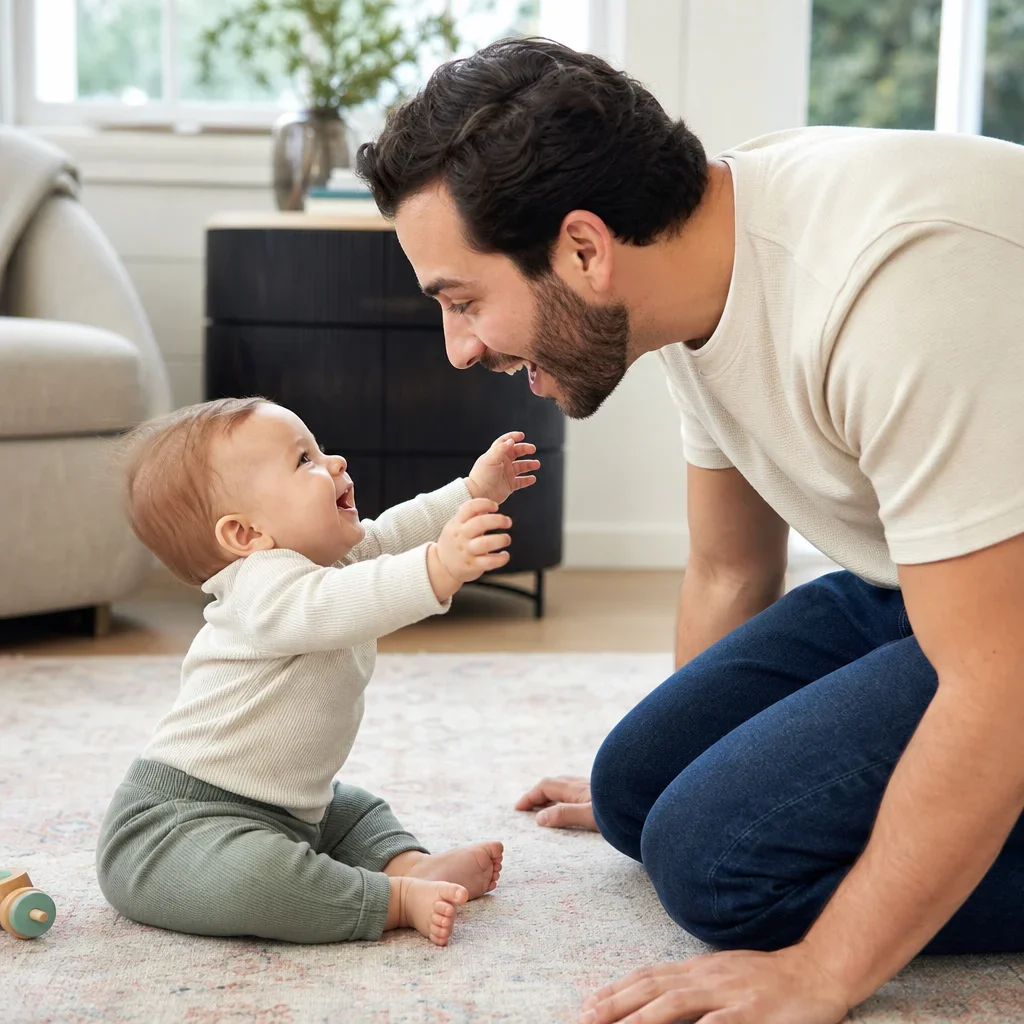
Emotional development in infants examples are usually easy to see once you know the cues. In the first year, joy may look like smiling when you approach, squealing during play, or laughing at a repeated game.
Distress has clear body-based signs in emotional infancy. A baby may cry when hungry, arch away when overstimulated, turn the head from too much input, or fuss during a hard transition like leaving a busy room.
Attachment shows up in specific social-emotional behaviours from 6-12 months. A baby may reach up to be held, calm faster with a familiar adult, or check back visually in a new space before moving farther away.
Fear and wariness are part of emotional changes in infancy. A baby may hide the face, cling to a caregiver, stare quietly at a stranger, or cry in an unfamiliar setting, especially from about 6-12 months.
Social growth becomes easier to recognize over time. A baby may imitate sounds, take turns in babble, point to share interest near the end of the first year, or bring an object to a caregiver to say, in effect, “Look at this with me.”
Toddler emotional development adds more intention and more complexity from 12-36 months. A toddler may say “mine,” insist on doing something alone, name simple feelings, or show concern when another child cries.
Social vs Emotional Development in Infancy: What’s the Difference?
Emotional development is about feelings and how a child expresses and later regulates them. Social development in infancy is about connection with other people through eye contact, imitation, shared attention, play, and relationship-building from birth onward.
These two areas grow together because babies learn emotions in relationships. A baby cries for comfort emotionally and seeks a caregiver socially at the same time.
A side-by-side view makes the difference easier to see.
| Area | What it includes | Example |
|---|---|---|
| Emotional | Feeling, expressing, and gradually regulating emotions | Crying when overwhelmed, smiling with delight |
| Social | Connecting, communicating, and sharing attention with others | Looking at a parent, imitating a sound, offering a toy |
| Overlap | Emotional experiences that happen inside relationships | Smiling back at a caregiver, seeking comfort when upset |
Birth and infancy social development often starts with gaze, calming, and turn-taking rather than play with peers. Social emotional development in infants is relational from the start, even before words appear.
When Key Emotional Milestones Usually Appear
Parents usually ask about timing for a few specific milestones, and ranges are more accurate than single dates. Social smiling often appears around 6 weeks to 2-3 months.
Laughter often begins around 3-5 months. It may start as a quiet chuckle and build with repeated face-to-face games.
Stranger wariness often appears around 5-6 months to 8-10 months. It may look like staring, hiding the face, clinging, or crying with unfamiliar adults.
Separation anxiety usually begins around 8-10 months to 9-12 months. It often shows up at drop-off, bedtime, or when a familiar adult leaves the room.
Joint attention usually appears in the later part of the first year. That means a baby looks at an object, then back at you, to share the same focus.
Mirror self-recognition often appears around 15-24 months. Before that, babies may enjoy the reflection without understanding that the image is “me.”
Early empathy signs often emerge around 18-24 months. A toddler may look worried when someone cries, pat a parent, or bring a comfort object.
Pride, embarrassment, guilt, and shame become more visible in late toddlerhood and the preschool years. At 24-36 months, you may start to see a child beam after finishing a task or hide the face after a social mistake.
Temperament and Goodness of Fit: Why Babies React Differently
Temperament is a child’s natural style of reacting and settling. Some infants are easy to soothe, some react strongly, and some need extra time to warm up to new people or places.
Classic child development descriptions often group temperament into three broad patterns: easy, slow-to-warm, and more intense or feisty. These are guides, not labels that define a child forever.
Goodness of fit means development goes more smoothly when caregiving matches the child’s needs. A slow-to-warm baby may need shorter introductions and more observation time, while an active toddler may need predictable movement, clear routines, and simple limits.
There is no good or bad temperament. Emotional skills for infants grow best when adults observe, adapt, and respond consistently rather than expecting every child to react in the same way.
How to Support Emotional Development From Birth to Age 3
Responsive caregiving is the foundation of emotional and social development in infancy and toddlerhood. When adults notice cues, respond consistently, and name what is happening in simple words, children learn that feelings can be met with help and structure.
Predictable routines support felt safety from 0-3 years. Regular patterns for feeding, sleep, play, and transitions help babies and toddlers know what comes next, even when they are still too young to explain it.
Emotion language supports understanding before full self-regulation exists. Simple phrases like “You are upset,” “That noise surprised you,” or “You wanted another turn” give children a calm framework for what they are experiencing.
Face-to-face interaction builds social emotional development in infants through repetition. Singing, mirroring expressions, turn-taking sounds, and peek-a-boo all support connection and shared attention.
Self-regulation grows through co-regulation first. Rocking, holding, a quieter space, and calm transitions are appropriate supports before expecting a baby or young toddler to settle alone.
Safe independence matters in the toddler years from about 12-36 months. Limited choices, simple routines, child-sized tasks, and consistent boundaries support autonomy without removing emotional safety.
A Montessori approach supports this work through a prepared environment, respect for the child, practical routines, and careful observation. In plain language, that means adults set up calm spaces, keep expectations clear, and support independence step by step.
Age-appropriate activities help when they stay simple and relational.
Activities for 0-3 months
- Hold face-to-face during quiet alert periods.
- Sing one familiar song during diapering or rocking.
- Pause after cooing to create turn-taking.
- Use gentle touch and slow transitions.
Activities for 6-12 months
- Play peek-a-boo and waiting games.
- Read simple board books with expressive faces.
- Name feelings in daily moments.
- Offer a familiar comfort object during transitions.
- Use songs with predictable repetition.
Activities for 1-3 years
- Read books about feelings and name the characters’ faces.
- Offer two simple choices during routines.
- Practice short turn-taking games.
- Use pretend play with dolls or stuffed animals.
- Model calm repair after frustration.
What to Do if Your Baby Cries, Resists, or Clings
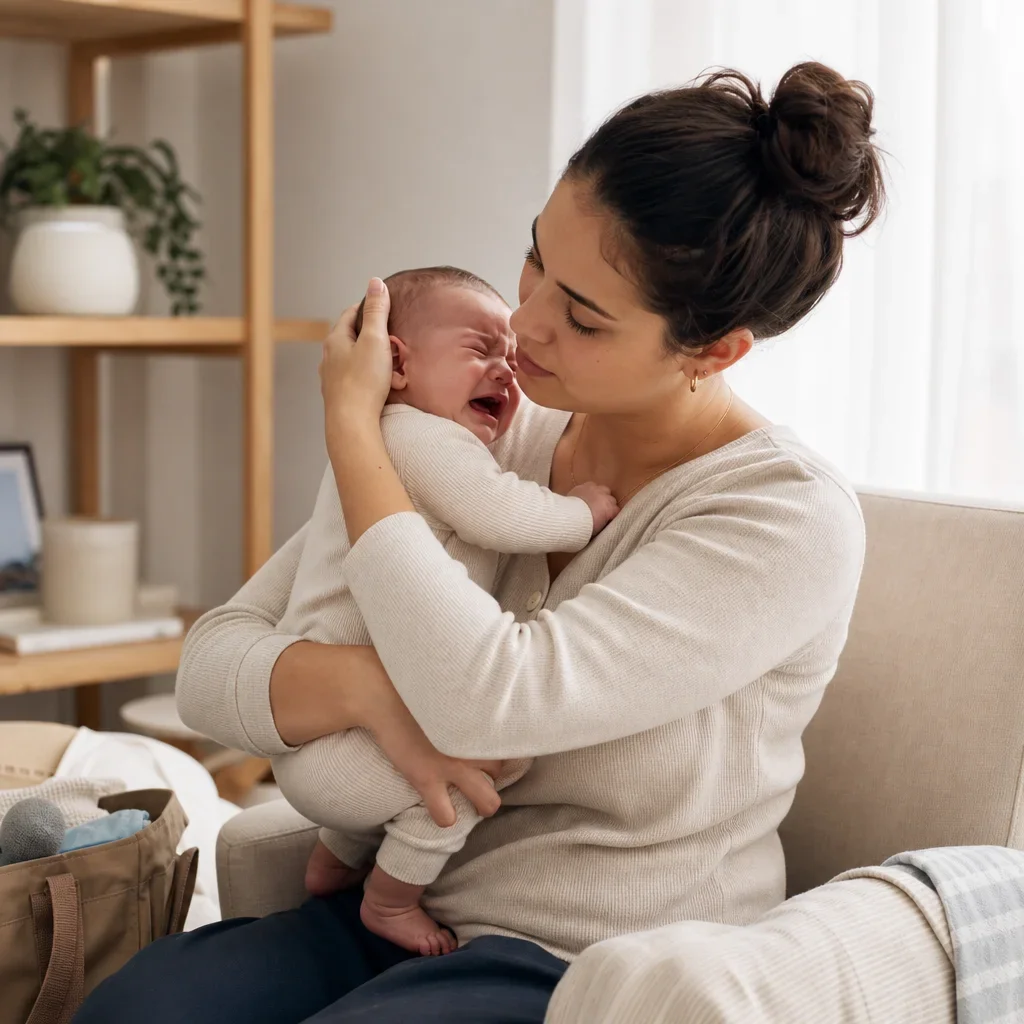
Crying, resisting, and clinginess are common parts of emotional development during infancy. They often increase during separation anxiety, illness, fatigue, overstimulation, or a new transition like starting care.
A simple 5-step response helps in the moment. Check basic needs first, reduce stimulation second, reconnect with touch or voice third, keep the routine predictable fourth, and watch for patterns over several days fifth.
Basic needs come first because hunger, fatigue, discomfort, and illness can all affect social and emotional behaviour. A baby who suddenly cries at drop-off may also be teething, overtired, or overwhelmed by a loud morning.
Lower stimulation when a child is overloaded. Dimmer light, fewer people, less noise, and slower handling often help more than adding extra toys or activity.
Reconnect before pushing independence. Holding, sitting close, using a calm phrase, or repeating the same goodbye routine often supports a smoother transition than leaving without warning.
Patterns matter more than one hard day. If crying is persistent, the baby cannot be comforted, feeding or sleep changes sharply, or behaviour shifts suddenly without a clear reason, medical guidance is appropriate.
Normal Variation vs Red Flags: When to Seek Help
Normal variation means children reach milestones within a range, but concerns become stronger when several social-emotional skills are missing, delayed together, or lost after appearing. Loss of previously seen skills at any age deserves prompt follow-up.
A baby in the first months should gradually show more social response over time. Limited eye contact, very little social smiling by about 2-3 months, or minimal back-and-forth engagement may be worth discussing with a health professional.
Later in infancy, concerns can include very limited comfort-seeking, little response to familiar caregivers, no pointing or shared attention by the end of the first year, or very little imitation. These signs do not diagnose anything on their own, but they do justify a closer look.
Signs of stress or distress in babies can include persistent irritability, unusual withdrawal, feeding disruption, sleep disruption, stiff or floppy body tension, or inconsolable crying. When several of these signs cluster together or feel intense, it is reasonable to seek guidance.
Speaking with a pediatrician, family doctor, or public health nurse is proactive, not alarmist. If hearing or vision concerns are part of the picture, those should also be discussed because they can affect social responsiveness.
Special Considerations for Premature, Medically Complex, or Neurodivergent Children
Some children follow a different timeline or show emotions in different ways, and that can still be developmentally valid. Emotional development in infancy 0 2 years is best understood through the whole child, not one rigid checklist.
For babies born prematurely, corrected age may matter when looking at milestones in the early months. Corrected age means counting from the due date rather than the birth date for development, and your healthcare team can show you how that applies to your child.
Medically complex or neurodivergent children may express social interest, distress, comfort-seeking, or regulation differently from other children. Individual observation is more helpful than forcing comparison with another child of the same age.
Parents do not need to sort this out alone. Child-specific guidance belongs with your pediatric providers and early childhood professionals who know your child’s medical and developmental context.
How Childcare Supports Social-Emotional Growth
High-quality childcare supports emotional and social development through consistent caregivers, predictable routines, calm transitions, and responsive communication. In a licensed setting, those supports are built into the day rather than left to chance.
At Cozy Time Montessori Academy, we offer Infant, Pre-Casa, and Casa programs for children from 6 months to 6 years. Our ratios are 1:3 in Infant, 1:5 in Pre-Casa, and 1:8 in Casa.
Those details matter because class ratio affects how closely adults can observe, support, and respond. Our staff include certified Montessori teachers, ECEs, and assistants, and all are First Aid/CPR certified with clean criminal record checks.
A Montessori childcare setting supports social emotional development in infants and toddlers through calm prepared spaces, practical routines, respect for cues, and independence within structure. We also prepare meals on-site, which helps keep the daily routine steady and predictable.
If you are comparing daycare in Vaughan, Montessori in Vaughan, or a licensed childcare option in Bolton, the best next step is to visit and see the classroom. That is where you can watch how adults greet children, support transitions, and help big feelings without rushing them.
Frequently Asked Questions About Emotional Development in Infants
What is emotional development in infants?
It is the process of feeling, expressing, recognizing, and gradually regulating emotions in relationships from birth onward.
What is the emotional development of a newborn?
Newborn emotional life is mostly about signaling needs and calming with caregiver help in the first 0-2 months.
When do babies start smiling socially?
A social smile often appears around 6 weeks to 2-3 months.
When does separation anxiety usually begin?
It often begins around 8-10 months to 9-12 months.
How do babies show emotions?
They use crying, facial expressions, body tension, gaze, reaching, calming, babbling, and later gestures like pointing or bringing objects to share.
What are examples of emotional development in infants?
Examples include smiling when a caregiver approaches, calming faster with a familiar adult, laughing during play, showing stranger wariness, and seeking comfort when upset.
What is the emotional development of a 12 month old?
At about 9-12 months, many babies show stronger attachment, separation protest, imitation, shared attention, and clear preferences for familiar people and routines.
What is the emotional development of a 2 year old?
At 18-24 months, a 2-year-old often has big feelings, growing independence, parallel play, early empathy, and a strong wish to say “no” or do things alone.
What is the social and emotional development of a 6 month old baby?
Around 4-6 months to 6-9 months, many babies laugh, enjoy face-to-face games, show excitement and frustration more clearly, and begin watching caregiver reactions in new situations.
How can parents support emotional development in babies?
Use responsive care, predictable routines, simple feeling words, face-to-face play, and calm co-regulation. Keep activities simple and repeated rather than overstimulating.
What are signs of stress or distress in babies?
Signs can include persistent irritability, withdrawal, feeding or sleep disruption, unusual body tension, and inconsolable crying. If these signs are intense, persistent, or sudden, seek guidance.
When should I worry about my baby’s social or emotional development?
Follow up when several skills seem absent together, when a baby shows very limited social response, or when previously seen skills are lost. If you are unsure, ask early.
If you want to see how a licensed Montessori daycare supports routines, relationships, and emotional safety in practice, we welcome families from Vaughan, Woodbridge, Maple, Thornhill, Newmarket, and Bolton to contact the centre and book a tour. Every child settles at their own pace, and seeing the classroom is often what helps parents feel clear.