

Parents often think infant music and movement activities need special toys or a class. They do not. For babies, infant music and movement usually means your voice, gentle rhythm, shared attention, and short moments that fit real life.
What infant music and movement activities are and why they matter
Infant music and movement is simple, responsive interaction, not performance. In early childhood, music and movement means singing, humming, rhythm, listening, swaying, rocking, bouncing, and repeating sounds or motions in a way a baby can follow .
These experiences help by supporting bonding, listening, body awareness, and emotional regulation without asking a baby to “do” much. A newborn may listen and watch while being held, and an older baby may kick, reach, clap, bounce, or shake a safe object with close supervision .
You do not need expensive equipment to begin. A caregiver’s face, voice, hands, and a calm pace are enough for many infant music activities at home .
Developmental benefits of music and movement for infants
Music for infants brain development is best understood as repeated human interaction, not a promise of results. Live singing, call-and-response sounds, and gentle movement can support language exposure, attention, sensory processing, and connection because babies learn through warm back-and-forth experiences .
Lullabies and steady rhythm can support calming because they add predictability. A familiar song before sleep, during rocking, or at diaper time gives the same cue each time, and that routine helps babies anticipate what comes next .
Movement-based songs support body awareness and early motor practice in a simple way. Knee bounces, slow sways, patting rhythms, and reaching toward sound give vestibular and proprioceptive input, which means babies feel where their body is and how it moves through space .
Fingerplays and naming songs support early listening and social engagement. When you sing a baby’s name, pause, and repeat a sound, you create turn-taking in a very early form, even before spoken words emerge .
Passive background audio does less than shared interaction. Babies usually respond more clearly when an adult sings, watches their cues, and adjusts volume, speed, and movement in the moment .
Infant music and movement activities by age
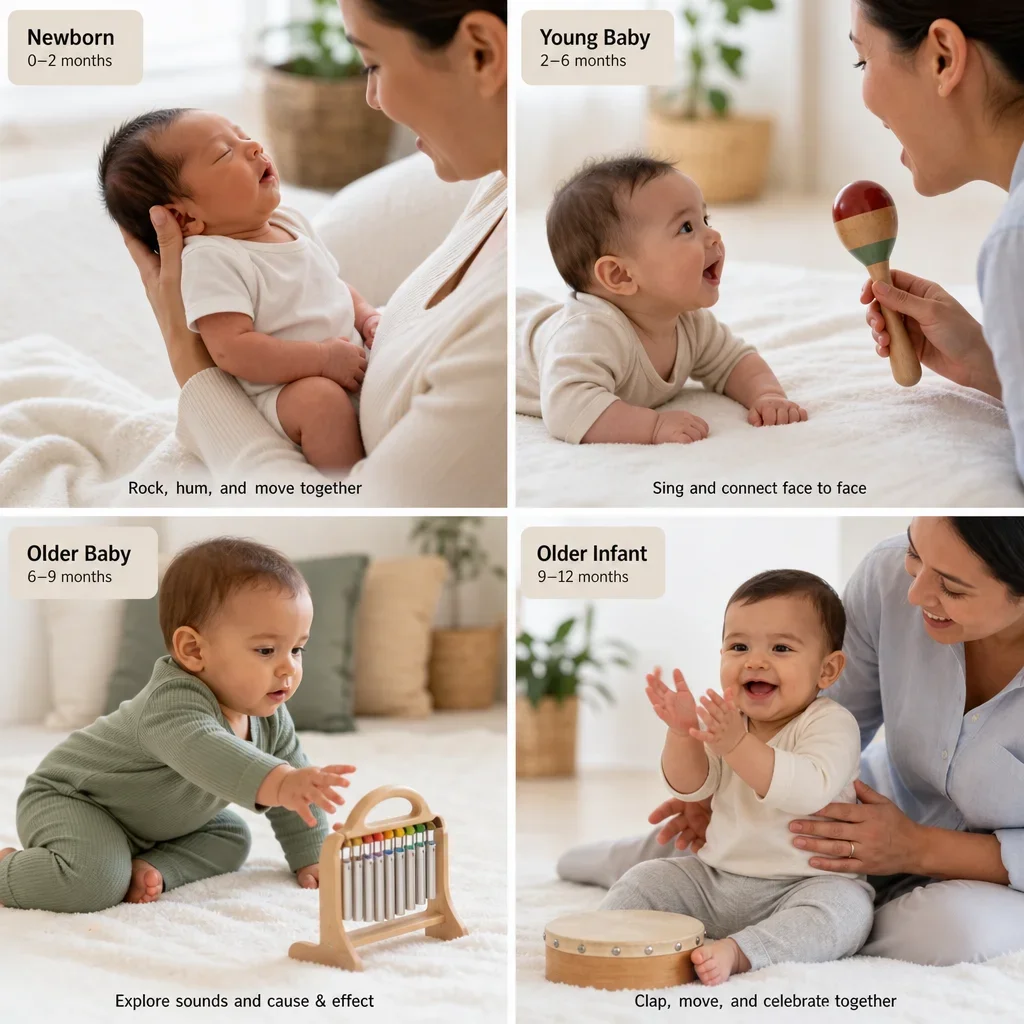
Babies participate differently across the first year, so age bands are more useful than fixed milestone lists. The simplest way to plan music and movement ideas for infants is by broad stages: 0-2 months, 3-5 months, 6-8 months, and 9-12 months.
| Age range | What often fits at this stage | Good music and movement ideas | If baby seems overstimulated |
|---|---|---|---|
| 0-2 months | Holding, feeding, brief alert windows, watching faces | Humming, skin-to-skin lullabies, slow swaying, rocking, soft vowel sounds, rhythm pats | Lower your voice, reduce movement, stop props |
| 3-5 months | Longer awake time, cooing, tummy time, visual tracking | Tummy-time songs, mirror songs, ankle rhyme games, vocal imitation, soft shaker listening | Pause, hold baby close, return to one familiar song |
| 6-8 months | Reaching, rolling, stronger response to repetition | Peekaboo songs, pat-a-cake adaptations, bounce songs, reaching toward sound, supervised shaker play | Slow the pace, shorten the activity, dim the room |
| 9-12 months | Sitting, cruising, hand use, social games | Action songs, supported dancing, stop-and-go games, drum tapping, call-and-response sounds | End while baby is still calm and interested |
Newborn to 2 months: simple musical activities for babies under 6 months
In the first 0-2 months, the best activity is usually being held while hearing a familiar voice. Soft humming during feeding, rocking, burping, or cuddling gives a newborn rhythm and closeness without too much input .
Short sessions work best at this stage. About 1-5 minutes is often enough for a newborn before sleep, hunger, or overstimulation changes the moment.
Slow side-to-side swaying fits newborn bodies better than big bouncing. You can pair that movement with one repeated line, a simple lullaby, or gentle vowel sounds like “ah,” “oo,” and “mm” .
Newborns do not need loud toys, long playlists, or several props at once. A calm voice, moderate volume, and one sensory input at a time are safer and easier to tolerate .
3 to 5 months: tummy-time songs and face-to-face play
From 3-5 months, babies often stay alert a little longer and start responding more clearly to repetition. Tummy-time songs work well here because they bring your face to floor level and add encouragement during a hard position .
Mirror songs fit this stage because babies can watch faces and mouth movements. Sing a baby’s name, copy a coo, pause, and wait, then repeat the pattern like a tiny conversation .
Gentle ankle and wrist rhyme games can add movement without overwhelming the baby. A slow pat-pat rhythm or a light tap with a nursery rhyme gives simple, predictable sensory input .
Soft bell or shaker listening can begin as adult-led observation, not independent handling. Keep the sound at a comfortable distance and move slowly from one side to the other so the baby can listen and track .
6 to 8 months: reaching, bouncing, and cause-and-effect play
From 6-8 months, babies often enjoy stronger rhythm and repeated social games. Peekaboo songs, pat-a-cake adaptations, and bounce songs give structure and clear anticipation .
Cause-and-effect play starts to make more sense at this stage. A securely sealed shaker used with close supervision lets a baby hear that movement changes sound, which is one reason infant music and movement can stay engaging without being complicated .
Reaching toward sound supports coordinated movement in a simple, playful way. Hold a safe sound source near, not far, and let the baby turn, lean, or reach rather than forcing the action .
A shorter, calmer version is still appropriate if your baby is cautious or sensitive. Every child settles into sensory play at their own pace, and following cues matters more than finishing the activity .
9 to 12 months: action songs and early dancing
From 9-12 months, many babies enjoy stronger participation in music and movement activities for infants and toddlers. Action songs with clapping, tapping, bouncing, or supported standing can fit well because babies at this stage often want to repeat motions they can predict .
Stop-and-go games become useful because older infants can notice contrast. You can sway or tap during the music, pause fully for a second, then restart so the pattern stays clear and playful .
Simple drum tapping works when the instrument is sturdy and closely supervised. A baby can use hands to pat a drum surface or a firm container while you model slow turns and gentle force .
Social circle songs can also work at the end of the first year. If siblings or caregivers join in, the baby still benefits most from a small group, repeated words, and a pace slow enough to follow .
The best music and movement ideas for everyday routines
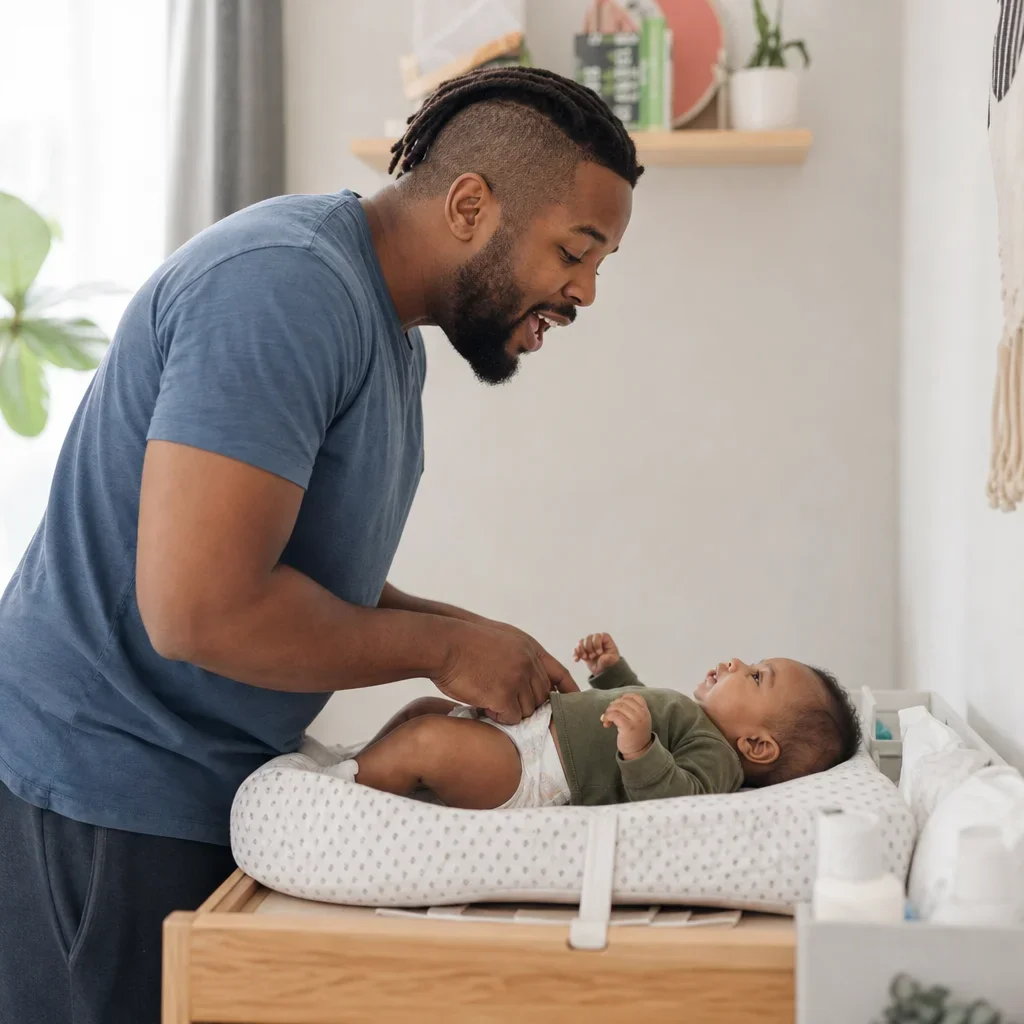
The easiest infant music activities at home usually happen inside routines you already do. Awake play, tummy time, diaper changes, bath time, stroller walks, car rides, transitions, and bedtime all give natural places for infant music and movement songs .
During tummy time, use face-level singing and short repeated phrases. A hello song, a name song, or a simple counting rhythm keeps your voice close and gives the baby a reason to look up .
During diaper changes, one predictable song can reduce the abrupt feeling of the transition. Repeating the same tune each time creates familiarity, and familiarity often helps babies stay more settled .
During bath time, use light splashing rhythms and soft singing rather than loud excitement. The water already adds sensory input, so a slower tempo usually works better than several fast songs .
During stroller walks, steady songs and narration fit the pace of movement. You can match the rhythm to steps or wheels and point out what the baby sees without turning the walk into a performance .
During car rides, calm music is usually the safer choice. Keep your baby’s hands free of loose objects in the car seat, and use your voice or recorded music rather than handing over props .
At bedtime, slower tempo and lower stimulation matter most. Dim lights, one lullaby, one rocking pattern, and repetition do more than adding new songs each night .
Simple songs, rhymes, and movement games to try
The best songs are the ones you will actually repeat. Babies benefit from hearing the same songs often, and repetition is a feature, not a flaw .
- Name song: Sing your baby’s name in a simple tune. Good from 0-12 months. Supports recognition and social attention.
- Lullaby with swaying: Any gentle lullaby while rocking. Good from 0-12 months. Supports calm transitions.
- Peekaboo song: Hide your face with hands, then reveal it on the same word each time. Good from 3-12 months. Supports anticipation.
- Tummy-time rhyme: A short rhyme repeated at floor level. Good from 3-8 months. Supports awake play.
- Pat-a-cake adaptation: Slow hand patting with your help. Good from 6-12 months. Supports rhythm and joint attention.
- Knee bounce song: Gentle bounce on your lap with a steady beat. Good from 4-12 months. Supports body awareness.
- Clap-and-pat game: You clap, then pat the floor or your knees. Good from 6-12 months. Supports imitation.
- Stop-and-go song: Move together, pause, then move again. Good from 8-12 months. Supports listening to contrast.
- Mirror song: Sing while facing a mirror together. Good from 3-9 months. Supports visual engagement.
- Hello and goodbye songs: Use the same opening and closing tune daily. Good from 0-12 months. Supports routine.
- Bath-time rhythm song: Match your words to slow splashing. Good from 3-12 months. Supports routine-based play.
- Fingerplay: Slow finger movements with a rhyme. Good from 4-12 months. Supports visual tracking.
You can sing in English, your home language, or both. Warmth, familiarity, and repetition matter more than singing perfectly .
Baby-safe instruments and props: what works and what to skip
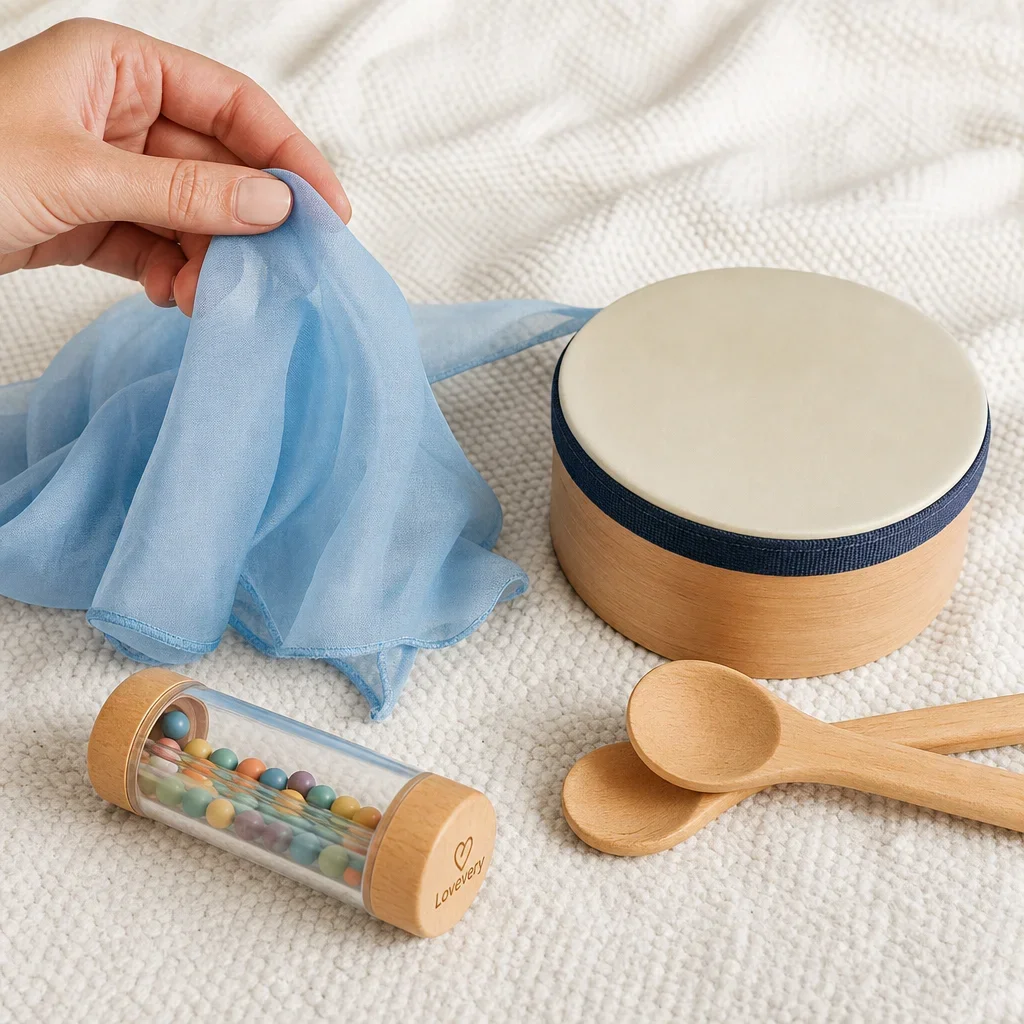
Many infant music activities require no equipment at all. Your voice, hands for clapping or patting, and gentle movement are enough for daily use .
Safe props are simple, sturdy, and always supervised. That can include a scarf used only while you hold it, a soft bell heard at a distance, a securely sealed shaker, or a floor drum used with adult support .
The main safety risks are loose parts, choking hazards, sharp edges, long strings, ribbons, and anything that can tear open. Balloons, fragile homemade items, and objects with detachable pieces should be skipped .
Observing a prop is different from handling a prop. A young infant may watch a scarf move or hear a bell without touching it, while an older infant may hold a baby-safe shaker only under close supervision .
Cleanliness also matters because babies mouth objects. Shared or homemade materials should be easy to wipe, wash, or remove from use if they become damaged .
DIY infant music activities at home
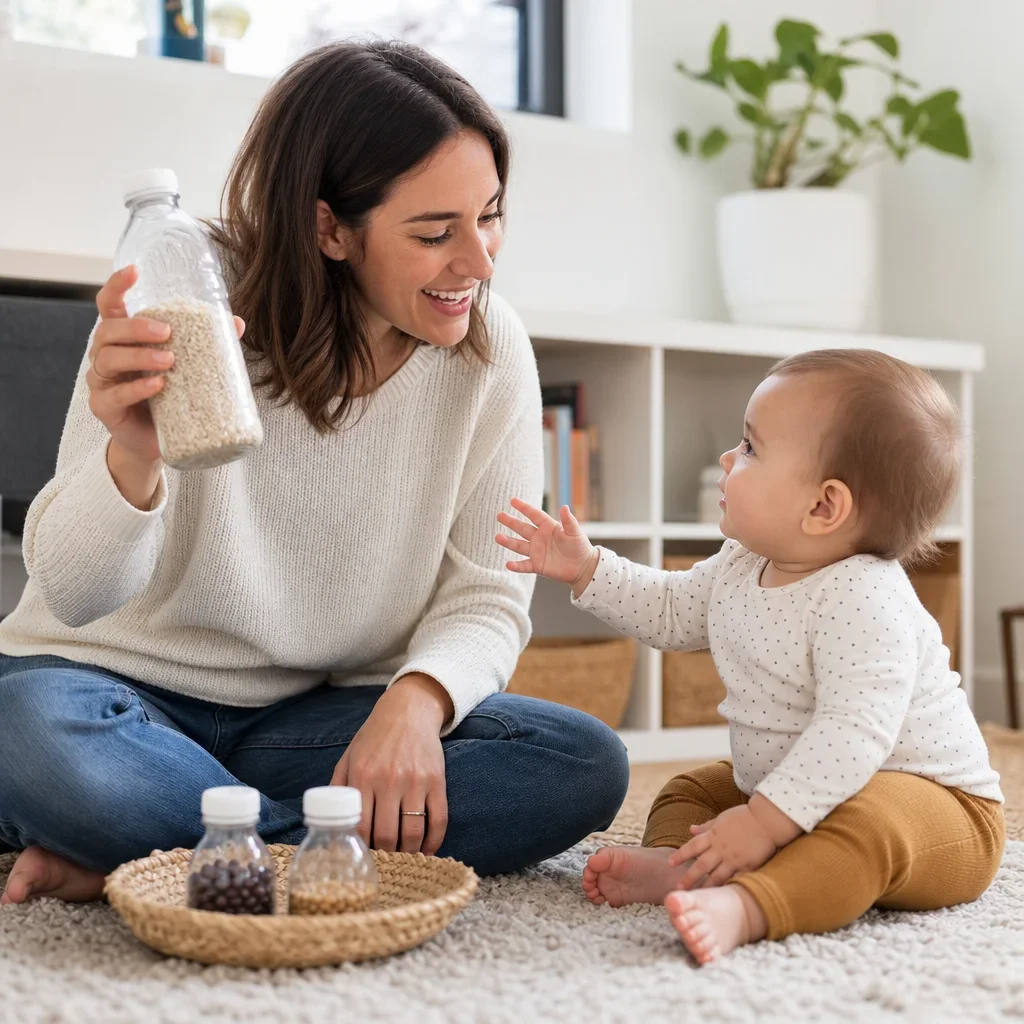
DIY works best when the item stays simple and the adult stays involved. The value comes from shared use, not from making a complicated toy .
A sealed bottle shaker can work if the container is durable, fully closed, and checked before every use. The fill should stay contained, and the baby should never use anything that can open, crack, or leak .
A wooden spoon rhythm activity can be adult-led for younger infants and more interactive for older infants. Tap a steady beat on the floor or a firm bowl while the baby watches, then offer a turn only if the item is smooth, large, and closely supervised .
A fabric scarf tracking game can be done with one lightweight scarf in your hand. Move it slowly side to side, up and down, or behind your face during a song, then put it away immediately after the activity .
Cupboard drumming can work for older infants who are sitting or standing with support. Use a stable surface, keep the sound moderate, and stay beside the baby the whole time .
A mirror-and-song station needs no construction at all. Sit with your baby in front of a secure mirror, sing one repeated song, and pause so the baby can watch your face and their own reflection .
Homemade materials should be cleaned according to the material and the maker’s instructions if applicable. If you are unsure how to sanitize a specific fabric or plastic item safely, the best next step is to clean it conservatively or replace it with an easier-to-clean option .
How long should infant music activities last?
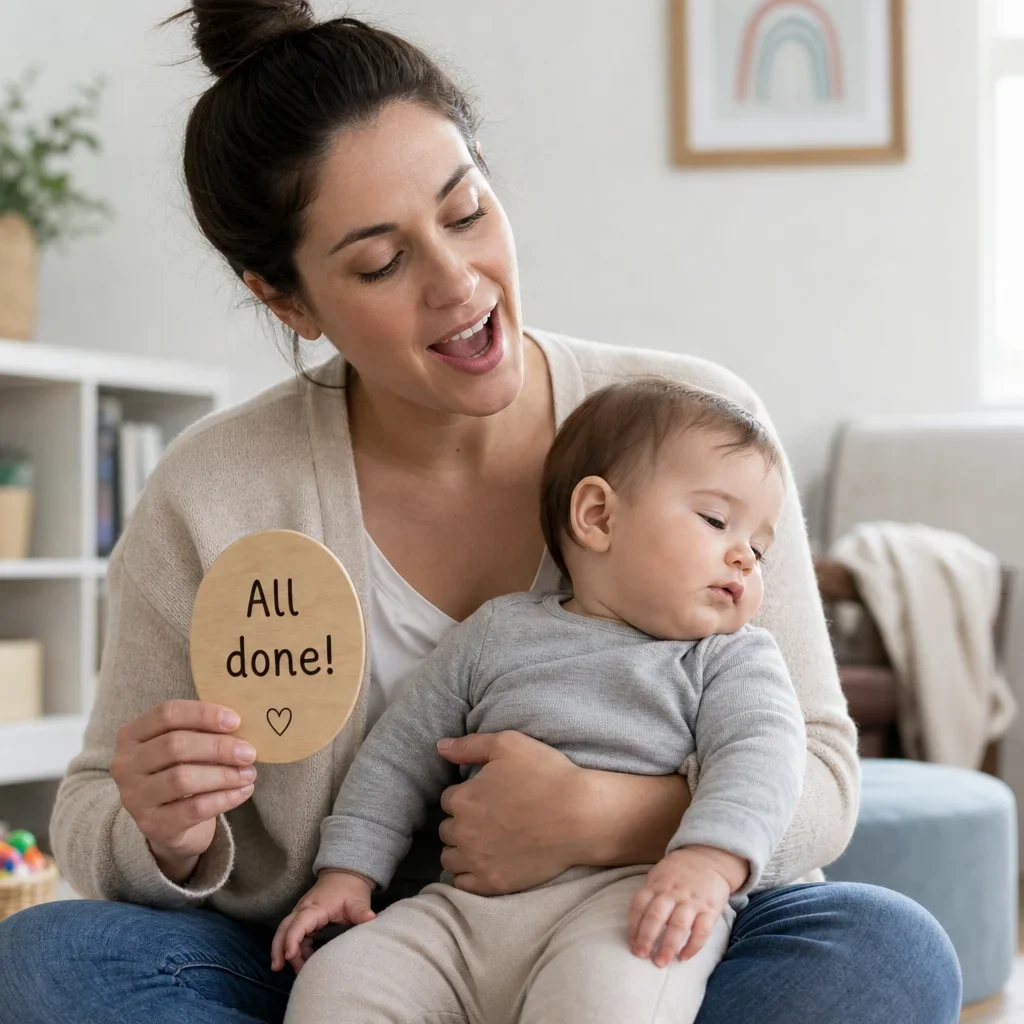
Short bursts are usually enough for babies. About 1-5 minutes can suit many newborns, and about 5-10 minutes can suit older interested infants, but the real limit is your baby’s cue pattern that day.
The clearest sign to continue is calm engagement. Eye contact, relaxed limbs, cooing, smiling, kicking, or quiet alert listening usually mean the activity still fits .
The clearest sign to stop is disengagement or stress. Turning away, stiffening, fussing, hiccupping, crying, arching, or seeming zoned out usually means lower the input or end the activity .
Stopping early is appropriate, not a failure. Babies may be hungry, tired, overstimulated, or simply finished, and responsive caregiving means adapting in the moment .
Choosing music for infants: live singing vs recorded music
Live singing is often the most engaging option because it is responsive. Your baby hears a familiar voice, sees your face, and gets changes in tempo and volume that match their cues .
Recorded music can still be useful for routines, variety, and calm background use in short periods. It works best when the volume stays moderate, the tone stays gentle, and an adult is still present and responsive .
The kind of music that is good for infants is usually music with a steady rhythm, simple melody, and a pace your baby tolerates well. Lullabies, folk songs, soft instrumental music, and culturally familiar songs are all reasonable places to start .
Constant background noise is less helpful than intentional use. Babies need quiet as well as sound, so turn music off when it is no longer adding connection or calm .
Multicultural and bilingual music choices for babies
Bilingual and multicultural songs fit infant music and movement naturally in many GTA homes. You can sing the same greeting song in two languages, alternate verses, or use one language for lullabies and another for daytime routines .
Babies do not need perfect singing or polished pronunciation to benefit from family songs. Familiarity, emotional warmth, and repetition are what make the experience meaningful .
Songs from your culture can also support family connection across generations. Grandparents, siblings, and caregivers can all use the same simple tunes so the baby hears a consistent pattern of voice and rhythm .
Adapting music and movement for sensory-sensitive babies or different abilities
Adaptation starts with lowering demand, not removing the experience. For sensory-sensitive babies, lower volume, fewer props, slower tempo, and predictable repetition often make music and movement easier to tolerate .
Non-mobile babies can participate fully through listening, gaze, touch, and assisted movement. A baby does not need to crawl, sit independently, or hold an instrument to join infant music and movement .
Babies with limited mobility can still have rich music experiences through voice-led songs, touch cues, facial expression, and supported arm or leg movement. The activity should fit the baby’s comfort and positioning needs, not a preset plan .
Babies with hearing differences may respond strongly to vibration, visual rhythm, facial expression, and shared movement. Floor tapping, chest-to-chest humming, and clear mouth movements can make the experience more accessible .
For premature babies or medically complex infants, your child’s healthcare team should guide any adjustments linked to health, feeding, positioning, or corrected age. Music can still be gentle and relational, but medical guidance comes first for that child .
A simple weekly infant music routine parents can actually follow
A workable routine is better than an ambitious one. For many families, 3-4 short music moments per day is realistic when those moments are attached to care routines you already have.
A simple weekly rhythm can stay almost the same each day. Use one morning hello song, one tummy-time rhyme or floor song, one movement game in the afternoon, and one evening lullaby routine .
Repeating favourites is useful because babies learn through familiarity. You do not need seven new songs each week, and rotating only 1-2 new experiences keeps the routine manageable for busy parents.
Here is a sample weekly plan:
- Monday: hello song, diaper-change rhyme, tummy-time song, bedtime lullaby
- Tuesday: hello song, mirror song, gentle knee bounce, bedtime lullaby
- Wednesday: hello song, name song, shaker listening, bedtime lullaby
- Thursday: hello song, tummy-time rhyme, peekaboo song, bedtime lullaby
- Friday: hello song, bath-time rhythm song, clap-and-pat game, bedtime lullaby
- Saturday: hello song, stroller walk song, supported dance, bedtime lullaby
- Sunday: hello song, family language song, quiet humming cuddle, bedtime lullaby
If your day is full, one or two calm musical moments still count. Consistency matters more than variety overload .
How Cozy Time Montessori Academy supports infant sensory learning
In a licensed Montessori daycare in Vaughan, parents usually look for calm routines, responsive caregiving, and safe sensory experiences. That is also how we think about infant care at Cozy Time Montessori Academy .
Our Infant program is for about 6-18 months at a 1:3 ratio. That class ratio gives our team the time to observe, support, and adapt routines for each baby rather than treating the day like simple supervision.
Our infant staff include ECEs, Montessori educators, and assistants, and all are First Aid/CPR certified with clean criminal record checks. In practice, that means babies are cared for by trained adults in a licensed childcare setting, not informal minding.
We use music, language, movement, practical life foundations, and sensory-rich routines in age-appropriate ways. For infants, that looks like short, responsive experiences during real care moments, because every child settles and participates at their own pace .
We also prepare meals on-site and run full-day care in Vaughan and Bolton, with hours from 7:00 AM to 6:30 PM. If you are comparing infant care options in the GTA, the best next step is to visit and see the classroom, then contact the centre to confirm availability for your child’s age group.
FAQ
How do music and movement help infants?
They can support bonding, listening, body awareness, sensory regulation, and routine predictability through short, shared interactions .
What are some easy infant music activities to do at home?
Try name songs, lullabies with swaying, tummy-time songs, mirror songs, peekaboo songs, and simple clap or pat rhythms. Most need no equipment .
What kind of music is good for infants?
Music with a gentle tone, steady rhythm, and moderate volume is usually easiest for babies to follow. Familiar songs from your family or culture are a good choice .
Can newborns do music and movement activities?
Yes. For newborns, the activity is usually very simple: being held, hearing your voice, feeling a gentle sway, or listening to humming for about 1-5 minutes.
How long should music activities last for babies?
Short is usually best. About 1-5 minutes may suit many newborns, and about 5-10 minutes may suit older interested infants, but baby cues matter more than the clock.
Are shakers and instruments safe for babies?
Some are, if they are sturdy, baby-safe, and closely supervised. Skip anything with loose parts, sharp edges, strings, ribbons, or breakable pieces .
Is live singing better than recorded music for babies?
Live singing is often more engaging because it is responsive and familiar. Recorded music can still help with routines if it stays calm and moderate in volume .
Can I sing to my baby in more than one language?
Yes. Bilingual songs, lullabies, and greeting routines are a natural way to share language and connection at home .
What should I do if my baby gets overstimulated during music play?
Lower the volume, stop the movement, hold your baby close, and return to one familiar calm song or end the activity. Stopping early is appropriate .
How can non-mobile babies join music and movement activities?
They can listen, watch your face, feel a gentle sway, track a scarf you hold, hear rhythm pats, or take part through assisted movement while being held or lying comfortably .
If you are also looking at infant daycare or Montessori childcare in Vaughan, ask what calm sensory routines look like in the classroom, who leads them, and what the licensed ratio is. If you would like to see how we support our Infant program day to day, you are welcome to book a tour or contact the centre to ask about your baby’s age group.