

A hard first drop-off does not automatically mean daycare is the wrong fit. The junior toddler adaptation period is the settling-in phase when a child gets used to a new routine, new caregivers, and time away from home.
What the junior toddler adaptation period means
The junior toddler adaptation period means the first stretch of adjustment after a child starts daycare, preschool, or a Montessori daycare transition. In plain terms, it is the period when a child learns the classroom rhythm, gets to know educators, and practises separating from family in a new setting.
The same process may be called daycare transition, separation adjustment, preschool settling-in, or a toddler adaptation period in daycare. The label changes, but the core task stays the same: the child is adapting to new adults, peers, sounds, meals, naps, and expectations.
This adjustment process can apply from infancy through the preschool years, not only to junior toddlers. At our centre, children enrol from 6 months to 6 years, so we see that infants, 1-year-olds, 2-year-olds, and older preschoolers all settle in differently.
How long toddler daycare adjustment usually takes
A realistic answer is that many children begin showing signs of settling within about 2 to 6 weeks. Settling does not mean perfect mornings. It usually means shorter crying at handoff, faster recovery after drop-off, more engagement in play, and steadier eating or resting during the day.
Adjustment is often uneven across those first 2 to 6 weeks. A child may have three smoother mornings, then a hard Monday after a weekend, an illness, or a schedule change.
Age, temperament, prior separation experience, attendance pattern, sleep, and family routine all affect timing. A child attending 5 days a week usually has more repetition than a child attending 2 days a week, and repetition often helps the routine feel more familiar.
Parents asking how long does it take a 2 year old to adjust to daycare or how long does it take 1 year old to adjust to daycare are usually hoping for one fixed deadline. There is no honest single number for every child, and the best next step is to watch the pattern over time rather than judge the whole transition by one difficult day.
Why children need an adaptation period
Children need an adaptation period because daycare asks them to manage several changes at once. They are learning new adults, a new room, a class ratio, group routines, and separation from the people who feel most familiar.
In a licensed childcare setting, routines are structured on purpose. Our programs are organized by age group, with Infant at 6 to 18 months and a 1:3 ratio, Pre-Casa at 18 to 30 months and a 1:5 ratio, and Casa at 30 months to 6 years with a 1:8 ratio.
A Montessori classroom adds another layer of newness, but also more predictability. The Montessori method uses a prepared environment, practical life work, sensorial materials, and clear routines, which means children begin to recognize what happens next even before they can explain it in words.
What is normal during the adaptation period
Crying at separation is normal for many children starting daycare separation anxiety work. Crying tells us the child notices the change. It does not, by itself, tell us the setting is unsafe or the transition is failing.
These short-term behaviours are commonly seen during daycare adjustment:
- crying at drop-off
- clinginess at pickup or at home
- changes in appetite
- nap disruption
- earlier bedtime fatigue
- temporary tantrums
- wanting more physical closeness after daycare
- brief regressions in skills like toileting or independent sleep
A child may cry at the classroom door and still settle shortly after the parent leaves. Another child may look calm all day, then release emotions at home after pickup.
Changes often increase after a weekend, an illness, or time away from care for 2 to 3 days. That pattern can be part of adjustment because the routine has to be rebuilt.
A simple timeline: first days, first weeks, and first month
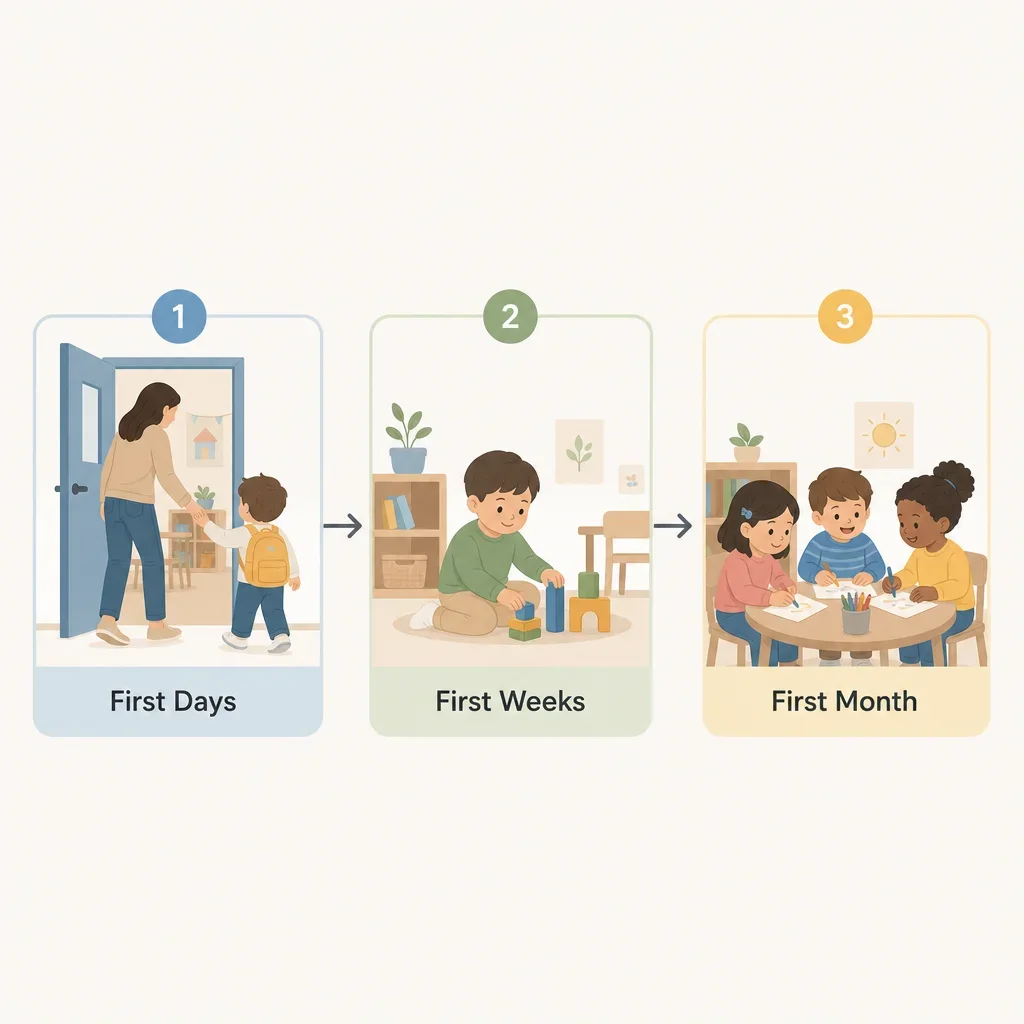
The first 1 to 3 days are usually about novelty, watchfulness, and protest. Some children stay close to an educator. Some observe the room before joining. Some show most of their feelings at the handoff.
The first 1 to 2 weeks often bring uneven mornings. This is the stage when a child may test the routine, resist transitions, or cry sooner because they now understand what drop-off means.
The first month and beyond is often when trust becomes easier to see. Parents may notice smoother handoffs, more interest in activities, more regular eating or resting, and warmer connection with educators.
These phases are not linear. A child can seem settled in week 3 and then struggle again after teething, a cold, travel, or a classroom change.
Age-by-age expectations from infancy to preschool
Infant adjustment looks different because the focus is bonding, feeding rhythm, sleep rhythm, and sensory comfort. In our Infant program, children are about 6 to 18 months, so the transition to daycare 3 months or transition to daycare 12 months question is really about how consistently the caregivers learn the child’s cues and routines.
Around 12 months, many children show stronger separation awareness. Familiar voices, a repeated handoff pattern, and clear communication between home and educators matter more than long verbal explanations.
Two-year-olds often react with bigger feelings because they understand more but still have limited language for stress. A transition to daycare for a 2 year old usually goes better with repetition, simple words, and the same daycare drop-off routine each morning.
Three-year-olds may use more language, but they can also anticipate the separation before arrival. For families asking how long does it take for a 3 year old to adjust to daycare, the same broad 2 to 6 week settling pattern can apply, though the child may express worry with words instead of only tears.
Four-year-olds can ask detailed questions and still need predictable structure. For families asking how long does it take for a 4 year old to adjust to daycare, we look for the same markers of settling: easier handoff, rejoining play, and more stable participation across the day.
What makes daycare adjustment easier or harder
There is no single hardest age to start daycare. What makes adjustment harder is usually the combination of separation awareness, sensitivity to change, limited language, inconsistent attendance, poor sleep, recent illness, and mixed messages between caregivers.
Temperament matters because some children warm up slowly in any new setting. A child who needs more observation time may not join group activity in the first few days, and that can still be a normal start.
Routine matters because repeated attendance gives the child more chances to recognize the same sequence. Wake-up time, breakfast timing, drop-off timing, and pickup timing all shape how manageable the day feels.
Adult behaviour matters because children read the handoff closely. Long negotiations, repeated returns to the classroom door, or sneaking out can make the separation less predictable.
How parents can help: the week before, first day, and first month
The week before daycare should focus on familiarity and rhythm. If a visit is available, use it. Start talking simply about school, adjust sleep and meal times closer to the daycare schedule, label belongings, and share comfort information with educators.
A useful week-before checklist includes:
- visit the classroom if the centre offers it
- practise the route or talk about who will drop off
- move bedtime earlier in small steps if needed
- label clothing, bottles, and comfort items
- tell educators about naps, meals, words, and soothing habits
- keep the message simple and positive
The first day works best when the morning is calm and not rushed. Leave extra time, use the same goodbye phrase, hand your child to the educator clearly, and avoid disappearing without saying goodbye.
A practical first-day checklist includes:
- wake up early enough to avoid a rushed handoff
- keep breakfast familiar
- bring the approved supplies the centre requested
- use one short goodbye script
- let the educator take over the transition
- expect feelings without treating them as failure
The first month usually goes better when attendance is as consistent as the family can manage. Keep evenings predictable, tell the centre about poor sleep or family changes, and expect some ups and downs while the routine becomes familiar.
A practical first-month checklist includes:
- keep attendance regular where possible
- maintain a steady pickup plan
- offer quiet connection after daycare
- keep bedtime consistent
- update educators about changes at home
- watch the overall trend, not one hard day
What to say at drop-off: sample scripts that actually help
Short, loving, predictable goodbyes usually work better than long speeches. A toddler needs clarity more than extra wording.
These sample scripts are simple enough to repeat every day:
- “I’m going to work. Your teacher will help you. I’ll be back after nap.”
- “Daddy is leaving now. You are safe with your teacher. I’ll come after outdoor play.”
- “One hug, one kiss, then school time. I will pick you up after snack.”
- “Mommy always comes back. Your teacher is here with you.”
Sneaking away often makes the next drop-off harder because the child loses trust in the sequence. Re-entering the room 3 times after saying goodbye can also restart the distress each time.
Should parents keep goodbyes short or stay longer?
A short goodbye is usually more helpful than staying longer once the handoff has happened. The key is not speed alone. The key is being calm, clear, and consistent.
Staying longer can help during a planned visit or orientation, but at the actual morning handoff it often blurs the moment of separation. Children then have to separate over and over instead of once.
If a centre suggests a specific settling approach, follow that team plan consistently for several days. In licensed care, educators can observe the pattern across the day and tell you what actually happens after you leave.
What if you cannot do gradual entry and need full-time care right away?
Full-time care from day 1 is a real family reality, especially for working parents in Vaughan and across the GTA. Gradual entry can help when available, but it is not the only way a child can settle.
If full-time care starts right away, keep the drop-off person consistent for the first 1 to 2 weeks if possible. Try to keep pickup timing, bedtime, and morning sequence as predictable as your work schedule allows.
When hours cannot be reduced, lower the pressure somewhere else. Keep evenings simple, avoid extra outings in the first week, and give the centre clear information about sleep, meals, comfort strategies, and familiar words.
The best next step is to ask the centre how they support full-time starters in your child’s age group. Contact the centre to confirm current availability for Infant, Pre-Casa, or Casa.
What educators do during the first day and first week

Educators help adaptation by observing, comforting, guiding, and keeping the day predictable. In a licensed daycare Vaughan families can verify, staffing and ratios are not casual. They are part of the structure that allows close supervision and responsive care.
At Cozy Time Montessori Academy, our staff include ECEs, certified Montessori teachers, and assistants. All are First Aid/CPR certified and have clean criminal record checks.
On the first day, the flow is usually simple and steady: welcome, handoff, comfort, invitation to a familiar activity, support through snack or meal, rest support, transition cues, and pickup communication. That is how a Montessori daycare Vaughan families tour often feels in practice: calm, structured, and based on observation rather than pressure.
In the first week, educators watch for concrete signs of settling. We observe whether the crying shortens, whether the child can reconnect with materials or play, whether meals and naps become easier, and what soothing strategies work best.
In a Montessori setting, the prepared environment supports this process. Practical life means real, purposeful tasks like pouring, carrying, tidying, and hand washing. Sensorial work means materials that help children sort and explore through the senses. Those predictable activities give children something clear to do with their hands and attention.
Can a comfort item help?
A comfort item can help some children bridge the gap between home and school. A small blanket, soft toy, or family photo can give the child one familiar point in a new setting.
The item needs to fit the centre’s rules and the child’s classroom routine. The safest next step is to ask whether the room permits comfort items, how they are stored, and when they are used.
Choose one item that is manageable, clearly labelled, and easy to wash. A comfort item is a support tool, not a sign that the child is adjusting badly.
Normal at home vs. concerning at daycare
What happens after pickup is not always the best measure of what happened during the day. Some children hold themselves together at school and decompress at home.
Here is a practical comparison:
| More typical during adjustment | More concerning and worth a closer conversation |
|---|---|
| crying at drop-off but settling later | distress that stays high through most of the day over time |
| clinginess after pickup | no clear recovery pattern across days or weeks |
| tiredness, short patience, bigger feelings at home | major refusal to eat or drink during care over time |
| temporary nap changes | escalating fear tied to daycare rather than gradual settling |
| uneven mornings after weekends or illness | functioning concerns across settings, not only at drop-off |
A more useful pickup conversation asks for specifics. Ask how long the crying lasted, what helped, whether your child engaged in play, whether they ate, and how rest went.
Red flags and when to ask for more help
Parents should worry less about one hard day and more about a pattern that is not improving at all. A red flag is distress that stays intense, spreads, or worsens instead of gradually becoming more manageable.
Other concerns include persistent inability to settle during the day, major feeding or sleep disruption that the family and centre both see, or signs that the child is struggling to function safely in the setting. We do not treat those signs as a diagnosis. We treat them as a cue to look more closely.
The first step is usually a detailed conversation with the centre across several days, not one pickup. Compare what happens at drop-off, through the day, at pickup, and at home.
If the concern remains significant, families may choose to speak with their child’s doctor or another qualified child-development professional. That step is about getting support, not assigning blame.
A simple decision path: continue, adjust routines, reduce hours if possible, or seek support
If the overall pattern is improving, even slowly, consistency is usually the best next step. Improvement can look like shorter crying, quicker recovery, more participation, or easier meals and naps over 2 to 6 weeks.
If the pattern is persistent but manageable, adjust the parts you can control. Tighten the drop-off routine, align bedtime, keep pickup more predictable, and share updates between home and the classroom.
If the distress is severe or clearly worsening, speak with the centre promptly and review whether changes in schedule or handoff are possible. Some families can reduce hours temporarily. Others cannot, and that does not mean they are doing the transition wrong.
If concern remains high after those steps, seek outside professional guidance while staying in close contact with the childcare team. Every child settles at their own pace, but families should not feel they have to guess alone.
Special situations: bilingual children, sensitive children, neurodivergent children, and multiple caregivers
Bilingual children often settle more smoothly when educators know key comfort words, family routines, and the correct pronunciation of the child’s name. Shared words for toileting, water, sleep, and comfort can be practical on day 1.
Highly sensitive children usually benefit from predictability and lower-pressure transitions. That can mean one consistent handoff phrase, one comfort item if permitted, and fewer extra demands after pickup.
Neurodivergent children or children with known support needs often do best when families plan ahead with the centre and relevant professionals. The article cannot assess an individual child, so the right next step is a direct discussion about routines, communication, and classroom fit.
Multiple caregivers help most when they use the same language and same expectations. If one adult says “I’ll be back after nap” and another says “I’ll come whenever I finish work,” the routine becomes less predictable for the child.
What about the 3-3-3, 7-7-7, and 10-10-10 rules for toddlers?
These numbered rules are not official childcare standards. Parents often see them on social media, but they are not a universal measure of how long a toddler adaptation period daycare process should take.
The useful part of those rules is the reminder that adjustment takes repetition and time. The misleading part is the idea that every child should match one formula.
A child who is still crying after day 7 is not automatically failing daycare. A child who looks cheerful by day 3 is not automatically fully settled either.
The more reliable guide is direct observation over time. We look at the pattern of separation, recovery, play, meals, rest, and connection with educators.
How a Montessori daycare supports smoother transitions
A Montessori daycare transition is often supported by calm order, clear routines, and purposeful activity. The environment is prepared in advance so children can move toward familiar materials and repeated sequences.
At Cozy Time Montessori Academy, we offer licensed childcare in Vaughan and Bolton for children from 6 months to 6 years. Our programs include Infant, Pre-Casa, and Casa, with ratios of 1:3, 1:5, and 1:8.
Licensed care matters because it sets real expectations for supervision, staffing, and program structure. That is different from unlicensed minding. Parents choosing licensed Montessori care are usually looking for real ECE and Montessori credentials, real class ratios, a real curriculum, and a full-day routine that includes on-site meals.
Our centre is open 7:00 AM to 6:30 PM, which matters for working families planning a realistic morning and pickup routine. We prepare meals on-site, and that daily structure helps educators observe how a child is settling across the whole day, not only at drop-off.
The Casa classroom also works as a multi-age classroom. Multi-age means children of different ages learn in the same room, which supports observation, modelling, and a steadier classroom rhythm. In Montessori terms, practical life, sensorial work, movement, meals, rest, and outdoor time all become part of a predictable day.
FAQ
What is the junior toddler adaptation period?
It is the settling-in period when a child adjusts to new caregivers, routines, peers, meals, naps, and separation from family in daycare or preschool.
How long does it take for a toddler to adapt to daycare?
Many children show signs of settling within about 2 to 6 weeks, but the process is not linear. Attendance pattern, age, temperament, sleep, and routine all matter.
Is crying at daycare drop-off normal?
Yes. Crying at separation is common, especially in the early days or after time away. What matters most is whether the child can recover and re-engage with the day.
How long does it take a 2 year old to adjust to daycare?
Two-year-olds often need repetition and a very consistent handoff. The same broad 2 to 6 week settling window is common, though some children need longer.
How long does it take 1 year old to adjust to daycare?
Around 12 months, separation awareness can be stronger, so routine and caregiver consistency matter a great deal. Some 1-year-olds settle quickly, and some need a longer runway.
What is the hardest age to start daycare?
There is no single best or worst age. Each age brings different strengths and stressors, from infant routine needs to toddler separation protests to preschool anticipation.
Should I stay longer at daycare drop-off or keep goodbyes short?
A short, calm, predictable goodbye is usually more helpful than a long farewell once the handoff begins. Sneaking out tends to make trust in the routine harder.
What if my child has to start full-time daycare right away?
That is common for working families. Focus on consistency, simple evenings, predictable drop-off language, and close communication with the centre.
Can my child bring a comfort item to daycare?
Sometimes, yes, if the centre permits it. Ask first about the classroom routine and choose one small, labelled item.
When should I worry that daycare adjustment is not going well?
Look for a pattern of distress that does not improve at all, clearly worsens, or affects feeding, resting, or basic functioning across settings. Start by speaking with the centre in detail.
What is the 3 3 3 rule for toddlers?
It is a popular online formula, not an official childcare standard. It may remind parents to allow time, but it should not replace observation of the individual child.
What is the 7 7 7 rule for toddlers?
Like the 3 3 3 idea, it is not a universal evidence-based standard for daycare adjustment. Use it cautiously and watch your child’s actual pattern instead.
Adjustment is a process, not a test. If you are weighing Infant, Pre-Casa, or Casa and want to talk through your child’s age, temperament, and schedule, the best next step is to visit the classroom and see how the routine works in person.