
A Montessori junior toddler program is not simply babysitting between infant care and preschool. It is a prepared early-learning classroom for young children who are beginning to walk, communicate, make choices, and participate in daily routines with adult support.
What Is a Montessori Junior Toddler Program?
A junior toddler program usually sits between infant care and a Casa or preschool classroom. The term is not used the same way by every Montessori school, so parents should compare the actual age grouping, staffing, daily routine, and classroom setup rather than relying on the program name alone.
A Montessori toddler program uses the Montessori method in age-appropriate ways. The Montessori method means teachers prepare an orderly environment, observe each child, offer purposeful materials, and support children as they practise everyday tasks.
At Cozy Time Montessori Academy, we offer Infant, Pre-Casa, and Casa programs for children from 6 months to 6 years. Families asking about a junior toddler program should contact the centre to confirm the current age placement that best fits their child.
Our Vaughan location serves families from Vaughan, Maple, Woodbridge, Thornhill, and Newmarket. Our second location serves Bolton families and nearby communities.
Ages Served and Signs of Readiness
Junior toddler placements are based on a child’s age, current classroom availability, and readiness for the routine. Cozy Time’s Infant, Pre-Casa, and Casa programs together serve children from 6 months to 6 years.
A child does not need to perform every self-care task independently before entering a toddler Montessori program. Teachers can support early attempts at hand washing, self-feeding, dressing, communication, and moving through a predictable routine.
Steady walking can help a child participate in a classroom designed for movement and choice. Emerging communication also helps teachers understand needs through words, gestures, signs, or familiar routines.
A child may be ready for a junior toddler classroom when they show interest in feeding themselves, exploring materials, joining short transitions, and separating from a parent with support. These are placement discussion points, not pass-or-fail requirements.
Potty training is not automatically required for early toddler entry at every Montessori school. Families should confirm diapering and toileting expectations directly with the centre before enrolment.
A 3-year-old can fit well within a Montessori progression, although the appropriate classroom depends on the child’s age grouping and the centre’s program structure. At Cozy Time, Casa is one of the programs serving children within the 6-month-to-6-year range.
Readiness checklist for parents
- Your child is becoming more mobile and interested in exploring safely.
- Your child can begin short separations with calm adult support.
- Your child shows interest in meals, routines, songs, books, or simple activities.
- Your child is beginning to communicate needs through words, gestures, sounds, or signs.
- Your family is ready to build a consistent arrival, pickup, and care routine.
Montessori Junior Toddler Program vs Daycare vs Preschool or Casa
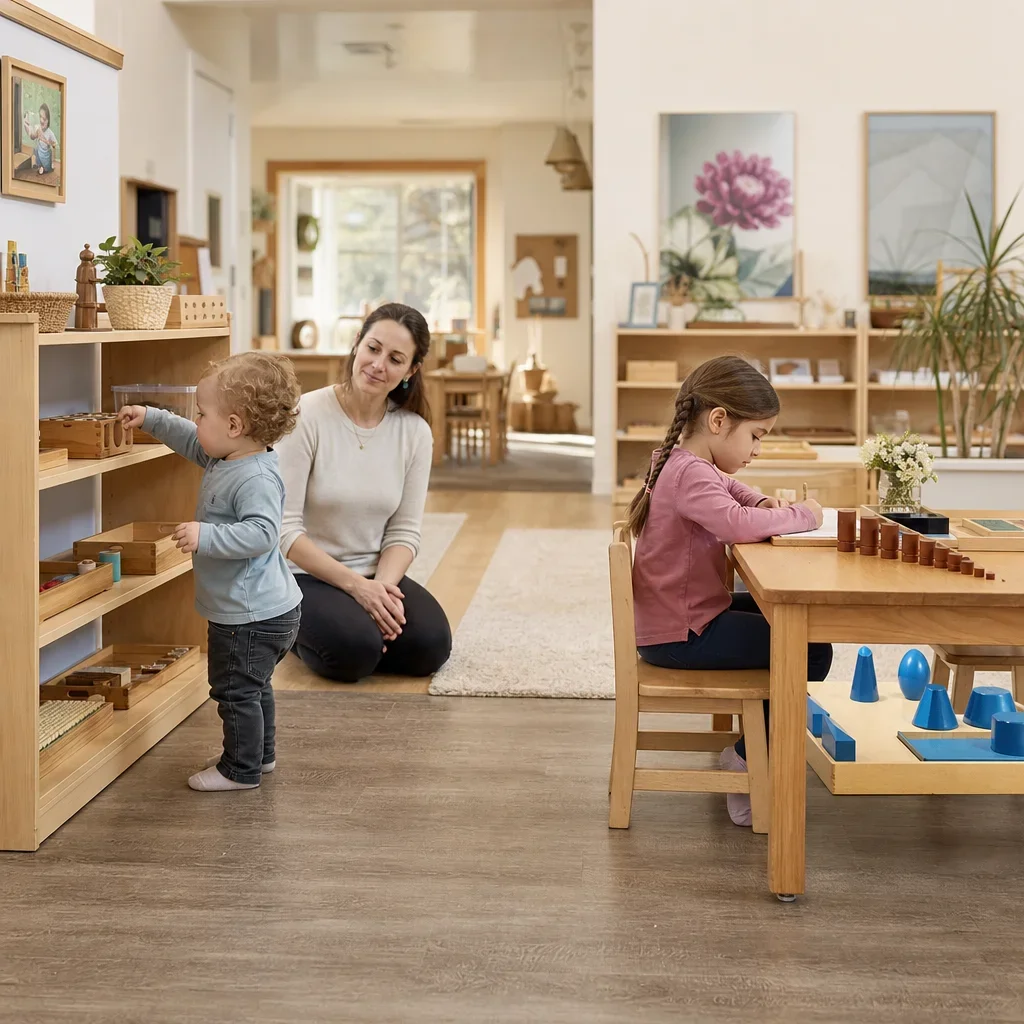
A Montessori day care program can meet a working family’s need for full-day care while also offering a structured early-learning environment. The difference is not that one setting cares and the other teaches. The difference is how the day, materials, adult role, and learning environment are organized.
| Area | Montessori junior toddler program | Traditional daycare setting | Preschool or Casa classroom |
|---|---|---|---|
| Daily environment | Child-sized materials are displayed on open shelves for purposeful use. | The setup varies by provider and curriculum approach. | Materials and routines are designed for older preschool-aged children. |
| Teacher role | Adults observe, model, supervise, and present activities. | Adults supervise, care for children, and plan activities according to the setting. | Adults guide more advanced Montessori lessons and longer work periods. |
| Independence | Children practise small care tasks such as tidying, feeding, and hand washing. | Independence goals depend on the provider’s daily routine. | Children usually manage more classroom routines with increasing support. |
| Materials | Activities may include pouring, matching, stacking, sorting, and vocabulary work. | Toys and group activities vary by program. | Materials may include more advanced language, sensorial, and early math work. |
| Rest and toileting | Care routines are part of the day and must be confirmed with each centre. | Care routines depend on the provider’s policies. | Expectations may differ because children are older. |
| Grouping | Some Montessori environments use multi-age groupings. | Grouping varies by licence category and provider. | Casa classrooms may include children across more than one preschool age. |
A Casa classroom is generally the next Montessori stage after early toddler care. Casa means “children’s house” in Montessori language, and it usually includes more complex materials and longer periods of independent work than a junior toddler setting.
No care model is automatically right for every family. Parents should choose a licensed setting that matches their child’s age, care needs, commute, family schedule, and the type of adult guidance they want in the classroom.
What Toddlers Do During the Day
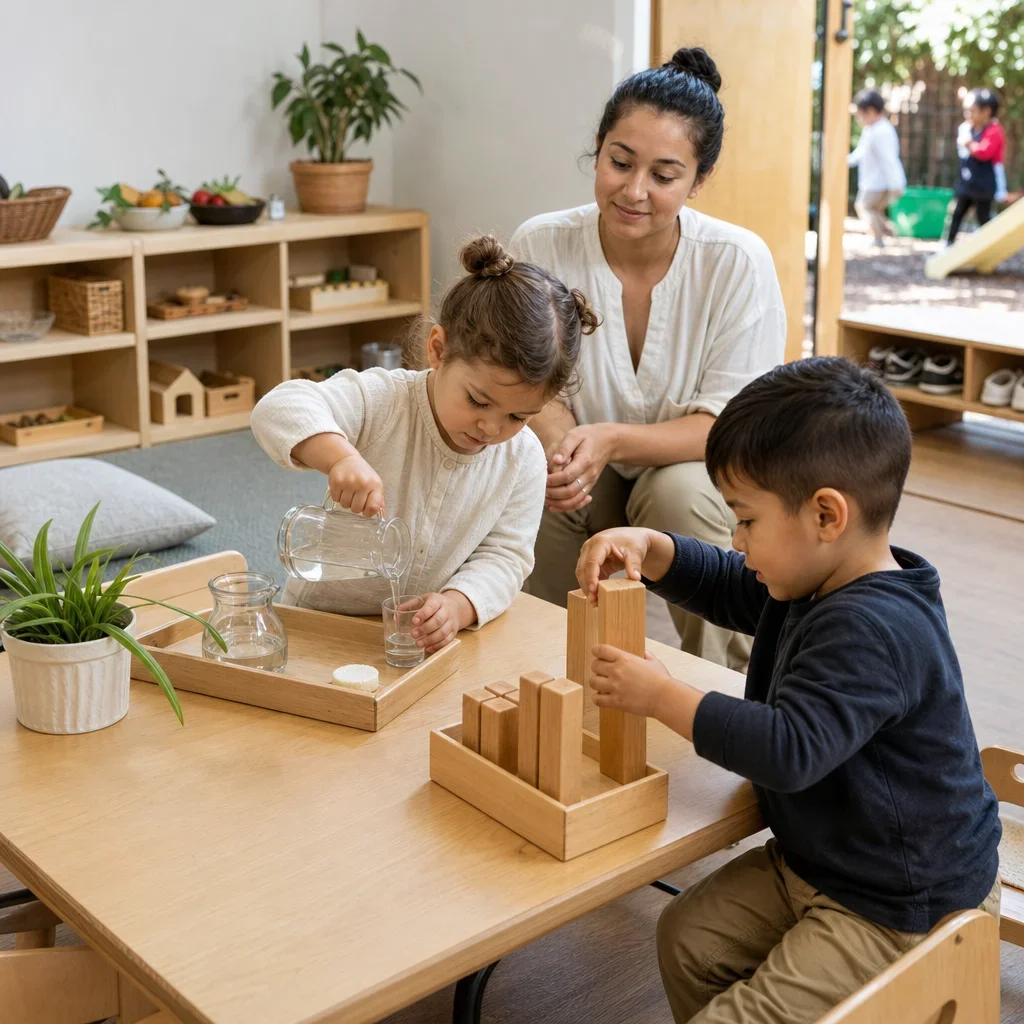
A toddler Montessori day follows a predictable rhythm rather than a constant stream of adult-led activities. Children move between arrival, activity time, meals, outdoor play, rest or quiet time, care routines, and pickup with teacher guidance.
A Montessori work cycle is a period when children choose from prepared activities, use a material carefully, return it to its place, and move to another activity. For toddlers, this may last only as long as their attention and routine allow.
Practical life activities are everyday tasks adapted for children. Pouring water, transferring with a spoon, wiping a table, putting away materials, and practising hand washing are examples of practical life work.
Sensorial work helps children explore differences they can see, touch, hear, or compare. Toddler materials may include objects for matching, sorting, stacking, nesting, texture exploration, and simple size comparison.
Language activities can include naming familiar objects, reading books, singing songs, matching pictures, listening to stories, and hearing adults model clear everyday language. Teachers observe each child and adapt presentations to the child’s participation and interests.
Creative arts, music, and movement can be part of a Montessori-based early-learning day. Cozy Time provides creative arts alongside practical-life skills and individualized learning.
Outdoor play gives toddlers space for movement, fresh-air routines, and supervised exploration. Parents should ask each campus how outdoor time is scheduled during different seasons.
An illustrative daily rhythm
A junior toddler schedule commonly includes these parts of the day, although the exact Cozy Time schedule should be confirmed with the centre.
- Arrival and a calm transition into the classroom.
- Montessori activities and individual or small-group presentations.
- Morning meal or snack routines, depending on the centre schedule.
- Outdoor play or active movement.
- Lunch and care routines.
- Nap or quiet time based on the classroom routine.
- Afternoon activities, snack, outdoor time, and pickup transitions.
What a Montessori Toddler Classroom Looks Like
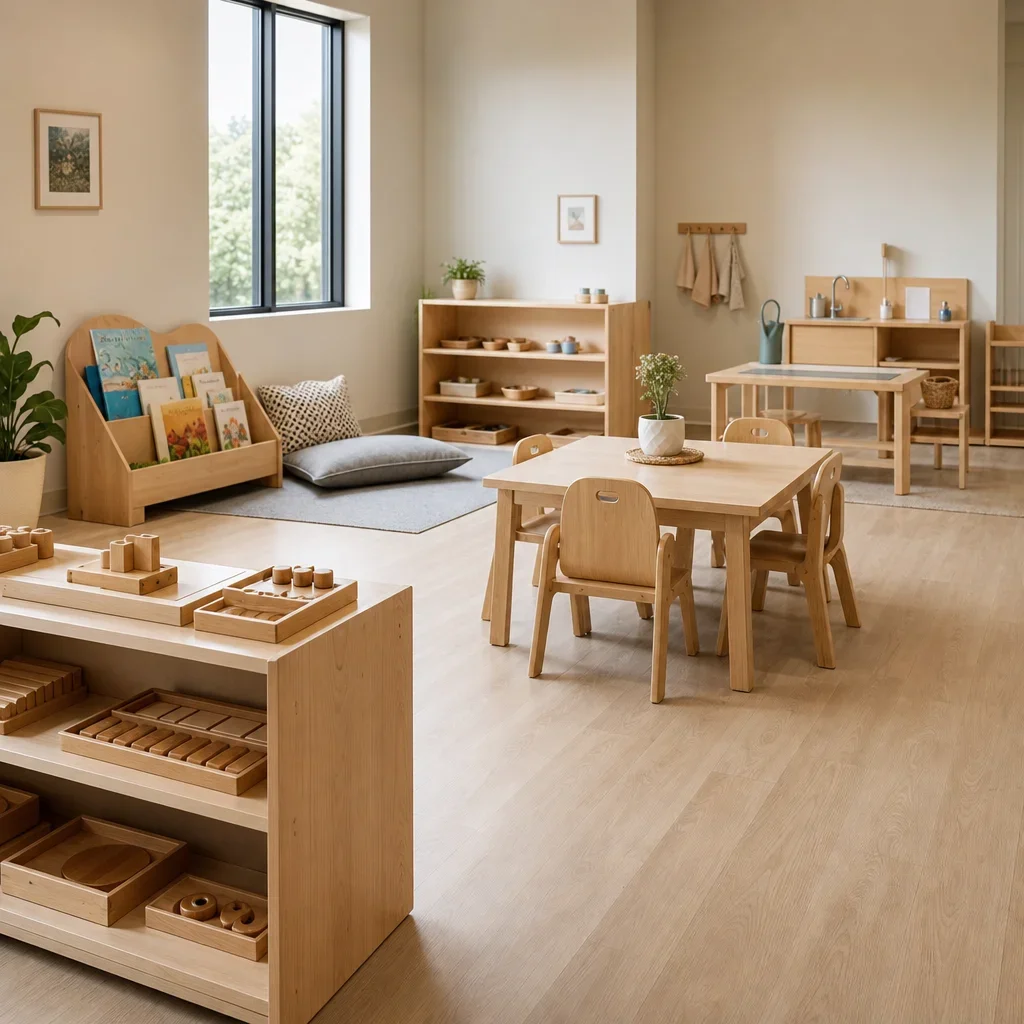
A Montessori junior toddler classroom is usually arranged so children can reach materials and understand where activities belong. Low open shelves, child-sized tables, defined activity areas, and simple displays help make the room easier to use.
Materials are shown in limited, intentional sets rather than piled together in large bins. This helps teachers present one activity at a time and helps children practise returning items after use.
A prepared environment is a core Montessori term. It means the room, materials, routines, and adult support are arranged for the age group using the space.
Order in the classroom does not mean expecting toddlers to be silent or still. It means adults provide clear places for activities, predictable transitions, and consistent routines for a busy age group.
Parents should ask to see the actual classroom during a tour. Real classroom photos and an in-person visit give clearer information than a generic description of Montessori materials.
Independence, Grace and Courtesy, and Big Feelings
Montessori supports independence through small daily tasks, not through expecting toddlers to manage alone. Teachers can model how to wash hands, sit for meals, carry a cup, put away an activity, and make a simple choice.
Grace and courtesy is Montessori language for respectful everyday behaviour. For toddlers, it can include gentle hands, waiting briefly, using words or gestures, caring for materials, and noticing other people in the classroom.
Tantrums, biting, conflict over materials, and separation anxiety can occur in any toddler setting. A quality program responds with close supervision, calm redirection, consistent language, adult modelling, and communication with families.
Montessori does not prevent normal toddler behaviour challenges. The value of a well-run classroom is that educators observe patterns, supervise closely, and respond in a consistent way rather than treating behaviour as a child’s fixed trait.
One criticism of Montessori is that some families perceive it as rigid or overly structured. Quality implementation should balance clear routines with responsive observation, realistic expectations, movement, and age-appropriate choices.
Children with ADHD, dyslexia, or other support needs should not be assessed through a website description of any school model. Families can discuss the child’s individual needs with the centre and relevant health or education professionals before choosing a program.
Naps, Meals, Toileting, and What to Pack
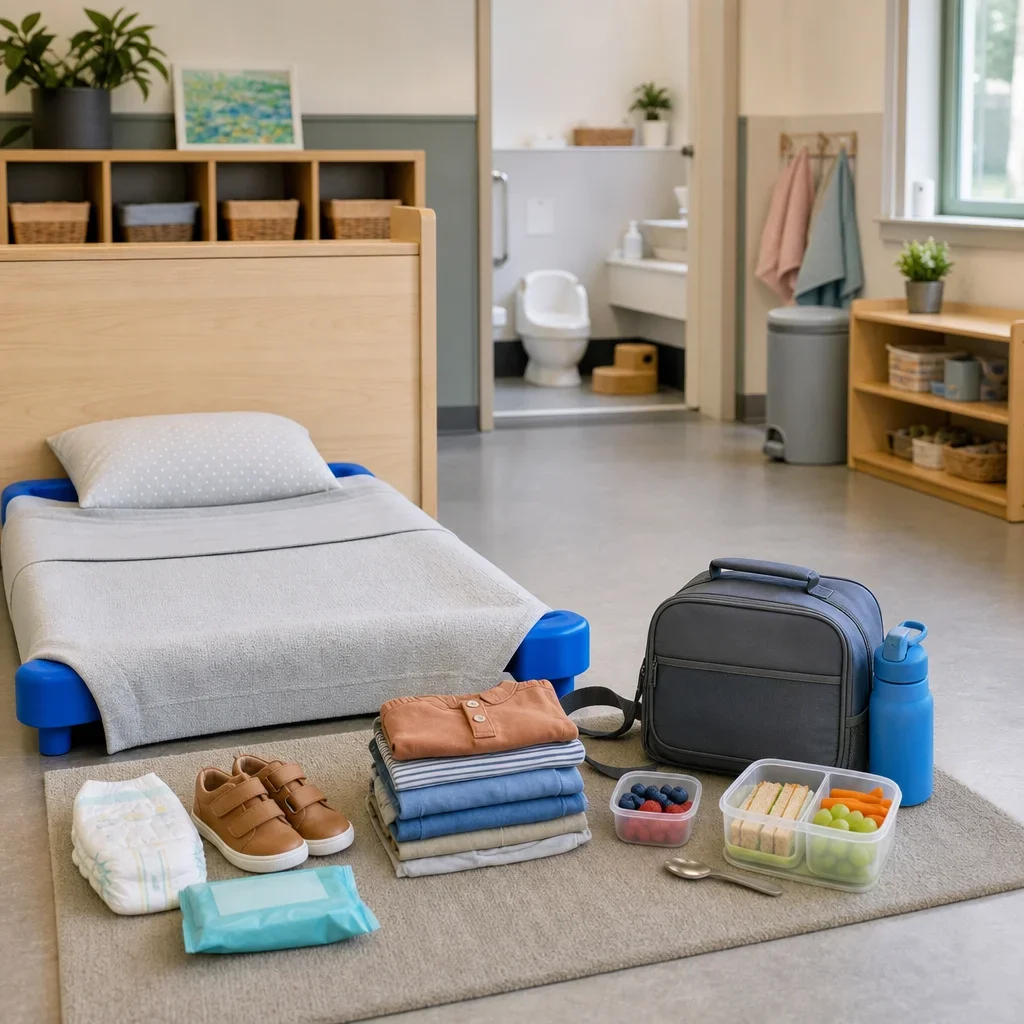
Daily care is part of licensed toddler programming, not separate from learning. Meals, rest, diapering, toileting, clothing changes, and comforting transitions all require attentive adult supervision.
Cozy Time Montessori Academy provides on-site meals. Families should contact the centre directly to confirm current menus, snack details, dietary accommodations, and allergy-related processes for their child.
Nap or quiet time is commonly included in full-day toddler care, but the exact routine and permitted comfort items should be confirmed with the relevant campus.
Respectful toileting support means treating diapering and toilet learning as care routines, not as a classroom test. The centre can explain its current expectations for diapers, wipes, spare clothing, toilet learning, and parent communication.
Parents usually need to provide labelled changes of clothing and personal care supplies requested by the centre. Indoor shoes, diapers, wipes, weather clothing, and sleep items may be requested depending on the program’s current procedures.
Teacher Qualifications, Ratios, Licensing, and Safety
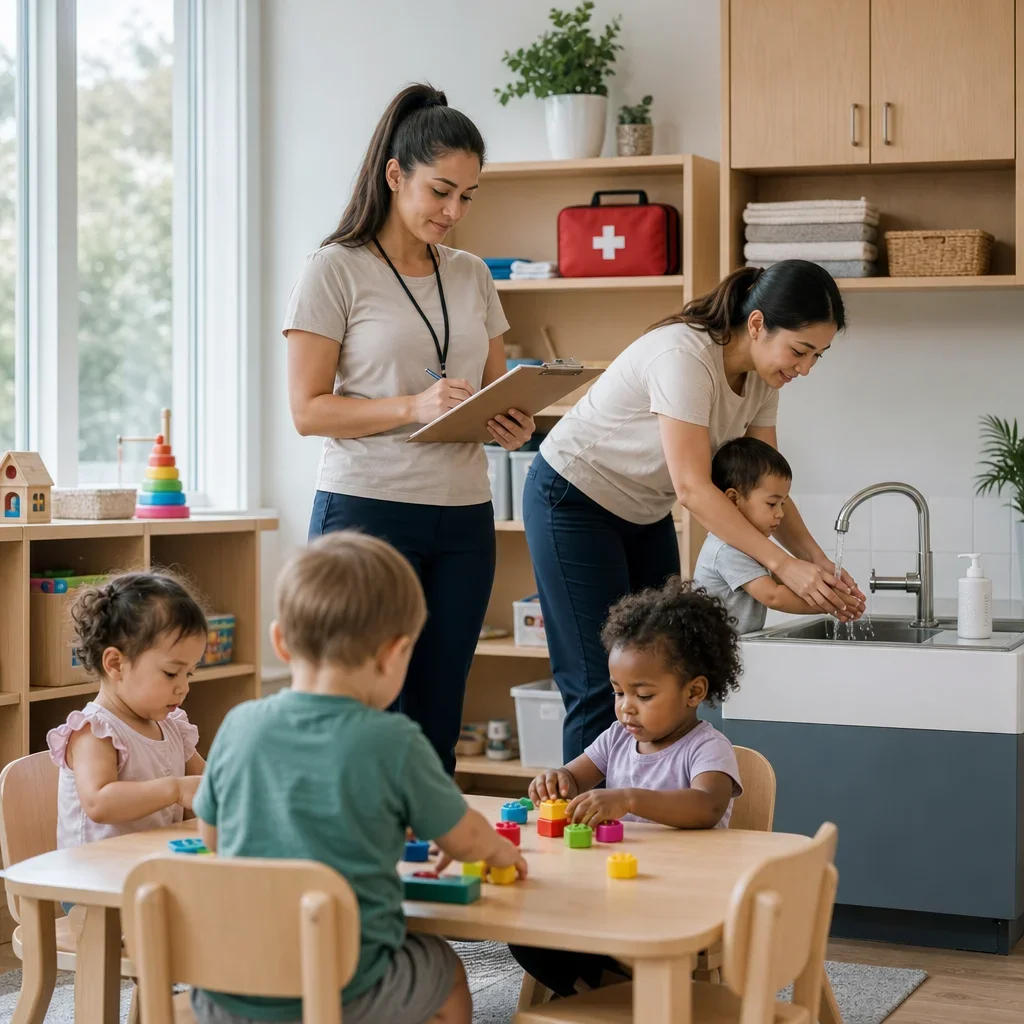
Cozy Time Montessori Academy is a licensed childcare centre in Ontario. Licensing matters because regulated childcare operates within Ontario requirements for supervision, staffing, health, safety, and program delivery.
Cozy Time’s stated ratios are 1:3 in Infant, 1:5 in Pre-Casa, and 1:8 in Casa. The centre can confirm which ratio and classroom grouping apply to a junior toddler inquiry.
A class ratio describes the number of children assigned per staff member. Ratios affect how educators supervise care routines, support transitions, observe children, and respond during active parts of the day.
Our staff include certified Montessori teachers, Early Childhood Educators, known as ECEs, and assistants. An ECE is a trained early-childhood professional whose work includes observing children, supporting play and learning, planning responsive experiences, and building relationships with families.
All Cozy Time staff are First Aid and CPR certified and have clean criminal record checks. Parents should still ask the centre to share its current safety, illness, pickup, emergency, medication, and allergy procedures before enrolment.
Licensed Montessori daycare Vaughan families should expect clear answers about ratios, staff roles, supervision, classroom access, and communication. A centre should be able to explain its actual practices without relying on vague reassurance.
Locations, Schedules, and Enrolment Steps
Cozy Time operates in Vaughan and Bolton, serving families across Vaughan, Maple, Woodbridge, Thornhill, Newmarket, and nearby GTA communities. This gives families searching for a Montessori junior toddler program near me a local starting point for comparing care options.
Families looking for Montessori daycare Woodbridge, Montessori daycare Maple, Montessori daycare Thornhill, or Montessori daycare Newmarket may wish to compare commute times alongside program quality. A shorter route can make morning drop-off and evening pickup more manageable for young children and working parents.
Families looking for Montessori daycare Bolton can contact our Bolton location to discuss current program placement and availability. The centre should confirm exact hours, full-time or part-time options, and any waitlist process directly.
The enrolment process usually begins with an inquiry and tour. Families can then discuss the child’s age, care needs, readiness, schedule, program placement, documentation, and current availability with the centre.
Every child settles at their own pace. A consistent arrival routine, familiar comfort strategies approved by the centre, and clear communication between home and educators can support the transition into group care.
Montessori Junior Toddler Program Cost and Funding Questions
Montessori junior toddler program cost depends on the child’s age group, schedule, location, and what the centre includes in its fees. Cozy Time does not publish tuition figures in this guide, so families should request current information directly from the campus.
A clear tuition conversation should cover monthly fees, registration costs, deposits, meal inclusion, schedule options, late pickup fees, and withdrawal terms. These policies should be confirmed in writing before a family enrols.
Families may also ask whether they qualify for local childcare subsidy programs or tax-related supports. Eligibility, funding participation, and application requirements are determined by the relevant government program and should not be assumed.
How to Evaluate Montessori Junior Toddler Program Reviews
Montessori junior toddler program reviews are most useful when they describe consistent practices rather than one unusually good or difficult day. Look for details about communication, cleanliness, teacher interaction, transition support, meals, routines, and how concerns are handled.
Reviews should not replace a tour. An in-person visit lets parents observe whether teachers are supervising actively, speaking respectfully, supporting care routines, and maintaining an environment that fits the child’s age group.
Parents should ask how the centre communicates about meals, sleep, toileting, mood, incidents, transitions, and classroom participation. The best communication method is one the centre can explain clearly and follow consistently.
Frequently Asked Questions
Montessori junior toddler program meaning
A Montessori junior toddler program is an early-learning setting for young children moving beyond infant care. The term is not universal, so families should confirm the school’s actual age grouping, routine, and classroom placement.
Junior toddler age in Montessori
Age placement differs by school and licence category. Cozy Time serves children from 6 months to 6 years across Infant, Pre-Casa, and Casa programs, and the centre can confirm the best current placement.
Montessori and 3-year-olds
Montessori can be an appropriate approach for a 3-year-old when the classroom placement, daily routine, and adult support fit the child’s stage. Cozy Time’s Casa program is part of its 6-month-to-6-year program offering.
Montessori compared with daycare
Montessori day care combines daily care with a prepared learning environment, purposeful materials, and adult observation. Traditional daycare programs can also provide quality care, but the curriculum and classroom approach may differ by provider.
Potty training requirements
Potty training is not automatically required by every early toddler program. Families should contact the centre to confirm its current diapering and toileting expectations before enrolment.
Toddler classroom activities
Toddlers may practise pouring, matching, sorting, stacking, language activities, music, movement, art, practical life, outdoor exploration, and care routines. The exact materials depend on the classroom and the child’s participation.
Naps, meals, and outdoor play
Cozy Time provides on-site meals. Families should confirm the current nap, snack, outdoor play, dietary, and comfort-item routines with the campus they plan to attend.
Licensed Montessori childcare ratios
Cozy Time states ratios of 1:3 for Infant, 1:5 for Pre-Casa, and 1:8 for Casa. The centre can explain which ratio applies to the available junior toddler placement.
Separation anxiety and tantrums
Educators support difficult transitions and big feelings through supervision, calm redirection, predictable routines, language modelling, and communication with families. Montessori programming does not guarantee that these normal toddler experiences will disappear.
Daily items to bring
Families may be asked for labelled spare clothing and requested personal-care supplies. The campus can provide the current list for diapers, wipes, shoes, weather clothing, sleep items, and other daily needs.
Booking a tour in Vaughan or Bolton
The best next step is to contact Cozy Time Montessori Academy and arrange a tour at the Vaughan or Bolton location. We can discuss your child’s age group, current program placement, care routine, and availability without asking you to guess from a program label alone.
A good tour should leave you with clear answers about licensing, ratios, educator qualifications, daily care, meals, communication, and your child’s possible transition into the classroom.