

Many parents think newborn brain development needs special toys or complicated routines. It does not. In the first 0–6 months, infant brain development is supported most by safe, repeated, responsive care: feeding, holding, talking, watching cues, and giving your baby time to rest. This guide is educational and focuses on birth to 6 months; if you are worried about your baby’s health or development, speak with your child’s doctor.
Newborn brain development at a glance
Newborn brain development from birth to 6 months is built through everyday experiences, not hacks. A baby learns from being comforted, hearing familiar voices, seeing faces up close, moving on the floor, and having an adult respond to cues in real time.
Early brain development in infants is uneven by nature. One baby may smile earlier, another may spend longer watching faces, and another may take more time to settle into play; variation across the first 6 months is normal.
Brain development for newborns is tied to the whole baby. Sleep, feeding, touch, movement, comfort, and relationships all work together, so the goal is not to push performance but to support a steady, safe routine.
Simple interaction matters more than expensive products. A parent talking during a diaper change, pausing for a coo, and answering that sound is doing high-value brain stimulation for infants without buying anything.
How a newborn’s brain develops from birth to 6 months
A baby’s brain starts developing before birth and keeps developing through childhood and beyond. In the first months after birth, the brain is organizing around repeated experience: what the baby sees, hears, feels, and does over and over.
Newborn brain development stages are easiest to understand as connection-building. When a baby hears your voice, turns toward light, kicks, feeds, or calms in your arms, the brain is linking sensation, movement, memory, and regulation through repetition.
Neurological development in infants is not separate from daily care. Vision, hearing, body awareness, attention, and early communication all grow through being fed, soothed, carried, placed on the floor, and spoken to throughout the day.
Mental development of an infant is also relational. Babies do not learn only from objects; they learn from back-and-forth interaction with people, especially when an adult notices a cue and responds in a calm, predictable way.
Month-by-month newborn brain development roadmap: 0–6 months
The clearest way to understand brain development 0 6 months is to look at what babies may notice, how they may communicate, how they may move, and what parents can do next. These are general patterns, not a diagnostic chart.
Birth to 4 weeks
In the first 4 weeks, babies usually focus best at close distance, notice strong contrast, startle to sudden sound, and calm to a familiar voice or touch. Communication is mostly crying, body tension, brief eye contact, and changes in sucking or alertness.
Movement at this stage is reflex-heavy. Your baby may turn toward touch, grasp reflexively, and move arms and legs in bursts, while social signs are short quiet-alert periods and interest in faces held close.
Helpful newborn brain development activities here are simple. Hold your baby face-to-face, talk during care, offer short tummy time when awake and supervised, and keep stimulation brief when your baby looks away or fusses.
1 month
At 1 month, many babies spend a little longer looking at faces and lights, and some begin to track a face or object briefly across a short distance. Communication still centres on crying, but you may hear small throat sounds or see more settled listening during a familiar voice.
Body control is still early at 1 month. Head lifting is brief, hands are often fisted, and floor play works best in short attempts rather than long sessions.
Help newborn brain development at this age by repeating the same small routines. Name what you are doing, pause after your baby’s sound or expression, and give short breaks between interactions.
2 months
At 2 months, babies often become more alert to voices, faces, and patterns. A social smile may begin around this period, and some babies start cooing during calm, face-to-face time.
Movement may include stronger kicking, smoother arm motion, and a little more head control in supported positions. Socially, your baby may show pleasure by brightening, widening eyes, or quieting when a familiar caregiver comes close.
Good infant brain development activities at 2 months include singing, reading aloud for a minute or two, slow visual tracking, chest-to-chest tummy time, and copying your baby’s sounds back.
3 months
At 3 months, babies often watch people more steadily and may track objects farther with their eyes. Cooing can become more frequent, and some babies begin early turn-taking sounds in response to an adult voice.
Hand discovery often expands now. Your baby may bring hands to mouth, bat at a toy, or spend time staring at fingers, which supports body awareness and attention.
Ways to stimulate infant brain development at 3 months include floor play, mirror time, songs with pauses, gentle rattles, and waiting a moment after your baby vocalizes so the interaction becomes a back-and-forth exchange.
4 months
At 4 months, babies often become more socially engaged and more interested in cause and effect. They may laugh, squeal, watch your mouth when you speak, and reach more clearly toward a toy or caregiver.
Movement becomes more intentional around this stage. Rolling attempts may begin, tummy time may last longer in small stretches, and your baby may push up more strongly through forearms.
Baby brain development activities 0 6 months are still low-tech at 4 months. Try peek-a-boo beginnings, grasping toys of different textures, nursery rhymes with gestures, and supervised floor time with space to turn and reach.
5 months
At 5 months, babies may show stronger curiosity about people, objects, and repeated games. They may use more varied sounds, react to tone of voice, and study an object before reaching, mouthing, or shaking it.
Physical exploration often grows here. Many babies roll one way, kick with force, transfer attention between a face and a toy, and spend longer in active play before needing a break.
Positive brain development for infants at 5 months is supported by repetition. Repeat songs, name family members, offer supervised texture play, and give your baby time to examine a simple object without rushing to the next activity.
6 months
At 6 months, many babies are more active, social, and vocal than they were in the newborn period. Babbling may begin for some babies around this stage, and interest in faces, routines, and simple games is often stronger.
Attention and movement also work together more clearly by 6 months. Your baby may reach with purpose, roll, push up, watch where a sound comes from, and show excitement before a familiar routine such as feeding or bath time.
How developed is a baby’s brain at 6 months? It is still in a very early stage and continues developing well beyond infancy. At 6 months, the useful question is not whether the brain is finished, because it is not, but whether your baby is connecting, moving, responding, and regulating in ways that fit a broad normal range.
Newborn brain development chart: 0–6 months
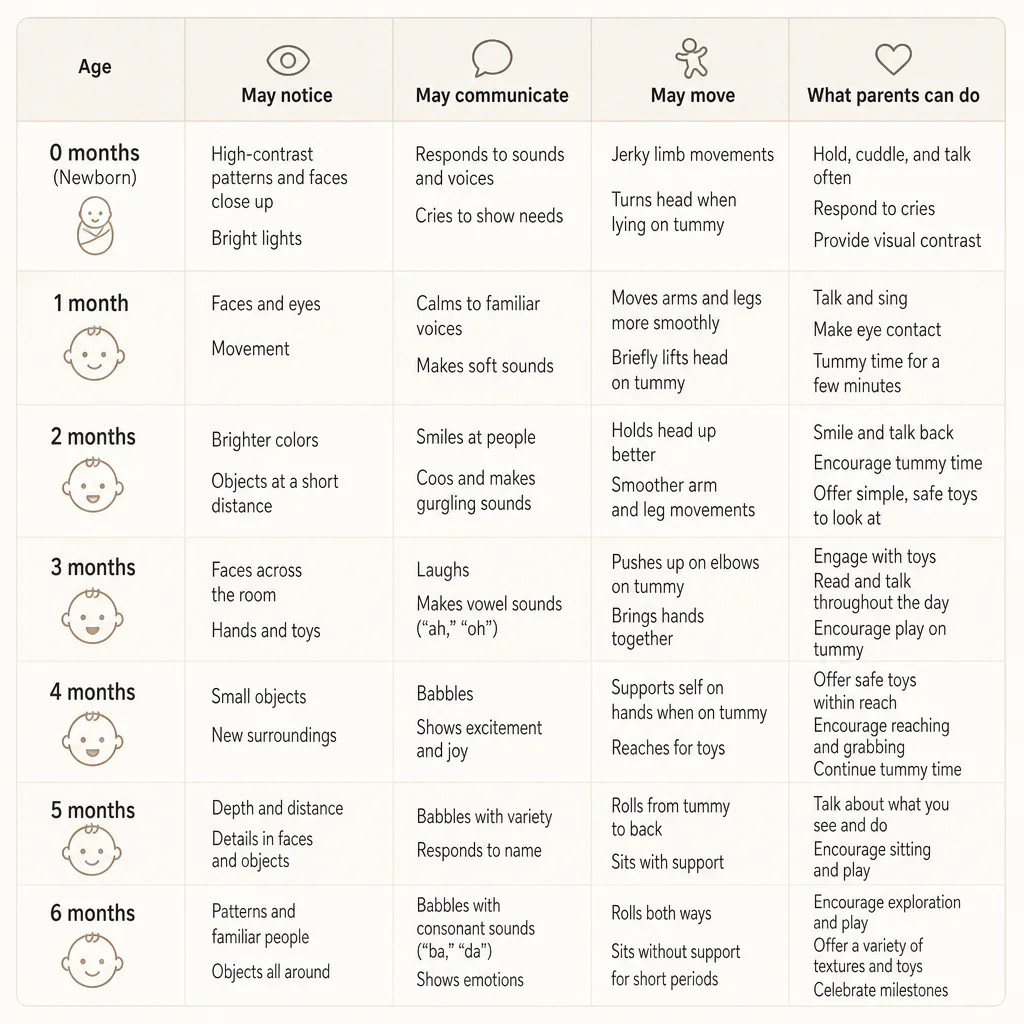
| Age | May notice | May communicate | May move | What parents can do |
|---|---|---|---|---|
| Birth to 4 weeks | Faces up close, contrast, voice | Crying, brief eye contact | Reflexive movement, short head lift | Hold close, talk, short tummy time |
| 1 month | Faces a bit longer, brief tracking | Crying, quiet listening | Brief head lift, hands fisted | Repeat routines, pause and respond |
| 2 months | Faces, patterns, voices | Cooing may begin, social smile may emerge | Stronger kicking, better head control | Sing, read briefly, copy sounds |
| 3 months | Tracks farther, studies hands | More cooing, turn-taking sounds | Bats at toys, brings hands to mouth | Mirror play, rattles, floor time |
| 4 months | Cause and effect, facial expression | Laughs, squeals | Reaches, rolling attempts | Peek-a-boo, textures, songs |
| 5 months | Objects and routines | Varied sounds | Rolls one way for some, longer play | Repeat games, texture exploration |
| 6 months | Sounds, faces, familiar games | Babbling may begin | Purposeful reaching, rolling, pushing up | Simple games, floor movement, narration |
What to do today: simple daily routines that support newborn brain development
The best ways to stimulate newborns brain development are already built into care routines. During waking, feeding, diapering, burping, bath time, cuddling, and bedtime, your baby gets repeated chances to hear language, feel secure, and learn what comes next.
Diaper changes support brain stimulation for infants when they become a short back-and-forth routine. Make eye contact, name each step, pause after a sound or movement, and let your baby see your face before moving on.
Feeding supports infant brain development because it combines closeness, rhythm, voice, smell, and regulation. Whether your baby is breastfed, formula fed, or both, feeding time can include quiet talking, waiting for cues, and slowing down when your baby needs a pause.
Burping and soothing support regulation when you use a predictable sequence. Hold, pause, pat gently, speak softly, and repeat the same few steps so your baby begins to connect sensation with comfort.
Floor time helps newborn brain development because movement and learning are linked. A few short supervised periods on a firm floor space let babies kick, turn, lift, stretch, and notice their own bodies without the limits of a container.
Bath and bedtime routines help newborn brain development by making the day more predictable. A simple order such as wash, dry, feed, cuddle, and sleep cue gives the baby repeated patterns to experience and reduces the need for constant novelty.
Even a tired parent can support early brain development in infants in a few minutes. One calm song, one short book, or one focused diaper change with eye contact still counts because responsive attention, not perfect performance, does the work.
Best newborn and infant brain development activities by age
The best newborn brain development activities are brief, interactive, and repeated. They should match your baby’s age band, and they should stop when your baby looks away, stiffens, cries, yawns, or seems tired.
Birth to 1 month
Face-to-face talking is enough at this stage. Add short tummy time, gentle rocking, skin-to-skin when it fits your family, and brief contrast images used for a moment rather than a long session.
1 to 2 months
Try singing during care, reading aloud in a calm voice, slow side-to-side tracking with your face or a simple object, and chest-to-chest play. Newborn brain development activities at this age work best in short repeats across the day.
2 to 3 months
Add mirror time, copying coos, pausing for your baby’s response, gentle rattles, and supervised floor play. Baby brain development activities 0-3 months do not need to look impressive; they need to be responsive.
3 to 4 months
Use grasping toys, songs with hand motions, more tummy time in short tries, and early peek-a-boo. Stimulate infant brain development here by waiting for your baby to notice, reach, or vocalize before you change the game.
4 to 5 months
Offer safe texture exploration, nursery rhymes, lap play, and simple cause-and-effect play such as shaking a rattle. Infant brain development activities become more fun here because babies often stay engaged a bit longer.
5 to 6 months
Try object passing from one hand area to another, more floor movement, song repetition, sound imitation, and simple hiding games with part of a toy or your face. Ways to stimulate infant brain development at 5 to 6 months still rely on people more than products.
Serve-and-return: the most important interaction skill for infant brain development

Serve-and-return means your baby sends a cue and you answer it. The cue may be a cry, coo, kick, smile, gaze, head turn, or reaching motion, and your response tells the baby that communication works.
This pattern supports infant brain development because it builds attention, early language, and emotional security through repetition. A baby coos, you coo back, the baby pauses, you smile and wait, and the exchange continues for another turn or two.
During feeding, serve-and-return can sound very simple. “You stopped sucking. You need a break. There you go.” The concrete fact is the sequence itself: notice, interpret, respond, pause.
During diapering, serve-and-return may start with a kick or sound. You can answer with “I see your feet moving,” wait, and then continue with the next step, which helps the baby connect action, language, and response.
Fathers, partners, grandparents, and caregivers can all do this. Help newborn brain development by making small back-and-forth moments part of care, not by trying to perform a lesson.
Talking, reading, singing, touch, and movement: what matters most
What stimulates baby brain development most reliably is frequent, responsive interaction spread across the day. Talking, reading, singing, gentle touch, eye contact, and movement all matter because they give the baby repeated sensory and social experience.
How much should you talk, read, and sing to your baby? There is no useful quota in this guide, and rigid targets are not the point. Newborns do best with short, repeated interactions rather than constant stimulation.
Parentese, which means the naturally warm, sing-song voice adults often use with babies, helps hold attention. Reading aloud also helps, even when your baby does not understand the words, because the baby is learning your rhythm, pauses, facial expression, and tone.
Touch matters because babies learn through their whole bodies. Holding, cuddling, rocking, massage if your baby enjoys it, and calm transitions between activities all support regulation and connection.
Movement matters because neurological development in infants includes visual tracking, head control, reaching, body awareness, and exploration. Floor time, carrying, stroller walks with narration, and supervised tummy time all fit into that picture.
Tummy time, floor play, and movement for brain and body development
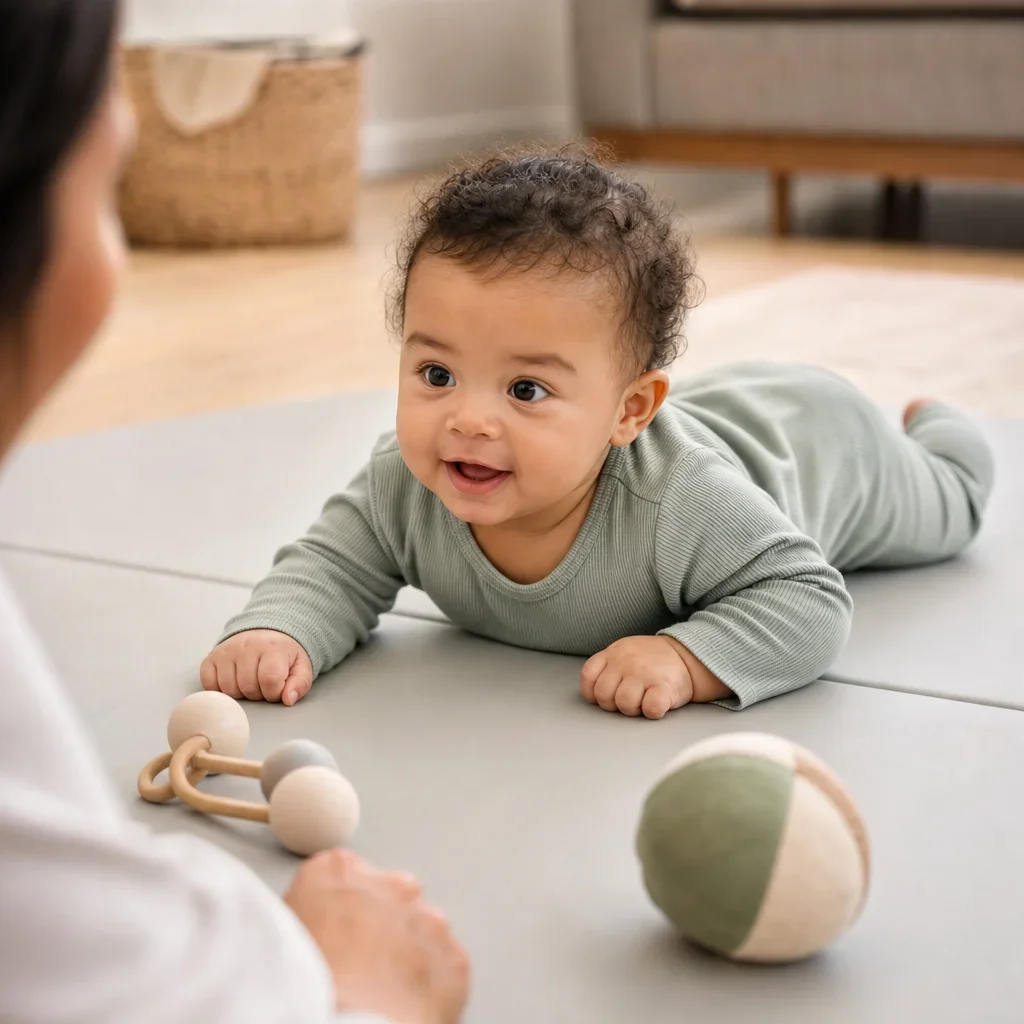
Tummy time supports both brain development for newborns and body development because it links vision, head control, shoulder strength, and awareness of space. It does not need to happen in one long stretch to be useful.
Short, supervised tummy time attempts can start in the newborn period. If your baby resists, chest-to-chest positioning, laying the baby across your lap briefly, or trying again later are practical alternatives.
Floor play matters because babies learn by moving against gravity and noticing what their bodies can do. Kicking, reaching, rolling attempts, turning toward sound, and looking from a face to a toy all come more naturally on the floor than in a seat.
Containers can be helpful for short practical moments, but they are not a substitute for open movement. When parents ask how to stimulate a newborn baby’s brain, one concrete answer is to make room every day for supervised floor time.
Sleep, feeding, and routines that support healthy brain development

What’s good for baby brain development is not only play. Babies learn and regulate best when they are fed, rested, comforted, and safe.
Sleep supports infant brain development because overtired babies often have a harder time engaging, feeding, and settling. A calm sequence before sleep can help without promising that every baby will sleep the same way.
Feeding supports early brain development in infants through nutrition, closeness, and cue reading. Families may use breastfeeding, formula feeding, or a combination, and responsive feeding matters across those approaches.
Routines support brain development for newborns because repetition helps babies predict what comes next. Predictability is especially useful in the first 6 months, when babies are learning how the day feels and how comfort arrives.
Around 6 months, some families begin talking with their healthcare provider about solids, but this guide stays focused on 0–6 months and does not replace feeding advice for your child.
What does not help: screens, overstimulation, and misleading products
Babies do not need expensive educational products for positive brain development. Human interaction has more value than passive entertainment because babies learn from response, timing, and relationship.
Screen exposure is not the same as conversation. A video can show colour and sound, but it cannot notice your baby’s cue, wait, or answer in the way a real caregiver can.
So-called educational products often promise more than they deliver. For newborn brain development, the useful standard is simple: if a product reduces real interaction, it is usually lower value than face-to-face time.
| Higher-value support | Lower-value support |
|---|---|
| Talking during care | Background videos |
| Reading aloud | App-based “learning” for a newborn |
| Singing and pausing for response | Constant flashing toys |
| Supervised floor time | Long periods in containers |
| Simple rattles, books, mirrors | Expensive products marketed as IQ boosters |
How to tell if your baby is overstimulated and how to calm them
More stimulation is not always better for newborn brain development. Babies often show they need a break by turning away, yawning, hiccupping, finger splaying, fussing, arching, crying, or becoming hard to settle.
Overstimulation signs are not a sign that you failed. They are a cue that your baby has had enough input for that moment, and some babies need shorter play windows than others.
Calming usually works best when you reduce input first. Lower the noise, dim the space if possible, hold your baby close, slow your voice, pause the activity, and offer feeding or comfort if that matches your baby’s cues.
Brain stimulation for infants works best when it is balanced with recovery. A short, calm interaction followed by rest is more useful than pushing a baby to stay engaged.
Normal newborn behavior vs signs of concern in the first 0–6 months
Parents often feel stuck between “this is probably normal” and “should I worry?” A simple comparison helps, but it does not diagnose a condition.
| Often normal in the first 0–6 months | Worth discussing promptly with a doctor |
|---|---|
| Crying as communication | Poor feeding or feeding difficulty that is persistent |
| Variable sleep and fussy periods | Extreme floppiness or marked stiffness |
| Startle reflex | No response to sound over time |
| Looking away when tired | Limited engagement that concerns you over time |
| Uneven mood across the day | Loss of skills already seen |
| Needing short play periods | Seizure-like activity, unusual repetitive movements, or persistent asymmetry |
A red flag is not about one imperfect day. A concern becomes more important when a pattern persists, when skills seem absent over time, or when your baby loses a skill already present.
Urgent symptoms need urgent care. Trouble breathing, blue colour, seizure-like activity, or marked lethargy should be treated as emergency concerns.
When to call your doctor or seek early support
If you are worried your baby is not developing normally, the right next step is to document what you are seeing and bring it forward. Notes about feeding, sleep, movement, sounds, eye contact, and soothing can make an appointment more useful.
Videos can help because they show what happens in real time. If a movement, staring spell, feeding issue, or asymmetry concerns you, a short video may help your doctor understand the pattern.
Early discussion is better than waiting and worrying. Screening tools and milestone trackers can support observation, but they do not replace a clinical assessment.
The safest path is simple. If a change feels significant, persistent, or unusual to you, call your child’s doctor.
Common myths about baby IQ, intelligence signs, and “boosting” brain power
There is no safe shortcut that guarantees a higher IQ. Claims that a toy, supplement, app, or pressure-based program will increase intelligence are not a sound basis for infant care.
How can I improve my baby’s brain development in a real sense? Support sleep, feeding, safety, responsive care, and early conversation. Those are the foundations parents can actually provide.
Early behaviours are not reliable labels of genius or low ability. A quiet baby, a busy baby, an early smiler, or a late babbler within a normal range should not be ranked as proof of future intelligence.
The healthier goal is support, not scoring. Newborn brain development stages are about connection and regulation, not trying to measure a baby’s future performance.
How fathers, partners, and other caregivers can support newborn brain development
Fathers, partners, grandparents, and other caregivers can support newborn brain development through repeated care, not only special play sessions. Bottle support, soothing after work, stroller walks with narration, bath routines, songs, and face-to-face play all count.
Consistency matters more than perfection. A caregiver who does the same bedtime song 5 nights a week is giving the baby repeated language, rhythm, and predictability.
Bonding does not have to feel instant to be real. For some adults, connection grows through changing, feeding, carrying, and settling a baby over the first weeks and months.
Multilingual homes support language through real use. Speaking in your family’s natural language gives your baby rich, meaningful input and helps caregivers interact more naturally.
How a high-quality infant daycare environment can support early brain development
A high-quality infant childcare setting supports infant brain development by extending the same responsive care parents use at home. What matters most is licensed care, trained staff, safe routines, calm transitions, floor time, language-rich interaction, and communication with families.
In Ontario, licensed childcare is regulated, and class ratios are set by age group. Parents choosing infant care should ask about ratios, staff qualifications, how the day is structured, and how caregivers respond to feeding, sleep, and soothing cues.
At Cozy Time Montessori Academy, our Infant program serves children from 6 months to 18 months with a 1:3 ratio. Our staff include Early Childhood Educators, certified Montessori teachers, and assistants, and our team members are First Aid/CPR certified with clean criminal record checks.
Our role is not to promise a developmental outcome. Our role is to observe, support, supervise, and communicate clearly so families know how their baby is eating, resting, playing, and settling through the day.
For Vaughan and GTA families looking at a Montessori infant program, the best next step is to visit and see the room. A tour shows more than a brochure can: the pace of the day, the ratio, the floor space, the tone of caregiver interaction, and how routines are handled.
0–6 month newborn brain development checklist
This brain development 0 6 months checklist is for observation, not diagnosis. If you have concerns, bring your notes to your healthcare provider.
Birth to 1 month
- Notices close faces or strong contrast
- Calms sometimes to a familiar voice or touch
- Has short quiet-alert periods
- Tolerates brief supervised tummy time
- Benefits from holding, talking, and gentle routine repetition
1 to 2 months
- Watches faces a bit longer
- May begin brief tracking
- Shows changing cries or small sounds
- Lifts head briefly during tummy time
- Enjoys singing, reading, and face-to-face play
2 to 3 months
- May social smile around this period
- Coos during calm interaction
- Kicks more strongly
- Watches your face during talking
- Enjoys copied sounds and short mirror play
3 to 4 months
- Tracks people or objects more steadily
- Brings hands to mouth
- Bats at toys
- Takes part in simple back-and-forth sounds
- Enjoys rattles, songs, and floor play
4 to 5 months
- Reaches more clearly for toys
- Shows more laughter or squeals
- Tolerates longer short play periods
- May attempt rolling
- Enjoys texture play and nursery rhymes
5 to 6 months
- Shows stronger curiosity about objects and people
- Uses more varied sounds
- Reaches with purpose
- May roll or push up more strongly
- Enjoys repeated songs, simple games, and open floor space
FAQ
What stimulates baby brain development?
Responsive interaction stimulates baby brain development most reliably. Talking, feeding, cuddling, eye contact, movement, and serve-and-return exchanges give babies repeated chances to build attention, regulation, and communication.
What helps newborn brain development?
Safe, predictable care helps most. Feeding, sleep, comfort, touch, short play periods, and calm repetition all support brain development for newborns.
How can I stimulate my newborn’s brain at home?
Use everyday routines. Talk during diaper changes, sing during feeding, offer short supervised tummy time, hold your baby face-to-face, and pause for your baby’s response.
What are the best newborn brain development activities?
The best activities are face-to-face talking, reading aloud, singing, tummy time, floor play, mirror time, simple rattles, and short sensory experiences matched to age.
How developed is a baby’s brain at 6 months?
A baby’s brain is still in an early stage at 6 months and continues developing through childhood and beyond. The goal at this age is responsive support, not trying to finish development early.
What are normal brain development milestones from 0 to 6 months?
General milestones include noticing faces and voices, calming to familiar input, social smiling, cooing, tracking, hand discovery, reaching, rolling attempts, and increasing social engagement across the first 6 months.
How much should I talk, read, and sing to my baby?
Think frequent and brief, not perfect and constant. Short, repeated interactions across the day are more realistic and more useful than trying to meet a rigid quota.
Do babies need special toys for brain development?
No. Simple, safe items and real interaction are enough. Your face, voice, hands, books, songs, floor space, and a basic rattle offer more value than most marketed products.
How can I tell if my baby is overstimulated?
Common signs include turning away, fussing, arching, hiccupping, yawning, finger splaying, crying, or having trouble settling after play.
What are early signs of neurological issues in infants?
Persistent feeding difficulty, marked stiffness or floppiness, no response to sound over time, loss of skills, seizure-like activity, or persistent asymmetry are worth discussing promptly with a doctor.
When should I call a doctor about my baby’s development?
Call when a concern is persistent, significant, or unusual to you, or when your baby seems to lose a skill. Seek urgent care for trouble breathing, blue colour, seizure-like activity, or marked lethargy.
Can daycare support infant brain development?
Yes, if the environment is licensed, responsive, safe, and age-appropriate. In infant care, parents should look for trained staff, low ratios, calm routines, communication with families, and time for floor movement and interaction.
If you are comparing infant daycare in Vaughan or Bolton, we recommend seeing the classroom in person. Contact the centre to confirm availability for your child’s age group and to ask how the infant day is structured.