
Cognitive lesson plans for infants are flexible plans for responsive play. They identify a learning opportunity, safe materials, caregiver actions, and behaviours to notice. Think face-to-face sounds, shared books, peek-a-boo, and exploring a simple toy, not lessons at a desk.
Age groups below help you find an activity to try. Your baby’s comfort, positioning, interests, and access needs guide the choice. A baby can watch, listen, touch, move, or pause without completing anything.
What Cognitive Lesson Plans for Infants Actually Include
An infant cognitive lesson plan organizes an opportunity to explore. Its objective might be noticing that moving a toy produces sound. The adult prepares the space, responds to the baby, and observes what happens.
Cognitive skills are ways of attending, remembering, recognizing, and exploring relationships. Movement lets a baby reach an object; cognition includes exploring what that object does. Language and relationships provide shared words, gestures, and responses during that exploration.
Supporting infant learning means offering accessible materials and responding to cues. During caregiving, you can name a familiar object, pause during a song, or describe an action. These are learning opportunities without drills, performance targets, or promises about development.
Cognitive Skills Babies Can Explore Through Play
The table groups infant cognition into seven practical categories. This is an organizing tool, not a universal developmental checklist. The behaviours are possibilities to notice, not responses every baby must demonstrate.
| Skill | Plain-English meaning | Possible observation | Play example |
|---|---|---|---|
| Attention | Orienting toward an experience | Turns toward a familiar voice | Face-to-face sounds |
| Memory and recognition | Recognizing something encountered before | Reacts when a familiar song begins | Repeating a familiar song |
| Cause and effect | Exploring connections between actions and events | Moves a sound toy again after hearing it | Sound and pause |
| Object permanence | Understanding that something still exists when out of view | Looks toward where a toy was partly hidden | Partly hidden toy play |
| Early problem-solving | Exploring ways to reach or use something | Changes a hand movement while reaching | A visible toy within comfortable access |
| Imitation | Copying an observed action, expression, or sound | Tries a familiar gesture after an adult models it | Copying a simple wave |
| Emerging categorization | Noticing similarities and differences | Explores similar objects together | Comparing large, age-rated play objects |
Cognitive development across 0–12 months does not follow a lesson schedule. Early plans can centre on faces, voices, and sensory experiences. Later invitations can include containers and simple searches when accessible. Categorization and pretend play are not newborn expectations.
A Reusable Infant Lesson-Plan Template
A useful plan describes the experience rather than a required achievement. Write “explore the sound produced by movement,” not “master cause and effect.” Use the template below freely for home play or caregiver planning.
| Planning field | What to record |
|---|---|
| Activity name | A short description, such as Sound and Pause |
| Suggested stage and readiness | Comfortable position, access needs, interest, and relevant exploration |
| Cognitive objective | The opportunity offered, without a performance target |
| Materials | Intact, age-rated items suitable for mouthing |
| Safe setup | Clear floor-level space, accessible materials, attentive supervision |
| Steps | A short sequence of adult actions and pauses |
| Caregiver language | Simple words, sounds, or gestures connected to the activity |
| Observations | What the baby actually looks at, touches, repeats, or avoids |
| Easier variation | Less stimulation, closer access, or an adult-held material |
| Next variation | A small change offered only when interest supports it |
Observations should describe actions without grades or conclusions about ability. “Looked toward the toy after the sound stopped” records something visible. “Understands everything” does not identify what happened or guide the next invitation.
Safe Setup Before Infant Play
Infant play needs attentive adult supervision and materials suited to the baby. Check the setup before offering any activity, including a familiar one.
- Choose intact, age-rated toys. Follow their use and cleaning instructions.
- Use a clear floor-level play area and a position the baby comfortably manages. Do not prop a baby into an unsupported position.
- Keep loose small parts, water beads, balloons, accessible magnets, button batteries, and cords out of play.
- Avoid homemade objects with detachable pieces, loose fillings, or uncertain construction.
- Offer tummy time only while the baby is awake and actively supervised. Use another comfortable position when needed.
- Keep loose play materials out of sleep spaces. These activities are for awake play.
- Clean mouthed materials according to their instructions before another child uses them. Do not pass shared mouthing toys between babies without appropriate cleaning.
- Pause for turning away, fatigue, distress, or signs that the experience is too much.
- Never cover the baby’s face during peek-a-boo. Hide your own face with your hands instead.
Physical activities for infants can include looking, reaching, turning, and exploring from a comfortable position. The purpose here is access to play, not practising a posture at any cost. Never pull limbs through a response or require sitting or crawling to participate.
Cognitive Play Plans for Babies Aged 0–3 Months

These early-infancy activities use an adult’s face, voice, or a simple image. They are home-play ideas, not a statement about childcare enrolment eligibility. Eye contact, sounds, and visual following are invitations, not requirements.
Face-to-Face Sounds and Pauses
Stage and readiness: An awake baby who is comfortable with quiet interaction. Objective: Offer attention and recognition through a familiar face and voice.
Materials: Your face and voice. Safe setup: Hold your baby securely with appropriate head support, or sit beside their clear floor-level play space.
- Bring your face into a comfortable viewing position.
- Make a gentle sound or a simple expression.
- Pause. Respond to a movement, sound, expression, or continued watching.
Caregiver language: “Hello. I hear you.” Observe: Notice orientation toward your voice, changes in expression, or turning away. Silence is not a failed response.
Easier variation: Speak softly without adding expressions or movement. Next variation: Echo a sound your baby makes, then leave a pause.
Look and Follow
Stage and readiness: An awake baby interested in looking. Objective: Offer visual attention without requiring tracking.
Materials: An intact, infant-safe high-contrast picture or board book. Safe setup: Keep the item in your hand, away from the baby’s face, while they rest comfortably.
- Present the picture where your baby can comfortably notice it.
- Hold it still before moving it slowly a little to the side.
- Pause or return to the original position if interest changes.
Caregiver language: “Here is the picture.” Observe: Notice looking, a head turn, a brief glance, or looking elsewhere. Do not seek sustained eye contact.
Easier variation: Keep the image still and reduce surrounding stimulation. Next variation: Present another simple image separately, following the baby’s interest.
Cognitive Play Plans for Babies Aged 3–6 Months
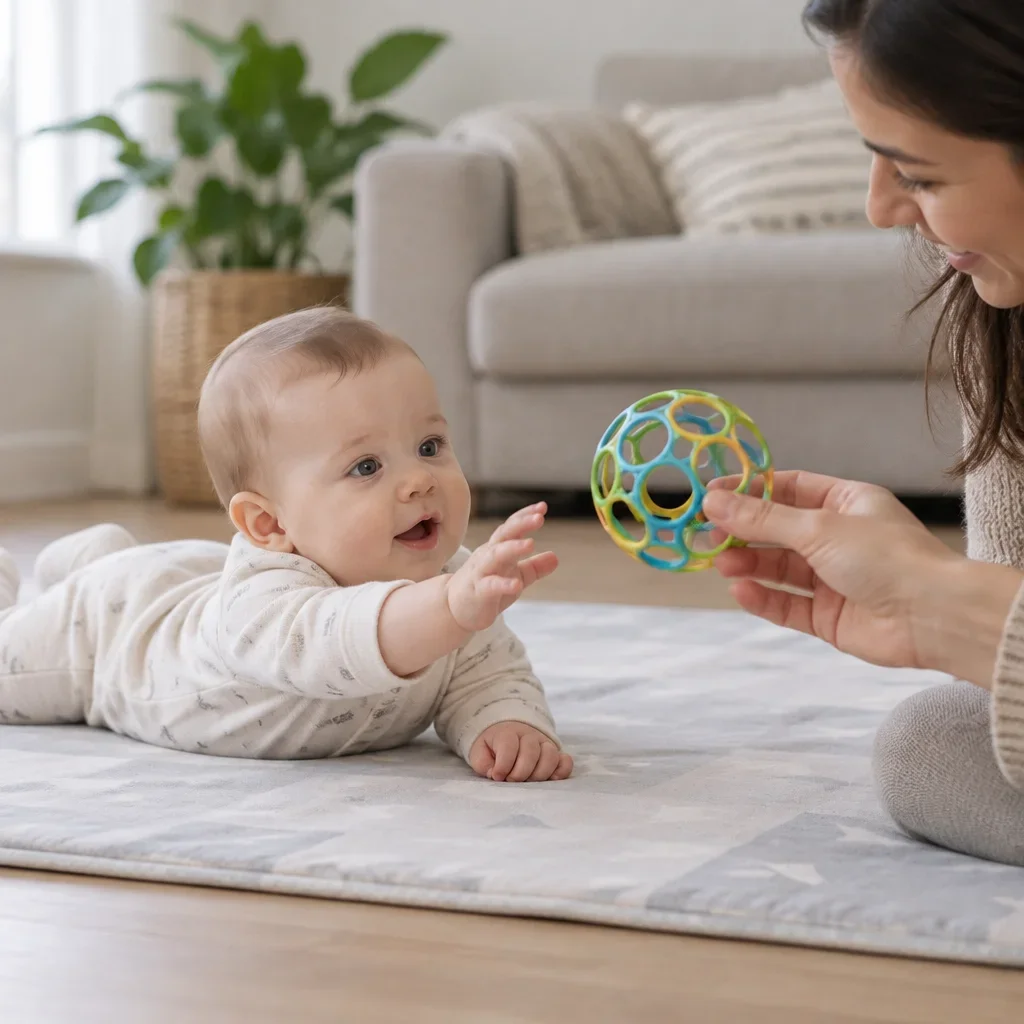
These plans connect sensory exploration with accessible movement. Use interest in looking, touching, or reaching to select a variation. A baby does not need to grasp independently to join in.
Reach and Discover
Stage and readiness: A baby interested in looking toward or touching a toy. Objective: Offer exploration of the relationship between movement and contact.
Materials: A lightweight, age-rated grasping toy. Safe setup: Use comfortable floor-based play or secure holding. Keep the toy within easy access.
- Present the toy and allow time to notice it.
- Bring it within comfortable touching distance without pressing it into the hand.
- Respond to contact, looking, or a pause without directing the baby’s arm.
Caregiver language: “The toy is here. You touched it.” Observe: Notice a hand opening, reaching, touching, or renewed looking.
Easier variation: Hold the toy close enough for incidental contact. Next variation: Change its visible position slightly while keeping access comfortable.
Sound and Pause
Stage and readiness: A baby comfortable with a gentle sound. Objective: Offer attention to sound and exploration of action and outcome.
Materials: A securely constructed, age-rated infant sound toy. Safe setup: Check that it is intact. Keep sound gentle and away from the ears.
- Move the toy gently to make its sound.
- Stop and leave a quiet pause.
- Offer access if your baby wants to touch or move it.
Caregiver language: “It made a sound. Now it is quiet.” Observe: Notice orientation, touching, movement, or a preference for quiet.
Easier variation: Make the sound yourself while the baby watches. Next variation: Allow more baby-led movement without asking for imitation.
Texture Words
Stage and readiness: A baby interested in touching or mouthing an appropriate toy. Objective: Offer exploration of texture alongside descriptive language.
Materials: An intact, washable, age-rated textured toy. Safe setup: Clean it as directed and supervise access. Avoid loose fabric scraps and detachable decorations.
- Present the toy within comfortable access.
- Allow the baby to explore in their own way.
- Describe the part they touch, then pause.
Caregiver language: “That part feels bumpy.” Observe: Notice rubbing, holding, mouthing, looking, or withdrawing from a texture.
Easier variation: Hold the toy steady for brief contact. Next variation: Offer a different suitable texture separately, without requiring comparison.
Cognitive Play Plans for Babies Aged 6–9 Months

Cognitive activities in this age group can include familiar social games and visible object exploration. Use back-lying, awake supervised tummy time, or securely supported positioning as appropriate. Independent sitting and crawling are not entry requirements.
Peek-a-Boo With Your Face
Stage and readiness: A baby interested in familiar face-to-face play. Objective: Offer anticipation and an experience of disappearance and return.
Materials: Your face and hands. Safe setup: Keep the baby’s face uncovered and their position comfortable.
- Let your baby see your face.
- Briefly hide your own face behind your hands.
- Reveal your face gently and pause for a response.
Caregiver language: “Where am I? Here I am.” Observe: Notice looking toward you, anticipation, expressions, or disengagement. This is not proof of object-permanence mastery.
Easier variation: Hide only part of your own face. Next variation: Repeat the familiar sequence with a gentle pause, without sudden sounds.
What Happens When I Move It?
Stage and readiness: A baby interested in touching or moving a toy. Objective: Offer cause-and-effect exploration through an accessible action.
Materials: An intact, age-rated toy that responds to movement or an easy action. Safe setup: Place it securely within reach, without cords or accessible small components.
- Demonstrate the toy’s action gently.
- Offer access and wait.
- Describe what happens when the baby touches or moves it.
Caregiver language: “You moved it. It rattled.” Observe: Notice repeating an action, changing a movement, watching, or stopping.
Easier variation: Hold the toy steady so a small movement can contact it. Next variation: Offer the same toy again rather than automatically increasing difficulty.
Familiar Object, New Position
Stage and readiness: A baby interested in a familiar visible toy. Objective: Offer attention and exploration of ways to access an object.
Materials: A familiar, age-rated toy. Safe setup: Use a clear floor-level area. Keep the toy comfortably accessible rather than deliberately frustratingly far away.
- Present the toy in its familiar position.
- Move it slightly to another visible, accessible position.
- Let the baby look, reach, turn, or choose not to engage.
Caregiver language: “Your toy is beside your hand.” Observe: Notice changes in gaze, hand movement, or body orientation without treating movement as a test.
Easier variation: Move the toy closer while maintaining visibility. Next variation: Try a different accessible position only if exploration remains comfortable.
Cognitive Play Plans for Babies Aged 9–12 Months
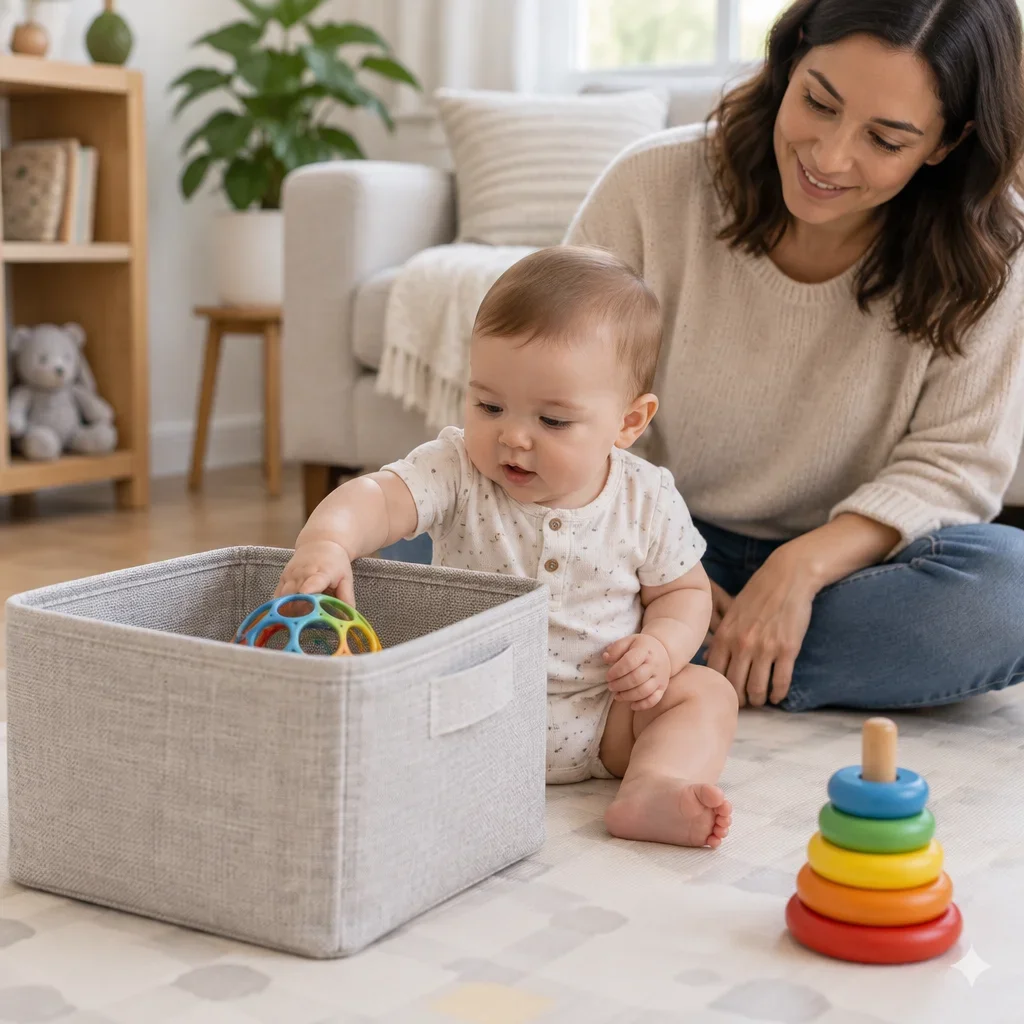
These activities offer search, container exploration, and shared attention. Choose them by readiness rather than a birthday. A response during a particular play session is not a diagnostic result.
Find the Partly Hidden Toy
Stage and readiness: A baby interested in a visible object and comfortable reaching toward it. Objective: Offer a simple search experience involving partial concealment.
Materials: A large, age-rated toy and a sturdy board book. Safe setup: Hold the book upright yourself. Keep the toy partly visible and accessible; do not leave a book balanced where it could fall.
- Let the baby see the toy.
- Hold the book so it obscures part of the toy.
- Pause, then reveal more if needed or follow the baby’s exploration.
Caregiver language: “Part of your toy is here.” Observe: Notice looking around the book, reaching toward the visible part, or returning attention elsewhere.
Easier variation: Leave the whole toy visible beside the book. Next variation: Change the visible portion while retaining a clear clue and easy access.
In and Out
Stage and readiness: A baby interested in handling objects or watching them move. Objective: Offer spatial exploration and simple action–outcome experiences.
Materials: Large, age-rated objects and an infant-safe open container without a lid, sharp edges, or pinch points. Safe setup: Keep the container stable and accessible at floor level.
- Place an object inside the container.
- Take it out slowly.
- Offer the materials for touching, removing, placing, or watching.
Caregiver language: “In the container. Out again.” Observe: Notice reaching inside, releasing an object, retrieving it, or watching your demonstration.
Easier variation: Place the object near the container’s opening. Next variation: Offer another suitable object without asking the baby to sort or count.
Familiar Book, Familiar Pause
Stage and readiness: A baby interested in looking at or touching a book with an adult. Objective: Offer recognition, shared attention, and language linked to an image.
Materials: An intact board book with familiar images. Safe setup: Share it in a comfortable position and supervise handling and mouthing.
- Open to an image the baby notices.
- Name it using a familiar word or gesture.
- Pause and respond to looking, touching, movement, or sound.
Caregiver language: “A dog. Woof.” Use the family’s familiar words. Observe: Notice returning to an image, touching the page, vocalizing, or choosing another page.
Easier variation: Stay with an image without turning pages. Next variation: Add a familiar sound or action rather than asking the baby to identify pictures.
Adapting the Plans for a One-Year-Old
For approximately 12–24 months, retain familiar activities while offering accessible variations. Readiness can include interest in placing, matching, stacking, or copying. These are invitations, not achievements required throughout that age range.
| Familiar activity | Simpler infant version | Readiness cue | Possible toddler variation |
|---|---|---|---|
| Container play | Watch an adult put an object in and out | Explores placing and removing objects | Offer large stacking cups suitable for the child’s age |
| Shared books | Look at a familiar image | Returns to particular pictures or objects | Pair a picture with a large, safe matching play object |
| Imitation | Watch a familiar gesture | Attempts to copy an everyday action | Copy wiping a table with an appropriate cloth under supervision |
| Object exploration | Handle a large, suitable object | Notices similarities between familiar objects | Offer large matching pieces without requiring correct pairs |
| Familiar routines | Watch an adult use a familiar object | Shows interest in copying its use | Offer a safe pretend action, such as feeding an age-rated doll |
Emerging categorization means exploring similarities; symbolic play means using an action or object to represent something else. Neither requires a sorting worksheet or scripted performance. Follow the child’s interest and keep materials age-appropriate.
A Flexible Weekly Cognitive Play Plan
This free weekly example uses activities suited to different readiness levels within 6–12 months. It is not a required daily curriculum. Repeat, skip, or replace an invitation according to sleep, feeding, health, comfort, and interest.
| Day | Play invitation | Cognitive focus | Materials | Observation prompt | Simpler variation |
|---|---|---|---|---|---|
| Monday | Peek-a-boo with your face | Anticipation and disappearance–return | Your hands and face | Does the baby look toward your returning face? | Hide only part of your face |
| Tuesday | What happens when I move it? | Cause and effect | Age-rated action or sound toy | Is an action repeated or changed? | Adult demonstrates while baby watches |
| Wednesday | Familiar book, familiar pause | Recognition and shared attention | Board book | Which image holds interest? | Remain on a familiar page |
| Thursday | Familiar object, new position | Attention and access exploration | Familiar age-rated toy | What changes when the toy moves? | Keep it close and fully visible |
| Friday | In and out | Spatial exploration | Suitable open container and large toy | Does the baby watch, reach, remove, or place? | Hold an object near the opening |
Caregiving routines can provide the same kinds of learning invitations. Sing a familiar song during dressing, name the clean clothing you are holding, or describe washing hands. Pause when possible so the baby can respond through movement, sound, or attention.
Repeating a familiar activity offers another chance to explore the same action or sequence. Keep the materials familiar and change only what helps access or interest. Variety can come from your words, positioning, or pauses rather than buying additional toys.
Adapting Activities and Noticing Learning
Access depends on positioning, sensory information, communication, and the baby’s preferences. Adapt the invitation rather than requiring a particular movement or response. Use an existing individualized support plan where one is in place.
| Observed need or preference | Practical adaptation | What to observe |
|---|---|---|
| Turns away during busy play | Reduce background sound and offer fewer materials | Whether quieter presentation changes engagement |
| Limited comfortable reaching | Bring the toy within easy access; do not force movement | Looking, touching, or small voluntary movements |
| Needs positioning support | Use the familiar positioning described in the child’s support plan | Comfort and access, rather than posture achievement |
| Uses vision differently | Offer suitable tactile or sound information according to individual preferences and guidance | Orientation, exploration, or signs of discomfort |
| Uses hearing differently | Pair words with visible gestures and accessible visual or tactile information | Responses through looking, touching, or movement |
| Prefers a slow introduction | Leave time to watch before offering direct interaction | Whether observation leads to voluntary engagement |
| Seeks a familiar routine | Repeat the same song, material, or sequence | Recognition, anticipation, or continued interest |
| Hears more than one language | Use familiar home-language words, songs, and gestures | Communication across sounds, gestures, and attention |
Language and communication activities for infants can use the languages spoken at home. A caregiver can name an object in their familiar language and pair it with a gesture. Do not treat multilingual exposure as a deficit or require English-only responses.
An illustrative observation might read: “During floor play, the baby touched the sound toy, paused after it rattled, then touched it again.” A possible next invitation is the same toy in the same accessible position. This records an action and context without claiming mastery or describing a real child.
Observations can differ with sleep, comfort, health, setting, and access to materials. Keep notes descriptive rather than assigning scores. Persistent developmental concerns or loss of previously used skills belong in a conversation with the child’s healthcare professional; a play activity is not an assessment.
Practical Answers About Infant Cognitive Activities
Activity Length
An activity lasts while the baby is comfortable and interested. Looking away, fatigue, distress, or disengagement are reasons to pause. Infant attention does not need to fit a timer for play to be worthwhile.
Repeating an Activity
Repeat an invitation when it remains welcome. Familiar books, songs, and action toys let you observe what the baby notices across different occasions. Stop or adapt when repetition becomes unwelcome rather than requiring a set number of attempts.
When a Baby Is Not Interested
Check comfort, hunger, tiredness, positioning, and the amount of stimulation. Then simplify the invitation or leave it for another time. Watching briefly and turning away are responses, not evidence that the lesson failed.
Everyday Examples of Cognitive Activities
Naming a familiar object, copying a sound, sharing a book, and exploring an action toy are cognitive play examples. They offer attention, recognition, imitation, or action–outcome exploration through ordinary interactions.
The Meaning of Seven Cognitive Skills
The categories in this guide are attention, memory and recognition, cause and effect, object permanence, early problem-solving, imitation, and emerging categorization. Other frameworks group cognition differently. This list is not a clinical test or a universal checklist.
Supporting Learning Without Testing
Prepare safe materials, model a simple action, and wait for the baby’s response. Describe what happens instead of asking repeated quiz questions. For problem-solving, keep an object accessible and allow exploration rather than creating an obstacle the baby must overcome.
Montessori Toys and Infant Learning
Montessori-informed infant activities do not require a branded toy collection. Relevant principles include observing the child, preparing accessible materials, allowing exploration, and avoiding unnecessary adult interruption. An intact board book or suitable grasping toy can support that approach.
What to Look for in an Infant Learning Environment
A clear infant learning approach connects observation with care. Ask how educators choose materials, adapt positioning, respond to disengagement, and share observations with families. Look for explanations of what adults actually do, not promises of accelerated development.
Licensed childcare and Montessori teaching address different parts of quality. Licensing provides a regulated care framework; Montessori describes an educational approach. At Cozy Time, our team includes Early Childhood Educators, or ECEs, and credentialed Montessori teachers. Parents should be able to discuss qualifications, supervision, curriculum, and daily routines, not simply hear that children are kept busy.
Home observations can make daycare conversations more useful. Share the songs your baby recognizes, materials they explore, comfortable positions, and cues that mean they need a break. These details help adults understand the child’s current interests without turning play into a progress report.
Explore Infant Learning at Cozy Time
At Cozy Time Montessori Academy, we provide licensed Montessori-based early learning in Vaughan, with a second location in Bolton. We observe children and adapt learning opportunities rather than promise developmental results.
If you are considering infant care, [explore Cozy Time Montessori Academy](/) and contact us to arrange a tour. We can discuss your baby’s routines, interests, care needs, and current options at the relevant location. Seeing the environment is a practical next step toward deciding what fits your family.