

Parents often ask a very practical question first: is pre casa for working parents actually manageable on a real workweek. In many cases, yes. A Montessori Pre-Casa program can work well when a centre offers full-day care, clear routines, meals on-site, qualified staff, and communication that helps you get through the day without guessing.
Is Pre-Casa a good fit for working parents?
Pre-Casa is often a strong fit when a family needs both reliable childcare and purposeful early learning in one place. That matters for parents comparing a full-day Montessori daycare with a more basic care model, especially during the toddler years when routines, meals, naps, and drop-off transitions shape the whole workday.
The fit depends on logistics as much as philosophy. Your commute, your child’s nap rhythm, your work hours, your backup pickup plan, and the centre’s policies all matter. The best next step is always to visit and see how the classroom works in real time.
A licensed setting also changes the conversation. We are a licensed childcare centre, and our programs run from ages 6 months to 6 years. That means care is organized around program structure, supervision, staff qualifications, and age-appropriate ratios, not informal minding.
What is Montessori Pre-Casa?
A Montessori Pre-Casa program is a toddler-stage classroom built around independence, routine, movement, language, and practical life. In plain language, that means children practice small daily tasks like carrying, tidying, washing hands, eating, choosing work, and moving through the room with support.
Montessori calls the classroom a prepared environment. That means the room is arranged for the child, not the adult: low shelves, child-sized tables, simple materials, and a clear place for each activity. A good Montessori toddler program is orderly on purpose, because order helps children understand what happens next.
You may see similar programs called toddler, Pre-Casa, or sometimes Jr casa, depending on the school. At Cozy Time, the confirmed program names are Infant, Pre-Casa, and Casa. If you are comparing labels between schools, ask what age group the classroom serves and how the day is actually structured.
What age is Pre-Casa for, and how does it relate to Casa or Jr Casa?
Pre-Casa sits between infant care and the Casa program Montessori families usually associate with the preschool years. Our centre serves children from 6 months to 6 years, with programs organized as Infant, Pre-Casa, and Casa.
The exact Pre-Casa age band is not specified in the provided centre information, so parents should confirm the current starting age and transition point directly with the centre. That is especially important if you are comparing Montessori casa age group ranges across different schools, because names and age cutoffs are not identical everywhere.
Readiness is not only about birthdays. Mobility, interest in routines, ability to join group flow, and comfort separating from a parent can all affect whether the Pre-Casa program is the right next step. Every child settles at their own pace.
Casa is the next stage after Pre-Casa. In Montessori language, Casa is the preschool classroom, and at our centre it is one of the three core programs we offer. If another school uses Jr casa as a bridge label, ask whether it is simply another name for a toddler room or a separate step before Casa.
Pre-Casa vs daycare vs preschool vs nanny care: which works best for working parents?

Pre-Casa usually appeals to families who want childcare coverage and a clear learning approach in the same day. A general daycare may offer care and play without a defined Montessori curriculum, while a preschool may focus on shorter program hours rather than full workday coverage.
Nanny care usually offers the most flexibility for early mornings, late evenings, or changing schedules. Centre-based care usually offers more routine, peer interaction, and classroom consistency. For some working families in Vaughan, Bolton, Maple, Woodbridge, or Thornhill, that predictable structure is exactly what makes mornings easier.
Staying at home can offer one-to-one familiarity, but it does not automatically provide the same group routine, classroom materials, or multi-step transitions into a school setting. A licensed toddler daycare Vaughan parents compare seriously should be evaluated on ratios, staff credentials, daily rhythm, and communication, not on branding alone.
Here is the simplest comparison:
| Option | Best for | Main strength | Main tradeoff |
|---|---|---|---|
| Montessori Pre-Casa | Families who want full-day care plus early learning | Routine, curriculum, peer setting, prepared environment | Less schedule flexibility than one-to-one care |
| General daycare | Families prioritizing broad childcare coverage | Practical care coverage | May not follow a defined Montessori method |
| Preschool | Families needing a shorter school-style program | Group learning exposure | Often not designed for a full workday |
| Nanny care | Families needing flexible home-based coverage | Custom schedule, home convenience | Less built-in peer group and classroom routine |
| Stay-at-home care | Families available at home | Familiar environment | No centre-based classroom structure |
What working parents gain from Pre-Casa day to day
A strong Pre-Casa for working parents review usually comes down to daily friction, not theory. When meals are prepared on-site, routines are consistent, and staff communicate clearly, parents make fewer last-minute decisions before work and after pickup.
A family with two full-time office jobs usually needs the same thing each weekday: dependable drop-off, a known nap window, lunch and snacks handled, and a reasonable picture of how the day went. Those practical supports are often what make a Montessori daycare Vaughan families can rely on feel manageable.
A parent with a longer commute usually needs commute timing and classroom timing to match. If a centre’s arrival flow, pickup process, or closure practices do not fit your real workday, the program may feel stressful even if the classroom itself is strong.
A family looking for predictable weekday rhythm often values the same sequence every day. Toddlers usually do better with repeated routines than with constant changes, and parents often do too. That does not guarantee an easy transition, but it gives the day a stable structure.
A sample Pre-Casa daily routine
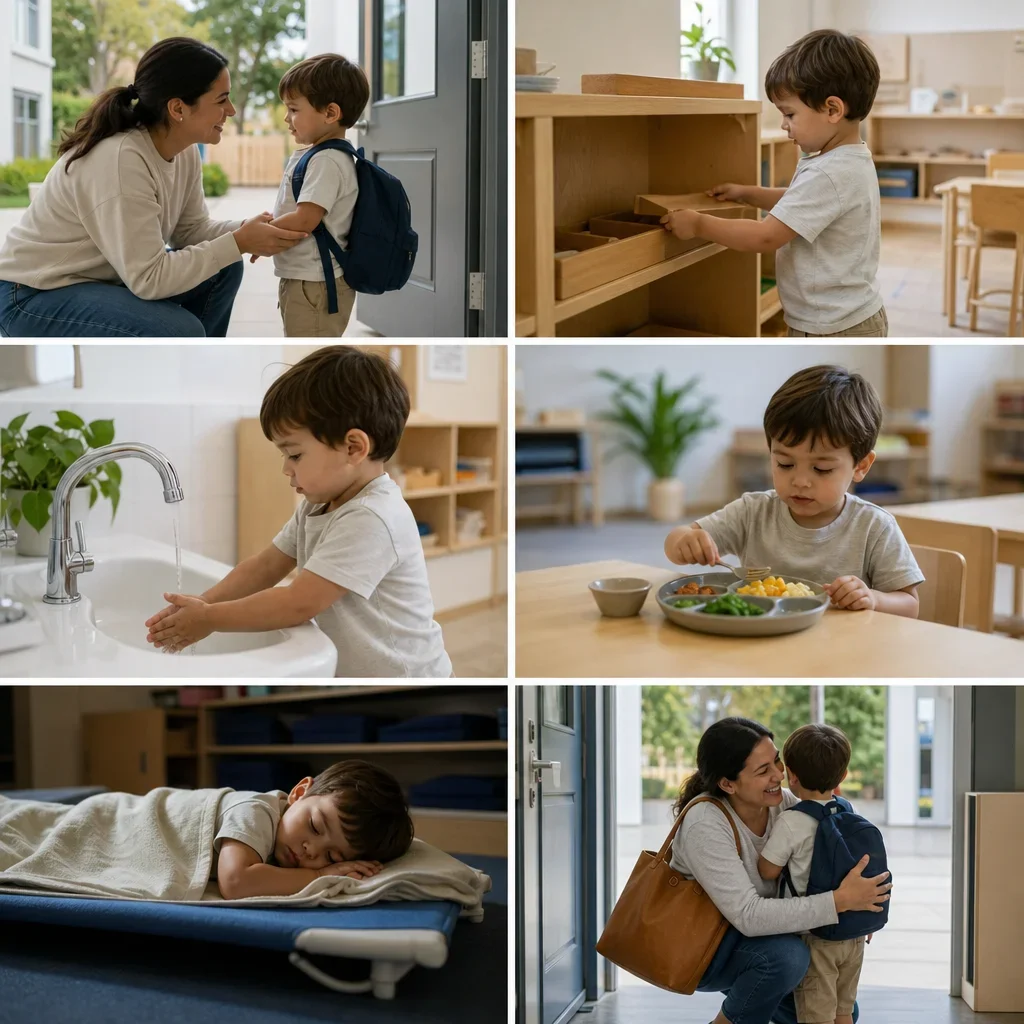
A Pre-Casa day usually follows a predictable flow built around care, movement, meals, rest, and Montessori work. The purpose is rhythm, not pressure. In a Montessori toddler program, children are not rushed through adult-paced lessons all day.
Morning arrival is usually about greeting, settling, and transitioning from home to classroom. For some children, this is the hardest part at first. Many families find that the first 2–4 weeks are the main settling-in period, although each child adjusts at their own pace.
The morning work cycle is the main Montessori block. Children choose from simple activities set on low shelves, and educators observe, guide, and redirect as needed. Practical life work may include spooning, pouring, carrying, hand washing, or putting away materials.
Midday usually includes toileting or diapering routines, lunch, and preparation for rest. For working parents, this matters because eating and care routines are part of the school day, not extra tasks waiting at home.
Afternoon time often includes nap or rest, a gradual wake-up, snack, movement, outdoor time if scheduled by the centre, and quieter activities before pickup. Ask the centre for the actual daily routine, because exact class timing and operating hours are not specified in the provided brief.
What children learn in Pre-Casa
Pre-Casa focuses on foundations that match the toddler stage: practical life, language exposure, sensorial work, movement, and early social routines. Practical life means everyday actions like carrying a tray, wiping a spill, feeding with support, or putting shoes in place.
Sensorial work means learning through the senses in a concrete way. A child may sort by size, match textures, notice sounds, or explore simple materials with the hands. In toddler classrooms, this is less about abstract teaching and more about repeated, supervised experience.
Language development is supported through naming, songs, books, conversation, and consistent routines. We do not promise an outcome. We create an environment where adults speak clearly, model vocabulary, and give children time to respond.
Social growth in Pre-Casa is simple and realistic. Toddlers often move from parallel play toward more cooperative moments over time. Parallel play means playing beside another child. Cooperative play means joining around the same activity with some shared purpose.
The Montessori method is guided by a few core ideas that matter to parents in practical terms: respect for the child, independence, order, hands-on learning, and a prepared environment. In daily care, that looks like slower demonstrations, clear routines, child-sized materials, and support without doing every task for the child.
What does a prepared environment look like in a Pre-Casa classroom?
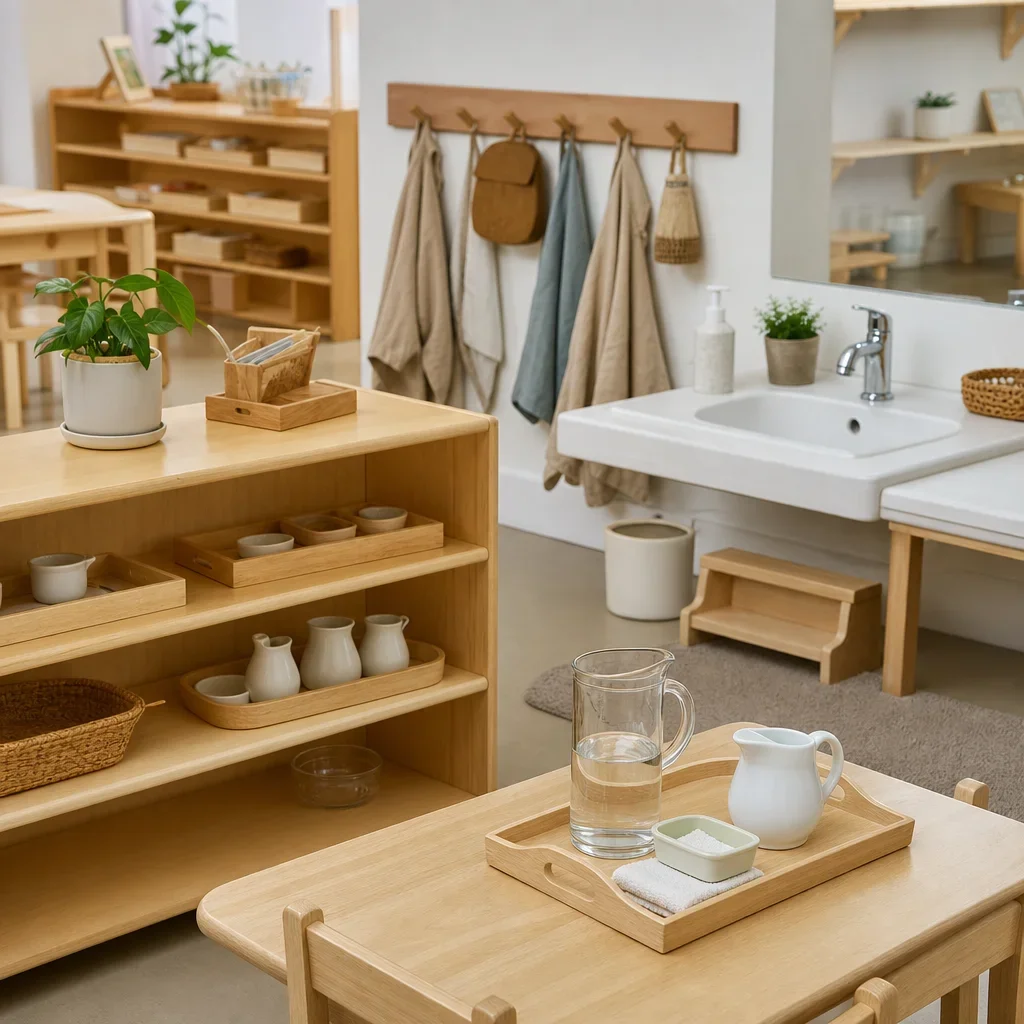
A prepared environment looks calm, simple, and organized for toddlers to use with supervision. Materials are placed on low shelves, furniture is child-sized, and each activity has a clear beginning, middle, and end.
A pouring station is a simple example. Instead of adults doing every step, a child may carry a small pitcher, pour into a cup, wipe a drip, and return the work to the shelf. The point is not perfection. The point is participation in real, manageable tasks.
Low hooks for coats, a defined spot for shoes, and accessible hand-washing routines are also part of being prepared. When a room is arranged this way, children can practice daily steps with less adult lifting and less confusion.
For working parents, that environment matters because routine becomes visible. You can often tell within a short classroom visit whether the room supports independence and supervision together, or whether adults are only reacting from one moment to the next.
Meals, snacks, naps, diapering, and potty training: the practical supports parents care about
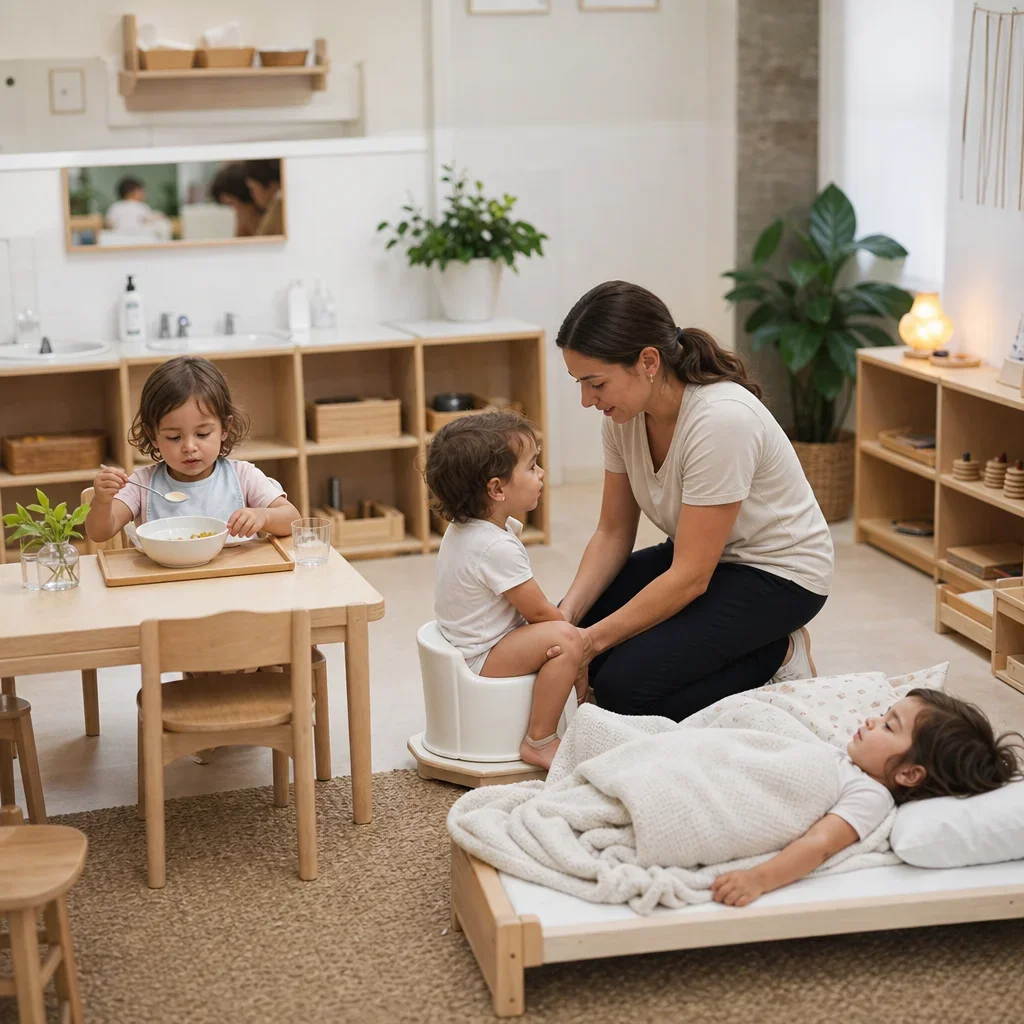
On-site meals can make full-day care much more manageable for working families. Our centre provides meals on-site, which removes one daily preparation task for parents and keeps the day more consistent for children.
The exact meal and snack schedule for Pre-Casa is not specified in the provided brief, so parents should confirm what is included, how menus are shared, and whether any food must be supplied from home. That is also the right time to ask about a part-time Montessori daycare schedule if you are not enrolling full days.
Allergy handling is important, but it is accuracy-sensitive. The provided brief does not confirm a peanut-free policy or a specific accommodation process, so parents should contact the centre directly to discuss allergies, cross-contact precautions, and any medical dietary needs.
Toileting support matters because many children enter a Pre-Casa age stage before they are fully independent. Potty training requirements are not specified in the provided brief, so ask directly whether your child must be toilet trained, whether diapering support is available, and how the classroom handles transitions into self-help routines.
Nap and rest routines also affect family life after pickup. A toddler who has had lunch, rest, and structured care at school usually arrives home from a full-day Montessori daycare with fewer unfinished care tasks waiting. The exact rest schedule should still be confirmed with the classroom.
Teacher-to-child ratios, licensing, and staff qualifications

Ratios are one of the clearest quality markers in childcare. Our site-wide program ratios are 1:3, 1:5, and 1:8, aligned to Infant, Pre-Casa, and Casa programs in the provided centre information.
For parents focused on the toddler years, the key number is the Pre-Casa ratio of 1:5. A class ratio tells you how many children are assigned per adult for that program. Lower ratios matter because supervision, transitions, meals, and toileting all happen in real time.
Licensing matters because it sets a standard for how care is organized and overseen. Cozy Time Montessori Academy is a licensed childcare centre, which separates structured, accountable care from unlicensed child minding.
Staff qualifications also matter. Our staff include certified Montessori teachers, ECEs, and assistants. ECE means Early Childhood Educator. That is a recognized early-childhood qualification, not just a general childcare label.
First Aid and CPR certification are confirmed for staff, along with clean criminal record checks. Those are not extra marketing features. They are baseline trust facts parents should ask every centre to state clearly.
How parents stay informed during the day

Good communication reduces a lot of first-day anxiety for working parents. The most useful updates usually cover meals, naps, toileting or diapering, participation in activities, and any notable changes in routine.
The provided brief does not confirm Cozy Time’s exact daily reporting method, so this is a question to ask on your tour. Ask whether updates are shared in person, digitally, at pickup, or through scheduled progress conversations.
Formal progress reporting also varies by centre. In a Montessori Pre-Casa setting, communication may include observations about independence, routines, language exposure, or classroom participation, but parents should confirm how often these updates are shared and in what format.
A good handoff at pickup should still feel specific. Even without a long written report, parents should be able to learn how the child ate, rested, transitioned, and participated that day.
Hours, extended care, and the policies working parents should ask about
Hours and policies can matter as much as curriculum when both parents work. If a centre’s opening time, closing time, holiday schedule, or illness rules do not fit your week, the program may not be sustainable even if you love the classroom.
The exact operating hours for the Vaughan and Bolton locations are not provided in this brief, so parents should confirm opening and closing times directly with the centre. The same applies to any extended hours daycare option, before-school, or after-school coverage.
Late pickup handling should always be discussed before enrolment. Ask how pickup authorization works, what happens if traffic delays you, who can be listed as an emergency contact, and what steps the centre follows if a parent is unexpectedly late.
Closures, holidays, and sick-day expectations also affect work planning. Ask for the annual closure calendar, illness exclusion guidance, and return-to-care expectations. Those policies are accuracy-sensitive and should come directly from the centre, not from assumptions based on another school.
If you are searching for Pre-Casa for working parents near me, this is where local convenience becomes real. Compare not just the classroom, but also the route, parking, handoff process, and how much margin you have before work each morning.
How to choose the right Pre-Casa program for your child and your work schedule
The right choice is the one that fits both your child and your workday. Child age, temperament, nap pattern, current care history, toileting stage, commute, and work flexibility all shape whether a Pre-Casa program will feel supportive or rushed.
Full-time care often suits families who need one stable Monday-to-Friday routine. Consistency can make transitions easier because the classroom rhythm repeats across the week, although no centre should promise a specific adjustment outcome.
Part-time care can work for some families, but the provided brief does not confirm whether part-time Montessori daycare is available at this centre. If you need fewer than full days, ask what schedule options exist and whether they are offered for the Pre-Casa program specifically.
A child moving from home care or infant care may need a more gradual transition plan. Ask how the centre supports first drop-offs, whether shorter initial visits are possible, and what signs staff watch during the settling-in period.
Use this checklist when comparing programs:
- Confirm the exact Pre-Casa age range for the classroom.
- Confirm whether full-day or part-time options are available.
- Confirm meals, snacks, rest routines, and toileting support.
- Confirm the class ratio and who the lead educators are.
- Confirm how daily communication works.
- Confirm holiday, closure, illness, and pickup policies.
- Confirm commute practicality for your real workweek.
Cost, value, and what to ask about fees
Pre-Casa cost should be asked directly, because tuition is not provided in this brief and should never be guessed. If you are comparing programs, ask for the current tuition structure, any registration fee, any waitlist fee, and what is included.
Value is not only about the monthly number. It is also about what the day includes: licensed care, Montessori programming, on-site meals, staff qualifications, and program ratios like 1:5 in Pre-Casa.
If you are comparing a Montessori daycare Bolton families use with another local option, ask the same fee questions in the same order. That keeps the comparison fair and practical.
Common concerns about Montessori: downsides, criticisms, and realistic expectations
The biggest criticism of Montessori is usually not that it lacks structure, but that its structure looks different from traditional group teaching. In toddler years, structure often lives in the environment, the routine, and the teacher’s observation, rather than in long whole-group lessons.
Some parents worry the Montessori method may not match every child’s temperament or every family’s expectations. That is a fair concern. A classroom can be well-run and still not be the best fit for a child who needs a very different pace, or for a family whose work schedule clashes with the centre’s routine.
Another real criticism is that quality varies widely between schools using the Montessori name. That is why licensing, educator credentials, ratios, and classroom observation matter more than branding alone.
We take a clear position here. A licensed Montessori program with ECEs, certified Montessori teachers, and defined ratios is different from unlicensed care that simply uses the word Montessori in marketing. Parents should ask for specifics and expect clear answers.
FAQ
Is Pre-Casa good for working parents?
Yes, it can be a strong fit when the program offers dependable full-day coverage, age-appropriate care, meals, and clear communication. The fit still depends on your work hours, commute, and the centre’s policies.
What age is Montessori Pre-Casa for?
The exact Pre-Casa age range varies by school. At Cozy Time, children are served across Infant, Pre-Casa, and Casa programs from 6 months to 6 years. Contact the centre to confirm the current Pre-Casa starting age and transition into Casa.
Is Pre-Casa the same as toddler daycare?
Not exactly. A Pre-Casa program is a toddler classroom, but in Montessori schools it usually follows a defined prepared environment, practical life work, and guided independence rather than general childcare alone.
Do children need to be potty trained for Pre-Casa?
The provided brief does not confirm that requirement. Ask the centre directly whether toileting independence is expected, whether diapering support is available, and how transition support works.
What does a child do all day in Pre-Casa?
A typical day includes arrival, a Montessori work cycle, meals or snacks, toileting or diapering routines, movement, rest, and afternoon activities. The exact classroom schedule should be confirmed with the centre.
Are meals and snacks included in Pre-Casa?
Meals are prepared on-site at our centre. Ask the centre which meals and snacks are included for Pre-Casa, how menus are shared, and how dietary needs are handled.
What is the teacher-to-child ratio in Pre-Casa?
The provided centre information identifies the Pre-Casa ratio as 1:5. Ratios should always be confirmed by classroom when you inquire.
How does Pre-Casa prepare children for Casa?
Pre-Casa builds familiarity with routines, practical life work, simple classroom expectations, and guided independence. It does not guarantee a particular outcome, but it gives children experience participating in a structured early-learning environment before Casa.
What should working parents ask before enrolling in a Pre-Casa program?
Ask about age range, ratio, staff credentials, meals, nap routines, toileting support, communication, operating hours, pickup procedures, holiday closures, illness policy, and schedule options.
How do I book a tour for a Montessori daycare in Vaughan or Bolton?
The best next step is to contact the centre and ask about tours, availability, and your child’s age group. If you are comparing Montessori daycare Vaughan and Montessori daycare Bolton options, share your preferred start date, schedule needs, and commute so the team can guide you clearly.
A practical next step for Vaughan and Bolton families
If you are choosing your first toddler program, you do not need every answer before you reach out. You do need the right questions. Contact the centre about Pre-Casa availability in Vaughan or Bolton, share your child’s age and preferred start date, and visit the classroom if you can. That is still the clearest way to tell whether the routine fits your family.