

Fine motor activities for infants do not need to be complicated. Most infant fine motor activities start with simple reaching, grasping, mouthing, transferring, and releasing during everyday play and care.
We see this often in our licensed Montessori infant program in Vaughan. Parents expect special toys. Infants usually need safe floor time, simple objects, close supervision, and repetition instead.
What fine motor skills are in babies?
Fine motor skills in babies are the small movements of the hands, fingers, wrists, and eyes working together. In plain language, this includes grasping a caregiver’s finger, bringing hands to mouth, reaching toward a toy, moving an object from one hand to the other, and picking up food with fingers later in the first year.
Fine motor development starts in infancy and changes quickly across 0–12 months. Newborns are mostly practicing awareness, reflexes, and early hand opening, while older infants begin to use more controlled actions like release, pointing, and early pincer grasp.
This guide gives general patterns, not a diagnosis. Every child settles into new activities at their own pace, and the best next step for any concern is to speak with your child’s pediatrician or another qualified health professional.
Fine motor vs gross motor skills: what is the difference?
Fine motor skills use the hands and fingers. Gross motor skills use larger body parts like the head, neck, trunk, arms, and legs. Rolling, sitting, crawling, and standing are gross motor skills. Reaching, grasping, and turning pages are fine motor skills.
Gross motor stability supports hand use. Babies need shoulder, neck, and trunk strength to reach with control, bear weight through their arms, and use both hands together. That is why tummy time and floor play matter for both gross and fine motor activities for infants.
How fine motor development in infants 0–12 months usually progresses
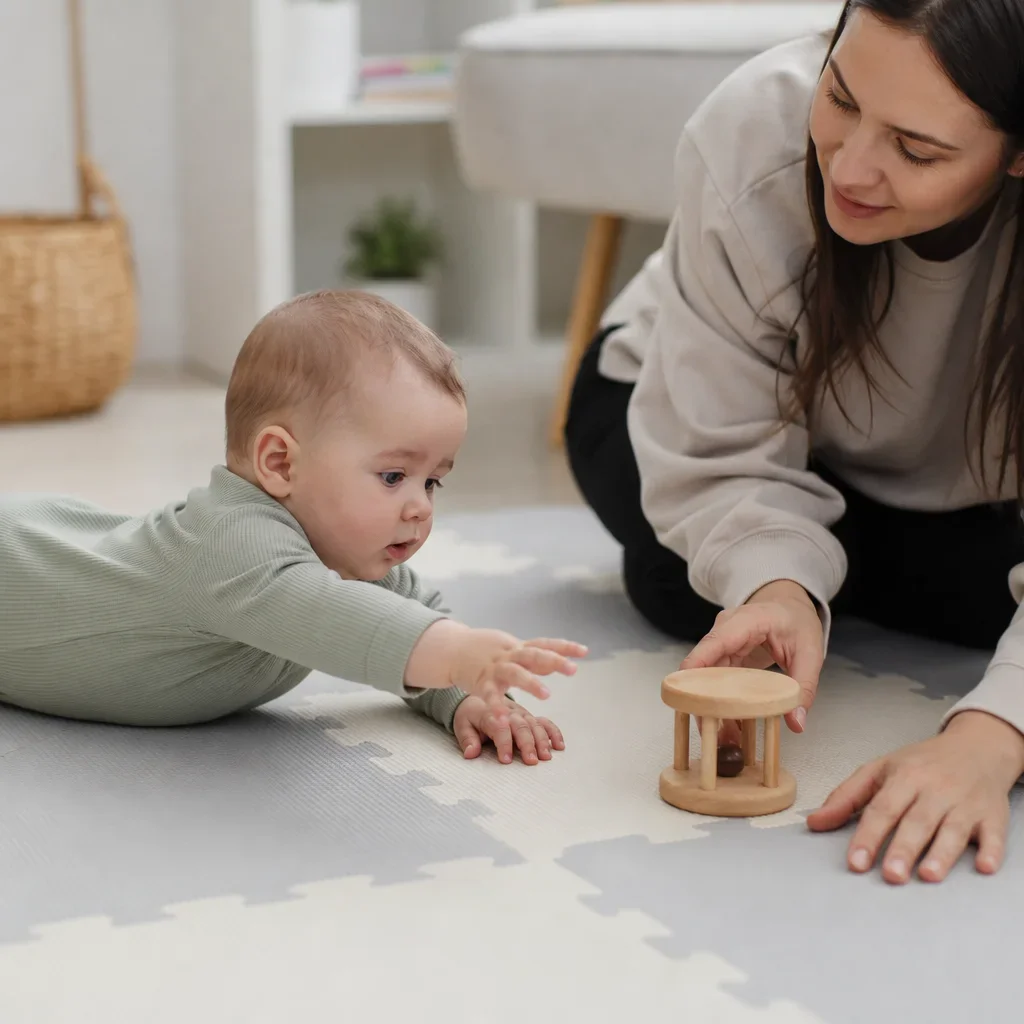
Fine motor development in infants 0–12 months usually moves from reflexive grasping to more purposeful reach and release across 0–3, 3–6, 6–9, and 9–12 months. Parents may notice hands coming to mouth first, then swiping and holding, then transferring toys hand to hand, then dropping objects into containers or picking up soft finger foods.
The grasp patterns also change over time. Early infancy often shows a reflexive grasp. Later, you may see a palmar grasp, where the whole hand closes around an object, then raking or radial-palmar patterns, and later an emerging pincer grasp using thumb and finger.
Some online lists mix infant and toddler tasks together. That can make normal play look behind when it is simply too advanced for the age. For this guide, the main focus stays on 0–12 months, with a short 12–18 month section for context only.
Fine motor milestones by age: quick reference table
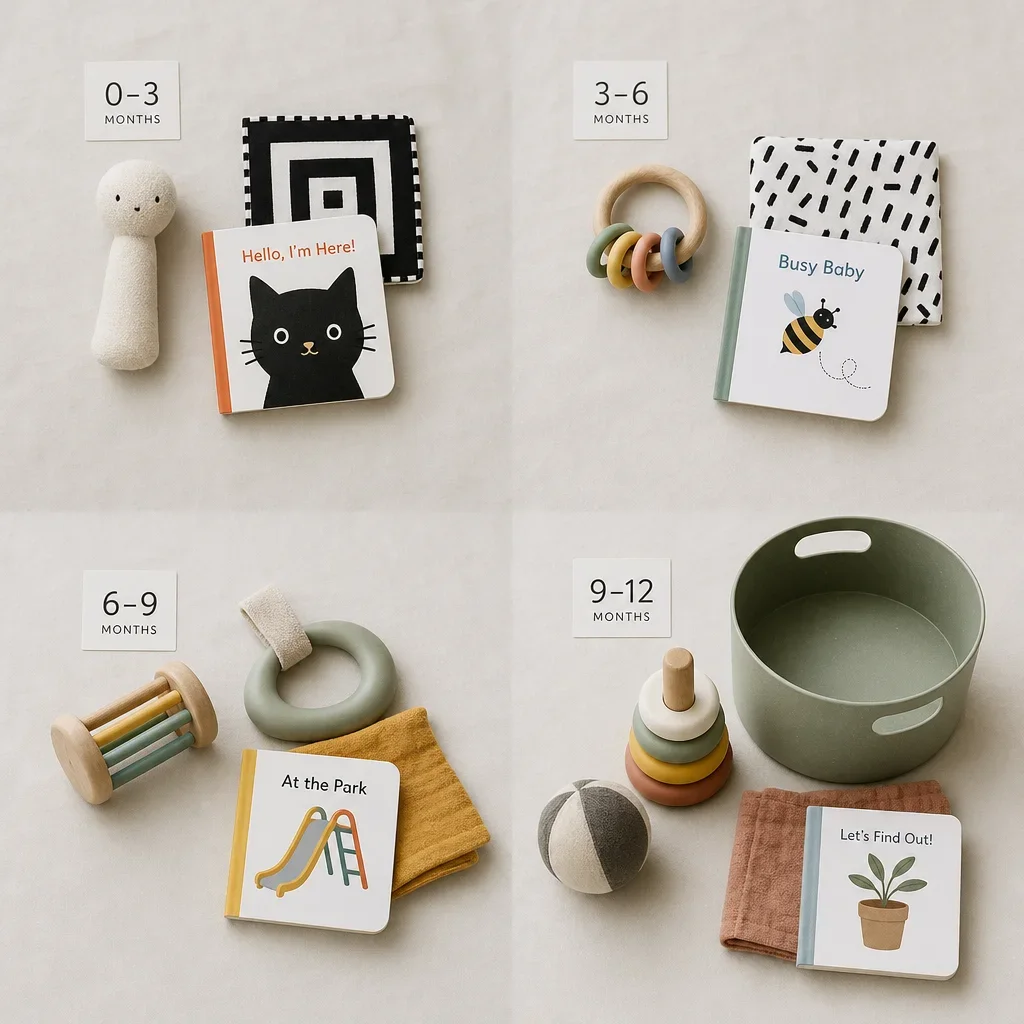
| Age range | What parents may notice | Example activities | Skill supported |
|---|---|---|---|
| 0–3 months | Hands often closed, brief grasp reflex, hands coming toward mouth, early visual tracking | finger grasp game, short tummy time, soft rattle near hand, black-and-white tracking | hand awareness, reflexive grasp, early hand opening |
| 3–6 months | More purposeful reaching, holding a toy briefly, bringing toys to mouth, batting at objects | grasping rings, crinkle cloth play, side-lying reach, tummy time reach | purposeful reach, grasp endurance, bilateral use |
| 6–9 months | Hand-to-hand transfer, banging toys, raking at objects, releasing into a large container | ring transfer, fill-and-dump play, fabric pull play, bath cups | transfer, release, bilateral coordination |
| 9–12 months | Better controlled release, pointing may emerge, early pincer grasp, page turning attempts | finger foods, drop into wide container, board books, cup stacking with help | pincer grasp, index finger use, hand-eye coordination |
| 12–18 months | More precise picking up, spoon practice, scribble attempts, stacking attempts | large crayons, large peg play with supervision, spoon use, simple containers | refined grasp, early tool use, controlled release |
Fine motor activities for infants 0–3 months
Fine motor activities for infants 0–3 months should focus on awareness, not advanced manipulation. At this stage, newborns are learning to notice their hands, briefly grasp, open the hand more often, and begin early reaching patterns.
A finger grasp game is simple and appropriate. Place your clean finger across your baby’s palm and let the hand close naturally. This supports reflexive grasp awareness and gives gentle hand contact during calm alert periods.
Short tummy time on the floor supports shoulder and forearm stability. A few minutes at a time is usually more realistic than one long session for fine motor activities for young infants, because young babies tire quickly and still need close supervision.
Soft rattles or lightweight cloth toys can invite early swiping and brief grasping. The item should be light, easy to clean, and large enough that it cannot fit fully into the mouth. At this age, the goal is exposure and awareness, not long independent play.
Black-and-white or high-contrast visual tracking can support early hand interest when a baby watches and then begins to move toward what they see. A parent face, a simple card, or a safe toy moved slowly can encourage visual attention and early arm movement.
Gentle hand opening during diaper changes can count as fine motor practice too. If your baby keeps the hands fisted much of the time, opening the palm softly during care routines can add extra sensory experience without forcing a task.
Fine motor activities for infants 3–6 months
Fine motor activities for infants 3–6 months work best when reaching starts to become more purposeful. Babies in this stage often enjoy seeing, reaching, grasping, and bringing objects to the mouth as part of learning.
Reaching for a soft toy during back play, side-lying, or tummy time builds purposeful arm movement. Side-lying is helpful because it reduces the effort of lifting against gravity and can make hand use easier for some babies.
Grasping rings or rattles supports grasp endurance and hand-to-mouth coordination. Choose lightweight items with a thick handle or open ring that is easy for small hands to hold.
Crinkle cloth play is a good example of activities for infants fine motor skills because it gives sound, texture, and easy feedback. The cloth should be baby-safe, clean, and used with direct supervision, since mouthing is still part of exploration.
Supported mirror play can increase reaching and swiping. A baby-safe mirror placed during tummy time or side-lying can encourage looking, lifting, and touching.
Tummy time toy reach helps connect upper-body strength with hand use. Place a toy just within reach, not far enough to frustrate, so your baby can shift weight through the arms and try to move toward it.
Fine motor activities for infants 6–9 months
Fine motor activities for infants 6–12 months start to look more intentional, and 6–9 months often brings transfer and release. Babies in this age band may move objects between hands, bang toys together, rake at items, and drop things on purpose.
Hand-to-hand transfer with rings or soft blocks directly supports bilateral coordination. Offer one object, wait for grasp, then present a second object so your baby has a reason to switch hands.
Fill-and-dump play with large safe objects helps babies practice release. A shallow basket and a few large cups, rings, or blocks can be enough. Posting tiny items into narrow openings is usually too advanced and unsafe for this age.
Fabric pull play using baby-safe scarves or cloth squares can support grasp, pull, and release. The fabric should be large, clean, and used one-on-one with direct supervision, not left as an unsupervised loose item.
Banging toys together builds hand strength and cause-and-effect learning. Two lightweight blocks, spoons, or cups are often enough for this kind of infant activities for fine motor skills.
Board book page lifting with help introduces early finger isolation and controlled movement. Thick board pages are easier than thin paper pages and better matched to this stage.
Fine motor activities for infants 9–12 months
Fine motor activities for infants 9–12 months can include more precise release and early pincer work. In daily life, this may look like picking up soft finger foods, dropping objects into a wide container, pointing, or trying to turn pages.
Picking up soft finger foods under close supervision is one of the clearest fine motor skills examples infants show in late infancy. This supports the shift from a broader raking pattern toward an early pincer grasp.
Dropping objects into a wide container helps with controlled release and hand-eye coordination. Start with a large opening and large objects, because narrow openings and tiny pieces raise frustration and choking risk.
Peekaboo scarves in and out of a container support bilateral coordination. One hand can hold the container while the other hand pulls or drops the fabric.
Turning sturdy board book pages, taking lids off large containers, and exploring a spoon at mealtime are also age-appropriate. These are early tool-use and index-finger practice experiences, not tasks a baby needs to master on command.
Raking grasp and pincer grasp are not the same. Raking uses the fingers together to pull an item toward the palm. Pincer grasp uses the thumb and index finger more precisely. That difference becomes easier to notice closer to the end of the first year.
Fine motor activities for mobile infants: crawlers and cruisers
Fine motor activities for mobile infants work best when they are built into movement across the day. Crawlers and cruisers often shift attention quickly, so short indoor activities in different settings are usually more successful than one long setup.
Floor play can include a basket with textured balls, large blocks, nesting cups, pull-out fabrics, and sturdy board books. These support grasping, transferring, release, and page turning while still allowing the child to move freely.
High-chair time can include supervised finger foods, spoon exploration, large soft stacking items, and simple water play with a spoon or cup. This is one of the easiest places for fine motor indoor activities for mobile infants because the surface is stable and the adult is nearby.
Bath time can support squeeze, scoop, pour, grab, and release using cups and soft bath toys. Keep the materials simple, and keep water play fully supervised.
Stroller or waiting-time play can include a cloth book, a large teether ring, or one attached toy for transfer practice. Fewer items usually works better than a crowded toy bar.
Mobile infants may also move between fine and gross motor tasks every few minutes. That is normal. Crawling to a basket, sitting to explore it, then moving on is still meaningful play.
Grasp development: from palmar grasp to pincer grasp
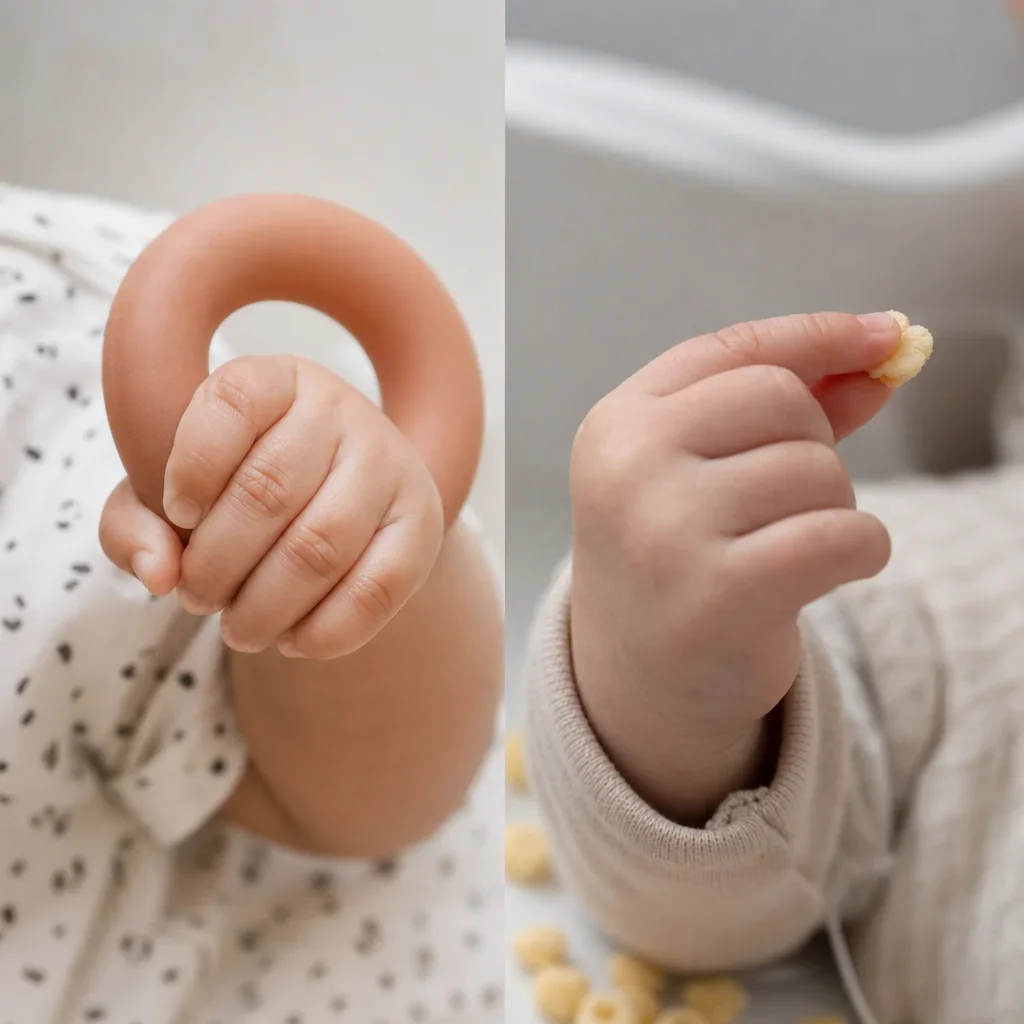
Parents often understand fine motor development better when they can name the grasp pattern they are seeing. The chart below keeps the language simple.
| Grasp pattern | What it looks like | Simple activity |
|---|---|---|
| Reflexive grasp | The hand closes around a finger or object automatically in early infancy | finger grasp game during calm awake time |
| Palmar grasp | The whole hand wraps around an object with the palm doing most of the work | holding a rattle ring or soft block |
| Raking or radial-palmar pattern | Fingers sweep or pull an item toward the palm with more side-thumb involvement | picking up soft dissolvable food pieces with supervision |
| Emerging pincer grasp | Thumb and index finger start picking up a small item more precisely | lifting soft finger foods or a safe large peg-sized toy made for infants |
Palmar grasp is broader and less precise than pincer grasp. A baby holding a rattle with the whole hand is using a different pattern than a baby picking up a small soft food piece with thumb and finger.
You do not need to teach grasp patterns as drills. Offer safe materials that fit the stage, then observe. If the activity is too hard, move back to a larger object, a wider opening, or more support.
How tummy time and floor play support fine motor development
Tummy time supports fine motor development because it builds the neck, shoulders, arms, and upper body needed for reaching and grasping. Babies use those larger body areas for stability before the hands can work with more control.
Short, frequent floor play usually works better than forcing one long session. A few minutes at a time may be enough at first, especially in the early months, and you can build from there as your baby tolerates it.
Face-to-face interaction often makes tummy time easier. A parent on the floor, a baby-safe mirror, or one toy placed just within reach can give the baby a clear reason to lift, look, and shift weight.
Some babies resist tummy time at first. Changing the timing, trying after rest, using a rolled towel only if appropriate, or starting on a caregiver’s chest can make the position more manageable. If resistance is persistent or you have concerns about movement, speak with your pediatrician.
Safe household items vs choking hazards: what to use and what to avoid
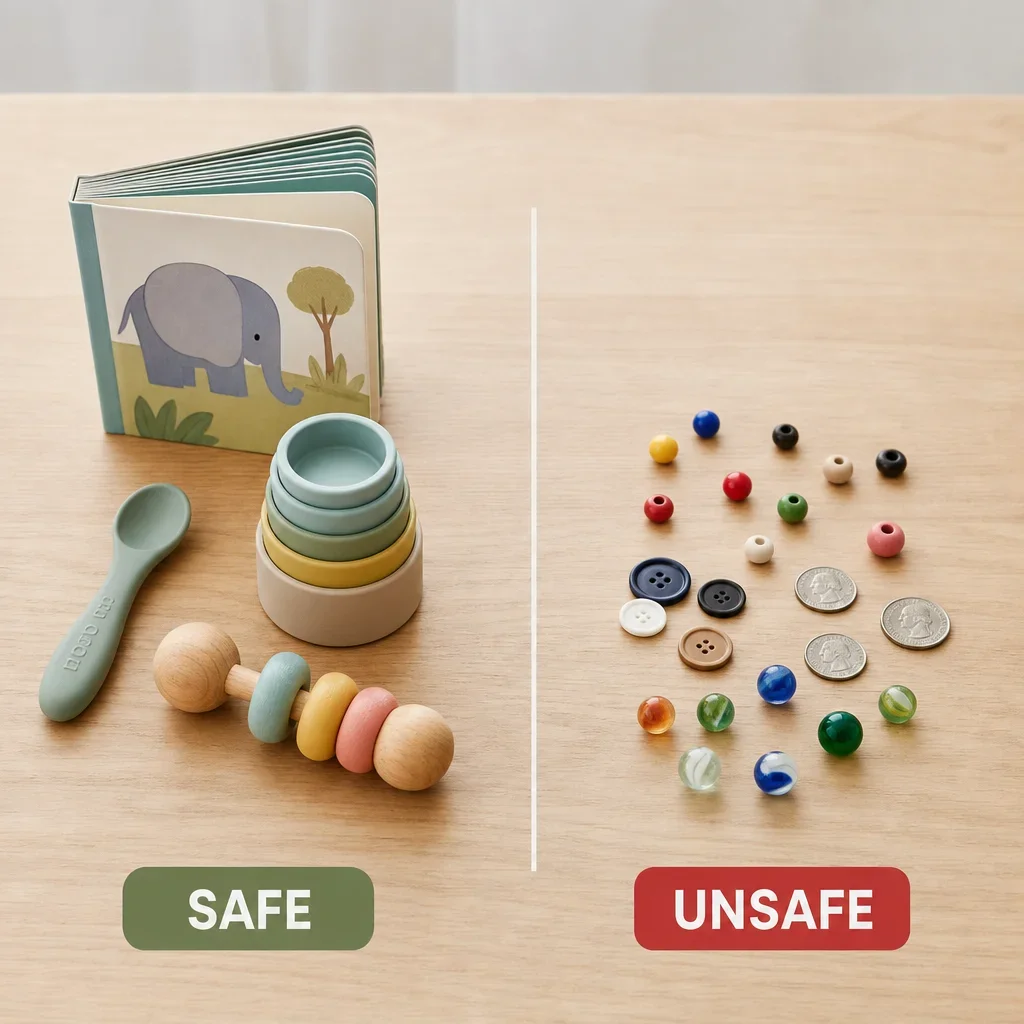
Safe infant fine motor play starts with large, simple, supervised objects. Household items can work well, but only when they are clean, unbreakable when possible, and too large to be a choking hazard.
| Safer supervised options | Avoid for infants |
|---|---|
| sturdy board books | coins |
| large stacking cups | buttons |
| silicone spoons | beads |
| textured balls made for babies | marbles |
| large wooden or silicone rings made for infants | magnets |
| large clean fabric scarves used one-on-one | water beads |
| baby-safe rattles and teething toys | small pom-poms |
| muffin tin with large safe objects for older infants under direct supervision | long strings or cords |
Anything that can break into smaller parts, peel, splinter, or fit fully into the mouth should stay out of infant play. Raw hard foods and loose busy-board parts are also poor choices for this age group.
Direct supervision matters more than the label “educational.” A simple cup and spoon used with an adult nearby is often safer and more useful than a novelty toy with multiple small parts.
What if my baby is not interested? Common challenges and simple fixes
Babies often engage better when the task matches their current stage. If a baby is not interested, the first fix is usually to lower the difficulty, shorten the activity, or change the timing.
If your baby resists tummy time, try shorter floor sessions, a new surface, parent face-to-face play, or toy placement closer to the hands. A calm, rested window often works better than trying right before sleep.
If your baby mouths everything, treat that as part of learning and adjust the materials. Use larger baby-safe items, keep them clean, and supervise closely rather than expecting the mouthing to stop.
If your baby dislikes textures, start with familiar smooth items and change only one feature at a time. A soft cloth, silicone spoon, or smooth cup is often easier than jumping straight to messy sensory play.
If your baby loses interest quickly, keep play sessions brief. A few minutes of focused practice can be enough, especially for fine motor activities for young infants and mobile babies who prefer to move often.
If one activity causes frustration, make it easier before trying again. Use larger objects before smaller ones, open containers before narrow ones, and thick board pages before thinner pages. Progress should feel gradual, not forced.
If you notice strong hand preference very early, little interest in reaching, or loss of a skill your baby used before, bring that concern to your pediatrician. Early discussion is more useful than waiting and wondering.
Do daily routines count? Easy fine motor practice built into the day
Daily routines absolutely count as infant motor activities. In fact, repeated everyday actions often give more useful practice than buying many new toys.
Grasping a caregiver’s finger during diaper changes is fine motor practice. So is reaching for a bottle, touching a washcloth in the bath, turning thick book pages with help, holding a spoon, grabbing a bib, and releasing toys into a basket during cleanup.
Self-feeding attempts later in infancy can also support hand use. Picking up soft food pieces, holding a spoon, or dropping food from the tray into a bowl all involve grasp and release under supervision.
At our centre, we build this same idea into the infant day. We prepare meals on-site, observe how each child uses hands during care routines and play, and adapt the environment so practice happens naturally rather than as a drill.
When to be concerned about fine motor development
Fine motor concerns are worth discussing when a baby’s hand use seems very limited compared with general expectations or when skills stop progressing over time. This section is not a diagnosis, and one behaviour alone does not confirm a delay or autism.
Reasons to ask a pediatrician for guidance can include very limited reaching or grasping, persistent stiffness or unusual floppiness, little bringing hands together or to the mouth by expected stages, loss of a skill already seen, very early strong hand preference, or difficulty using hands during feeding and play.
Autism concerns at 12 months involve more than fine motor skills alone. Social communication, response to name, shared attention, and patterns of interaction matter too. Fine motor differences by themselves should not be used to draw conclusions.
If concerns persist, ask your child’s pediatrician whether further assessment is appropriate. They may discuss occupational therapy, physiotherapy, or another early intervention pathway based on the whole picture, not one activity result.
How Montessori-style infant environments support fine motor development
A Montessori infant environment supports fine motor development by keeping the space calm, ordered, and scaled to the child. In practice, that means safe low materials, room for floor movement, simple objects, and enough time for repetition.
In a licensed Montessori daycare, the environment is prepared with purpose. We observe how infants reach, grasp, transfer, and explore, then rotate age-appropriate materials instead of overwhelming them with too many choices.
Our Infant program serves children from about 6–18 months at a 1:3 ratio. That ratio gives educators more space to supervise closely, support transitions, and notice the small changes parents usually ask about during the first year.
Our staff include Early Childhood Educators, Montessori teachers, and assistants, all with First Aid/CPR certification and clean criminal record checks. That matters because infant care is not babysitting. It is licensed care with observation, routine, safety, and developmental support built into the day.
The best next step, if you are comparing care in Vaughan or Bolton, is to visit and see the classroom. A tour shows more than a brochure can, especially in the infant room.
FAQ
What are fine motor activities for infants?
Fine motor activities for infants are simple play and care experiences that use the hands, fingers, wrists, and hand-eye coordination. Examples include grasping a finger, reaching for a toy, transferring a ring between hands, turning a board book page, and picking up soft finger foods later in the first year.
What are 5 examples of fine motor skills?
Five clear fine motor skills examples infants may show are grasping, bringing hands to mouth, reaching, transferring an object hand to hand, and releasing an object into a container.
What are fine motor skills for newborns?
For newborns, fine motor skills are mostly early awareness and reflex-based movements. This can include a reflexive grasp, brief hand opening, hands moving toward the mouth, and early swiping or arm movement toward what they see.
What activities should a baby be doing at 0 to 6 months?
From 0–6 months, appropriate activities usually include short tummy time, finger grasp games, visual tracking, soft rattle play, side-lying reach, crinkle cloth play, and bringing safe toys to the mouth under supervision.
What are fine motor activities for a 6 month old?
At about 6 months, good options include grasping rings, transferring toys hand to hand, banging two objects together, lifting board book pages with help, and reaching during tummy time or supported sitting.
What are fine motor activities for mobile infants?
For mobile infants, good choices include basket play on the floor, finger foods in the high chair, bath cups for scoop and pour, board books, nesting cups, and large objects to drop into a wide container.
How do infants develop fine motor skills?
Infants develop fine motor skills through repeated daily movement, floor play, safe object exploration, feeding practice, and responsive caregiving across the first 12 months. The pattern usually moves from reflexive grasping toward more controlled reaching, transfer, release, and early pincer use.
How does tummy time support fine motor development?
Tummy time helps build shoulder, arm, neck, and trunk stability. That body support makes reaching, grasping, and using both hands together easier over time.
Do daily routines count as fine motor practice?
Yes. Diaper changes, feeding, bath play, book sharing, grasping a spoon, and releasing toys into a basket all count when they are age-appropriate and supervised.
What are some red flags at 12 months?
Possible concerns around 12 months can include very limited reaching or grasping, loss of a skill already seen, little interest in interacting with objects, unusual stiffness or floppiness, or concerns that appear alongside social or communication differences. These signs should be discussed with a pediatrician, not judged in isolation.
When should I talk to a pediatrician about fine motor delay?
Talk to a pediatrician when hand use seems much more limited than expected, progress stalls, one hand is strongly favoured unusually early, or feeding and play with the hands seem difficult. It is reasonable to ask sooner if your instinct says something feels off.
What toys and household items are safe for infant fine motor play?
Safer options include sturdy board books, large stacking cups, silicone spoons, baby-safe rattles, textured balls made for infants, and large clean fabrics used with direct supervision. Avoid small loose parts, magnets, coins, beads, marbles, water beads, and anything that can fit fully into the mouth.
Everyday play counts more than perfect play. If you want to see how a licensed Montessori infant setting supports reaching, grasping, self-feeding practice, and calm age-appropriate routines, you are welcome to book a tour at Cozy Time Montessori Academy and ask about current availability for your child’s age group.