
What should parents really expect from junior toddler skills? We find that most families feel better once the skills are broken into clear, everyday areas instead of one long list of toddler milestones.
What Are Junior Toddler Skills?
Junior toddler skills usually mean the early toddler developmental skills that build between about 18 and 24 months, though families and programs may use the term a little differently. In a Montessori setting, we look at communication, movement, practical life, play, thinking, and social-emotional growth rather than one narrow target.
Development in this stage is broad, not perfectly even, and that is normal. A child may show strong toddler gross motor skills first, while another shows more toddler communication skills or toddler self-help skills during the same 18 to 24 month window.
The clearest junior toddler skills list includes 7 main areas: communication, fine motor, gross motor, cognitive problem-solving, social-emotional growth, self-regulation, and practical life independence. Montessori toddler skills fit naturally here because the method uses hands-on work, repetition, movement, and child-sized routines.
Realistic expectations vs optional enrichment Naming body parts, following simple routines, carrying a small item, scribbling, climbing, and using gestures are common expectations in the toddler years. Early alphabet recitation, long circle-time sitting, or perfect sharing are nice to see, but they are not the standard for healthy growth on their own.
Junior Toddler Skills by Age: 18 Months, 24 Months, and 36 Months
A simple age map helps more than a vague junior toddler skills checklist. These ages are approximate markers, not deadlines, and the best next step if you are unsure is to watch patterns over time and speak with your child’s doctor when concerns feel persistent.
| Age | Common expectations | Nice to see, but not required yet |
|---|---|---|
| About 18 months | Uses gestures and familiar sounds or words, follows very simple directions, walks steadily, climbs with supervision, points to wanted objects, begins pretend play, helps with spoon feeding, helps with dressing steps | Names many items on request, sits for long group activities, shares easily with peers |
| About 24 months | Uses more words and short combinations, points to pictures or familiar items, runs and climbs, scribbles, stacks and sorts, begins short turn-taking with adult help, washes hands with help, puts toys into a basket | Knows formal letters or numbers, zips independently, manages long transitions without support |
| About 36 months | Speaks in longer phrases, follows 1- to 2-step directions, jumps and balances more confidently, uses simple puzzles and matching tasks, shows more pretend play, starts cooperative moments with peers, helps with dressing, helps set the table | Writes neatly, shares consistently in every setting, sits still for long periods |
A younger toddler and an older toddler do not look the same in daily life, even inside the same classroom. Around 18 to 24 months, the focus is usually movement, naming, imitation, routine, and very early independence, while 24 to 36 months often brings more pretend play, longer language, stronger problem-solving, and more social awareness.
The Main Skill Areas Every Junior Toddler Is Building
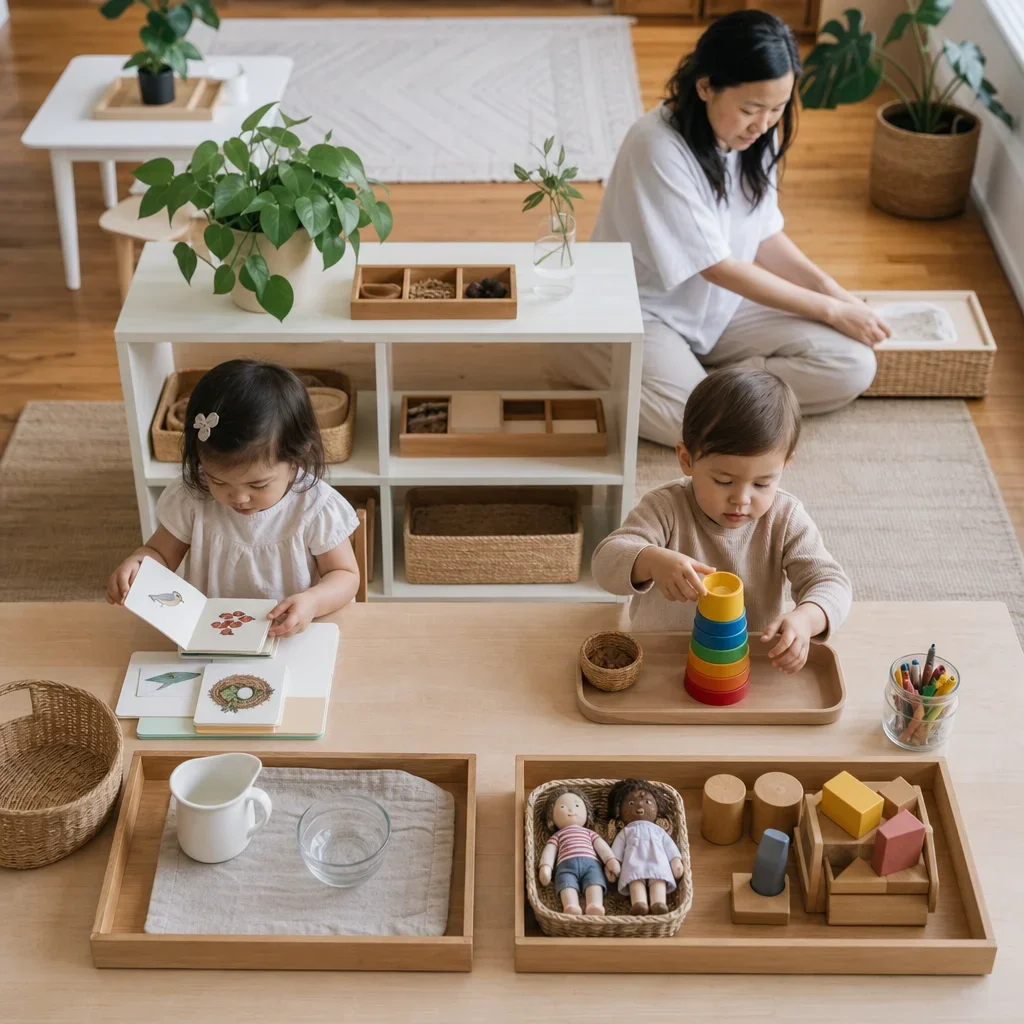
The most useful answer to “what are the skills for toddlers” is that toddlers build several domains at the same time, not one at a time. We usually sort toddler developmental skills into 8 areas so parents can see what daily growth looks like clearly.
Communication includes understanding words, recognizing routines, using gestures, making sounds, and gradually using words or short phrases. This area covers both receptive language, which means what a child understands, and expressive language, which means what a child says.
Gross motor work includes walking, climbing, squatting, pushing, pulling, carrying, running, and later jumping and balancing. These toddler gross motor skills are built through floor time, outdoor play, music and movement, and safe chances to repeat body actions.
Fine motor work includes grasping, turning pages, stacking, posting objects, using crayons, holding a spoon, and trying dressing fasteners. These toddler fine motor skills support real daily tasks, not just table activities.
Cognitive and early learning skills include matching, sorting, cause and effect, remembering routines, noticing order, and solving simple problems. Early learning also includes exposure to shapes, colours, books, and songs, but not pressure for formal academics.
Social-emotional growth includes eye contact, imitation, joint attention, greeting, noticing other children, and starting simple turn-taking. Self-regulation skills sit close to this area because toddlers are also learning transitions, waiting briefly, and calming with adult support.
Practical life, which is a Montessori term, means real self-care and care-of-environment work. It includes eating, handwashing, wiping spills, putting toys away, carrying a small bag, and helping with very simple routines.
Play and imagination are also core skills, not extras. Parallel play, pretend feeding, toy kitchen work, doll care, block building, and sensory exploration all help toddlers practice language, movement, and thinking together.
Communication and Language Skills for Junior Toddlers
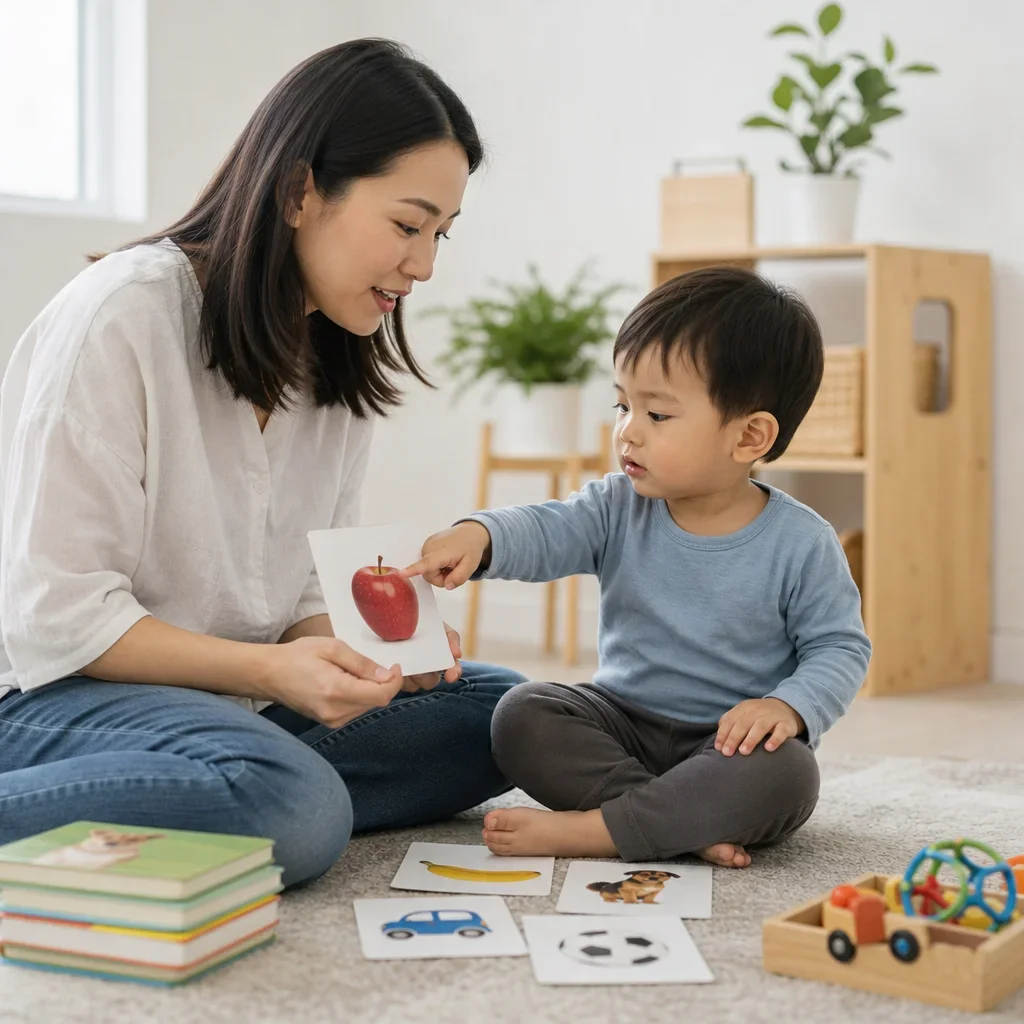
Language starts with understanding before it shows up as clear speech. A toddler may recognize names, routines, familiar objects, and short directions well before using many spoken words.
Toddler communication skills usually grow through repetition in ordinary moments, not formal lessons. Reading aloud, naming objects at mealtime, singing songs, and narrating dressing or cleanup all give words a real context.
Expressive language can look like gestures, pointing, sounds, single words, word approximations, and later simple word combinations. A child does not need to use every form at once for communication growth to be meaningful.
The strongest support at home is simple and consistent. Offer 2 choices, pause for a response, repeat key words, and speak in the languages your family naturally uses during meals, dressing, bath time, and play.
A multilingual home does not cause a language problem by itself. Rich exposure, meaningful conversation, and consistency across the languages a child hears matter more than forcing one language only.
Multilingual household note Use the languages that help your family connect naturally. A child can hear more than 1 language without that being a concern on its own. If you are worried about overall understanding, response, or loss of skills across all languages, speak with your child’s doctor.
A persistent concern about limited response to sound, reduced interest in communication, or loss of previously used words should be discussed with a pediatrician or another qualified professional. This page is educational, not medical advice, and it cannot assess a specific child.
Activities that support toddler communication skills
- Read the same short books often
- Name objects during snacks and meals
- Sing action songs with gestures
- Offer choices like cup or water bottle
- Pause after a question and wait
- Repeat and expand simple words
- Narrate routines like shoes on, wash hands, zip coat
Fine Motor and Gross Motor Skills
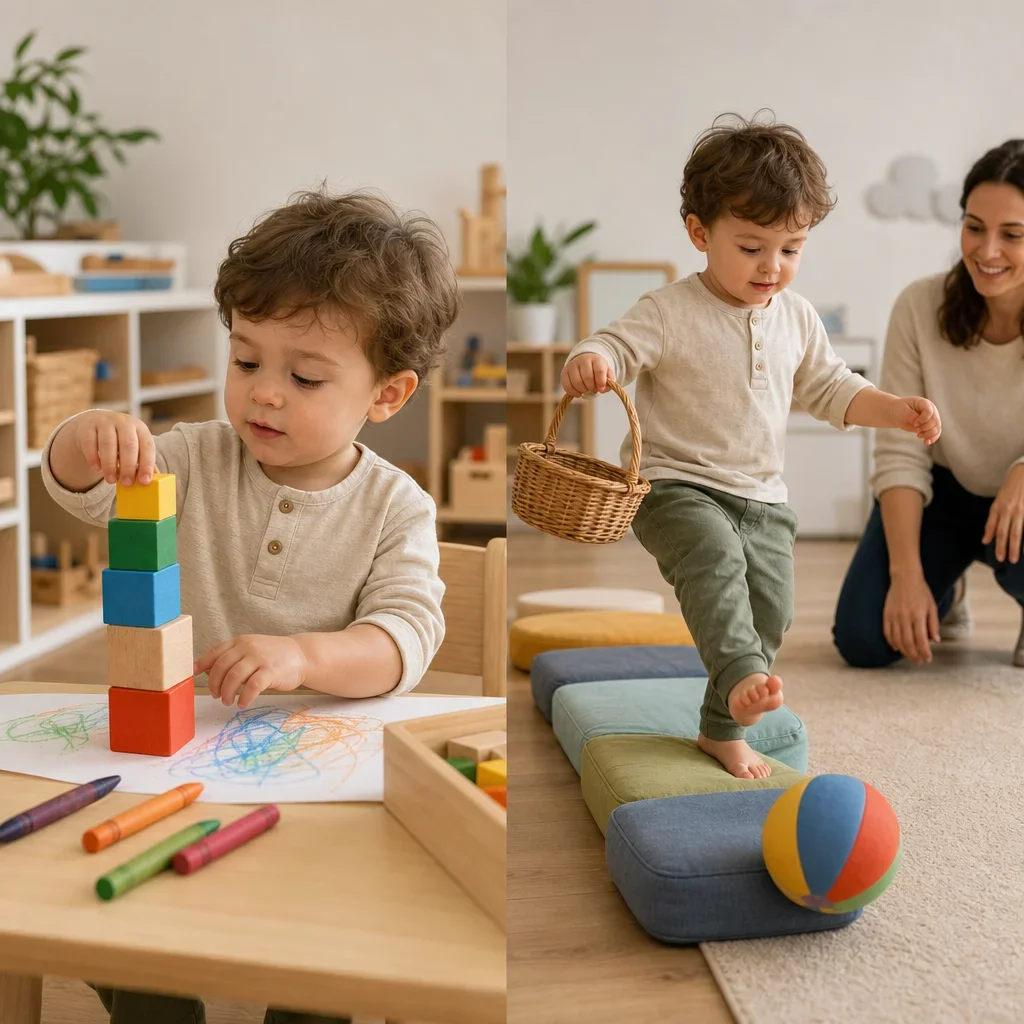
Fine motor and gross motor skills develop together because toddlers use the whole body to learn. A child may carry a basket across the room, squat to pick up an object, then use fingers to place it on a shelf in one sequence.
Toddler fine motor skills include stacking blocks, turning thick pages, using a spoon, posting objects into a container, scribbling, and trying simple puzzles. Beginning dressing steps like pulling off socks or helping with a zipper are also part of this domain.
Toddler gross motor skills include walking steadily, climbing low structures with supervision, pushing toys, pulling objects, dancing, kicking a ball, running, and later jumping. Outdoor time matters here because larger movement needs space and repetition.
The best home activities are simple and low-pressure. Playdough, transferring large objects between bowls, supervised water pouring, ball play, short obstacle paths, music and movement, and park visits all support motor growth without turning it into drill work.
Safety still matters more than the activity itself. Small objects need close supervision, climbing needs adult oversight, and sensory bins should use materials that match the child’s age and mouthing stage.
Activities that support motor skills
- Large knob puzzles
- Stacking cups or blocks
- Thick crayons and paper
- Child-sized spoon and fork practice
- Laundry transfer from basket to basket
- Ball rolling and kicking
- Couch cushion stepping with supervision
- Outdoor walks on different surfaces
Social, Emotional, and Self-Regulation Skills
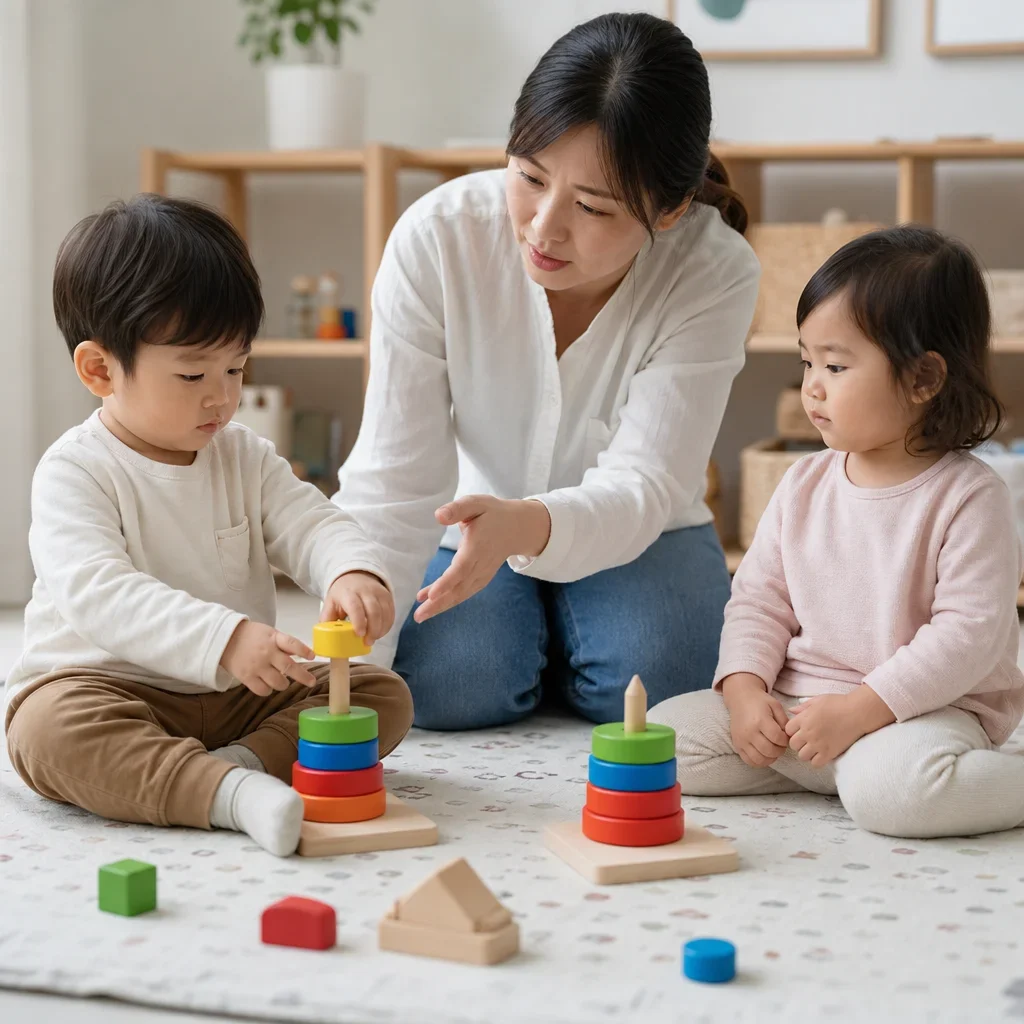
Toddlers usually begin with parallel play before true cooperative play. Parallel play means playing beside another child, while cooperative play means working or pretending together toward the same idea.
Toddler social skills at this stage often look small but important. Looking at another child, copying an action, offering a toy briefly, waving hello, joining a song, or noticing another person’s feelings all count.
Self-regulation skills are early and unfinished in the toddler years. Following a simple direction, waiting a brief moment, moving through a familiar routine, or calming with help after frustration are real foundations.
Tantrums, strong preferences, and frequent “no” are common parts of toddler development, not proof that teaching has failed. Toddlers need predictable routines, short language, simple choices, and calm adult support because adult-level impulse control is not realistic yet.
Sharing is usually taught through repeated short experiences, not expected as a polished habit right away. Taking turns with an adult, using duplicate materials, and keeping playtimes brief often works better than long verbal correction.
Practical Life Skills and Independence
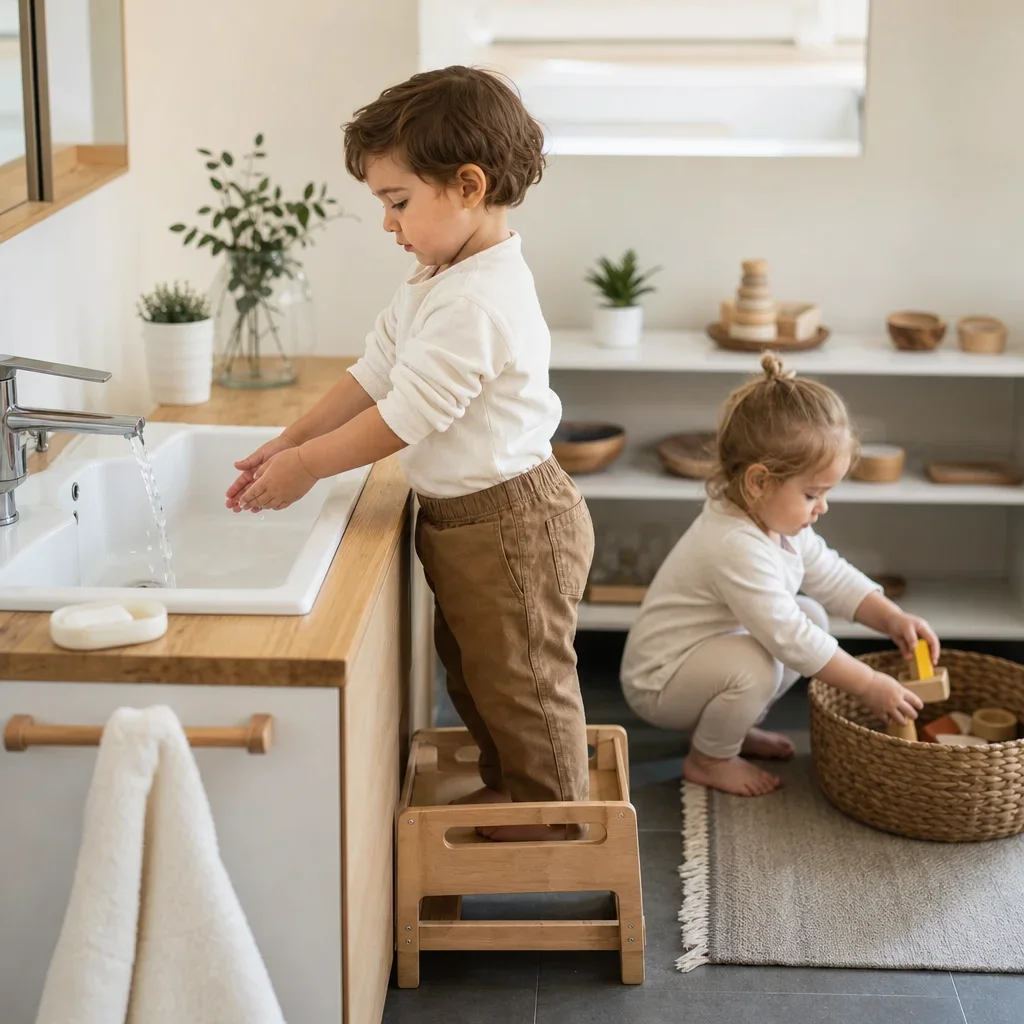
Practical life skills for toddlers are some of the most useful skills to support because they happen every day. In Montessori, practical life means real tasks that help a child care for self and the environment.
Toddler self-help skills often begin with eating and dressing routines. Drinking from a cup, trying a spoon or fork, helping remove socks, pushing an arm through a sleeve, and carrying a bib or small bag are meaningful early tasks.
Cleaning and routine work also belong on a practical life skills list. Wiping a spill, placing toys on a shelf, putting laundry in a basket, carrying a small dish to the table, and helping throw away a tissue all build independence through repetition.
Handwashing is both a self-care routine and a sequence task. A toddler may learn to approach the sink, wet hands, rub with help, rinse, and dry with support long before doing each step independently.
Toileting readiness should be handled gently and without pressure. Readiness timelines differ from child to child, and families should look at the full routine rather than expecting one age to fit everyone.
7 essential life skills examples for toddlers
- Drinking from an open cup with support
- Using a spoon or fork
- Washing hands with help
- Putting toys away
- Wiping small spills
- Helping with dressing steps
- Carrying a small item from place to place
More age-appropriate household chores and independence tasks
- Put laundry into a basket
- Place napkins on the table
- Carry a child-sized water cup
- Return books to a low shelf
- Throw away scraps after snack
- Help feed a pet with supervision
- Put shoes near the door
- Bring a diaper to an adult
Early Learning, Problem-Solving, and Pretend Play
Early learning skills in toddlerhood grow best through hands-on exploration. Sorting, matching, filling and emptying, nesting, simple puzzles, and cause-and-effect toys all support problem-solving in ways a toddler can understand physically.
Letters, numbers, colours, and shapes are helpful exposures, not the full measure of healthy development. A child who notices routines, imitates actions, explores objects, and begins pretend play is doing important cognitive work even without early academic performance.
Pretend play is a strong sign that ideas are starting to connect. Feeding a doll, stirring an empty pot, putting a toy to bed, or pretending to talk on a phone shows memory, imitation, and imagination working together.
Sensory play supports thinking because it gives language and movement a real anchor. Water play, scooping, playdough, textured art, and outdoor nature play all invite noticing, comparing, and experimenting.
Activities that teach new skills through play
- Sort socks by colour or size
- Match lids to containers
- Hide and find familiar objects
- Feed a doll and copy care routines
- Build towers and knock them down
- Use simple inset or knob puzzles
- Scoop rice or pom-poms with supervision
- Scribble with thick crayons
How Toddlers Learn Best: Daily Routines, Play, and Montessori Materials
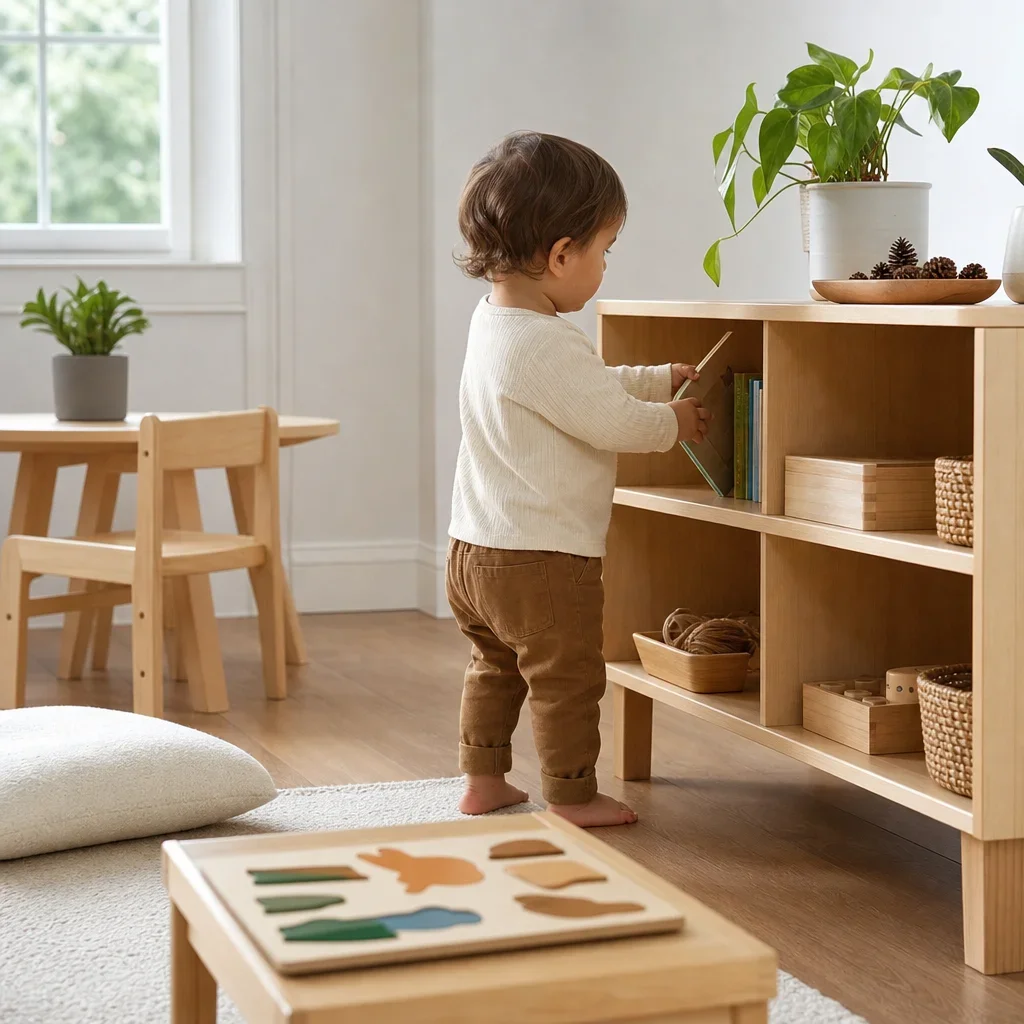
Toddlers learn best when the same skills appear across the day in real moments. Breakfast builds language and spoon use, dressing builds body awareness and sequencing, cleanup builds practical life, and bedtime builds routine and memory.
A Montessori-friendly setup supports independence by making materials visible, reachable, and limited. Low shelves, child-sized tools, and simple choices reduce confusion and help a child repeat useful work.
Quality interaction matters more than expensive products. A few well-chosen materials used often will usually support more learning than a room full of toys with no clear purpose.
The most helpful toy and material recommendations are usually grouped by skill type. This makes it easier for parents to choose what actually matches the child’s stage instead of buying for a label.
Toy and material recommendations by skill type
For communication and language
- Board books
- Picture cards with real objects
- Songs and fingerplay
- Everyday objects to name
For fine motor skills
- Stacking cups
- Large beads with supervision
- Posting boxes
- Thick crayons
- Simple puzzles
For gross motor skills
- Balls
- Push toys
- Low climbing structures with supervision
- Ride-on toys sized for toddlers
For practical life skills
- Child-sized pitcher
- Small cloths for spills
- Toddler broom or brush
- Low hooks or basket for belongings
For pretend play and problem-solving
- Dolls
- Toy kitchen items
- Blocks
- Open-ended containers
- Matching and sorting materials
Screen Time, Behaviour Challenges, and Realistic Expectations
Screen use can crowd out movement, conversation, and hands-on play when it takes too much space in the day. For toddlers, direct human interaction and real-world routines do more for language, motor practice, and self-regulation than passive viewing.
Behaviour challenges are part of the toddler stage because growth is uneven by nature. Strong feelings, short attention spans, quick frustration, and sudden refusals can all appear while communication and self-control are still developing.
The hardest age with a toddler is not the same for every family. One child may struggle more around transitions at 18 to 24 months, while another shows a more intense “do it myself” phase closer to 2 to 3 years.
Calm limits work better than long lectures. Short phrases, predictable routines, transition warnings, and offering 2 simple choices give a toddler structure without expecting mature reasoning.
Online phrases like the “3 3 3 rule” or “7 7 7 rule” for toddlers are used inconsistently and are not standard developmental frameworks unless a credible professional source is named. Parents are usually better served by watching daily functioning across language, movement, play, and routine skills.
When to Seek Extra Support for Your Toddler
A pattern across time matters more than one hard day or one missed skill. We encourage families to look at the full picture across communication, movement, play, eating, response, and daily routines.
A conversation with a pediatrician is appropriate when there are concerns about hearing, loss of previously used skills, very limited response to name, persistent feeding difficulties, significant movement concerns, or delays showing up across more than one area. Those are not diagnoses, but they are reasonable reasons to ask for guidance.
Early questions are worth asking because reassurance is also useful information. Parents do not need to wait for every concern to become severe before bringing it to a qualified professional.
Junior Toddler Skills Checklist for Parents
This junior toddler skills checklist works best as a quick scan, not a pass-fail test. Children often show skills unevenly across domains, and one strong area does not require every other area to match it right away.
Junior toddler skills list
Communication and language
- Uses gestures to communicate
- Understands familiar words
- Responds to simple routines
- Points to wanted objects
- Imitates sounds or words
- Uses words or word attempts meaningfully
Fine motor
- Stacks or nests objects
- Turns thick book pages
- Scribbles with a crayon
- Uses hands to place objects into containers
- Begins spoon or fork use
Gross motor
- Walks steadily
- Climbs with supervision
- Squats and stands again
- Carries objects while moving
- Runs or moves faster with control improving over time
Social-emotional and self-regulation
- Notices other children
- Joins simple songs or routines
- Accepts help to calm down
- Follows very simple directions
- Starts brief turn-taking with support
Practical life and self-help
- Drinks from a cup with help or practice
- Helps with handwashing steps
- Puts toys into a basket or on a shelf
- Helps with dressing steps
- Carries a small belonging
- Wipes a small spill with help
Cognitive, play, and early learning
- Matches or sorts simple items
- Explores cause and effect
- Repeats familiar actions
- Shows pretend play
- Enjoys books, songs, or naming games
How a Montessori Daycare Supports Junior Toddler Skills
A licensed childcare centre supports junior toddler skills best when the day is structured, observed, and age-appropriate. Routine, movement, practical life, meals, rest, and guided play give toddlers repeated chances to build skills in context.
At Cozy Time Montessori Academy, our toddler-age children are typically in the Pre-Casa program, which serves about 18 to 30 months at a 1:5 ratio. That ratio matters because close supervision and observation help staff support routines, transitions, and hands-on work safely.
Our centre is licensed, and our team includes ECEs, Montessori teachers, and assistants who are First Aid and CPR certified with clean criminal record checks. That is different from unlicensed child minding because credentials, ratios, curriculum, and oversight shape the care itself.
Our Montessori approach uses practical life, sensorial work, language-rich routines, movement, and child-sized materials. We also prepare meals on-site and build the day around predictable care routines, which is often where toddler self-help skills grow most naturally.
Our full program range runs from 6 months to 6 years across Infant, Pre-Casa, and Casa, so families can see how independence and routine continue as children grow. The best next step is to visit and see the classroom, then contact the centre to confirm availability for your child’s age group at our Vaughan or Bolton location.
FAQ
What are junior toddler skills?
Junior toddler skills are the early everyday abilities that usually develop around 18 to 24 months. They include communication, movement, play, problem-solving, social-emotional growth, self-regulation, and practical life skills.
What skills should a junior toddler be learning?
A junior toddler is usually learning to understand simple language, move more confidently, imitate routines, use hands with more control, and participate in basic self-help tasks. The exact mix can differ from child to child.
What are 5 developmental skills for toddlers?
A simple 5-part view includes language, gross motor, fine motor, cognitive problem-solving, and social-emotional development. We also encourage parents to include self-help and self-regulation because those daily skills matter greatly in toddlerhood.
What practical life skills should toddlers learn?
Useful toddler self-help skills include cup drinking, spoon use, handwashing with help, toy cleanup, carrying small items, wiping spills, and helping with dressing steps. These are practical life skills because they connect directly to daily routines.
How can I help my toddler develop language skills?
Read aloud, name real objects, sing songs, offer simple choices, and pause for your child to respond. Strong toddler communication skills usually grow from frequent back-and-forth interaction, not formal lessons.
How do toddlers learn through play and daily routines?
Toddlers learn best through repetition in meaningful settings. Meals, dressing, bath time, outdoor walks, pretend play, and cleanup all teach language, movement, attention, and independence together.
What should I do if my toddler seems behind?
Watch patterns across time and across more than one area. If concerns involve hearing, movement, feeding, response, or loss of skills, speak with your child’s pediatrician or another qualified professional.
Is it normal if my toddler is not sharing yet?
Yes, often it is. Many toddlers start with parallel play before cooperative play, so brief turn-taking with support is usually a more realistic goal than polished sharing.
How can I support a toddler in a multilingual home?
Use the languages your family speaks naturally and often. Rich conversation, songs, books, and routines in meaningful relationships support language growth better than forcing one language unnaturally.
What is the 3 3 3 rule for toddlers?
This phrase is used in different ways online and is not a standard child development framework on its own. It is better to focus on observable daily skills and raise persistent concerns with a qualified professional.
What is the 7 7 7 rule for toddlers?
This phrase also appears inconsistently online and should not be treated as a formal milestone guide without a credible source. Parents usually need clearer, age-based observations instead.
How does Montessori help junior toddler development?
Montessori toddler skills are supported through hands-on materials, practical life routines, movement, order, and respectful observation. In a licensed Montessori daycare, those experiences are built into the daily schedule rather than added as extras.
If you would like to see how these routines look in real life, we welcome you to book a tour or contact the centre about age placement and availability. Seeing the classroom often answers more than a checklist can.